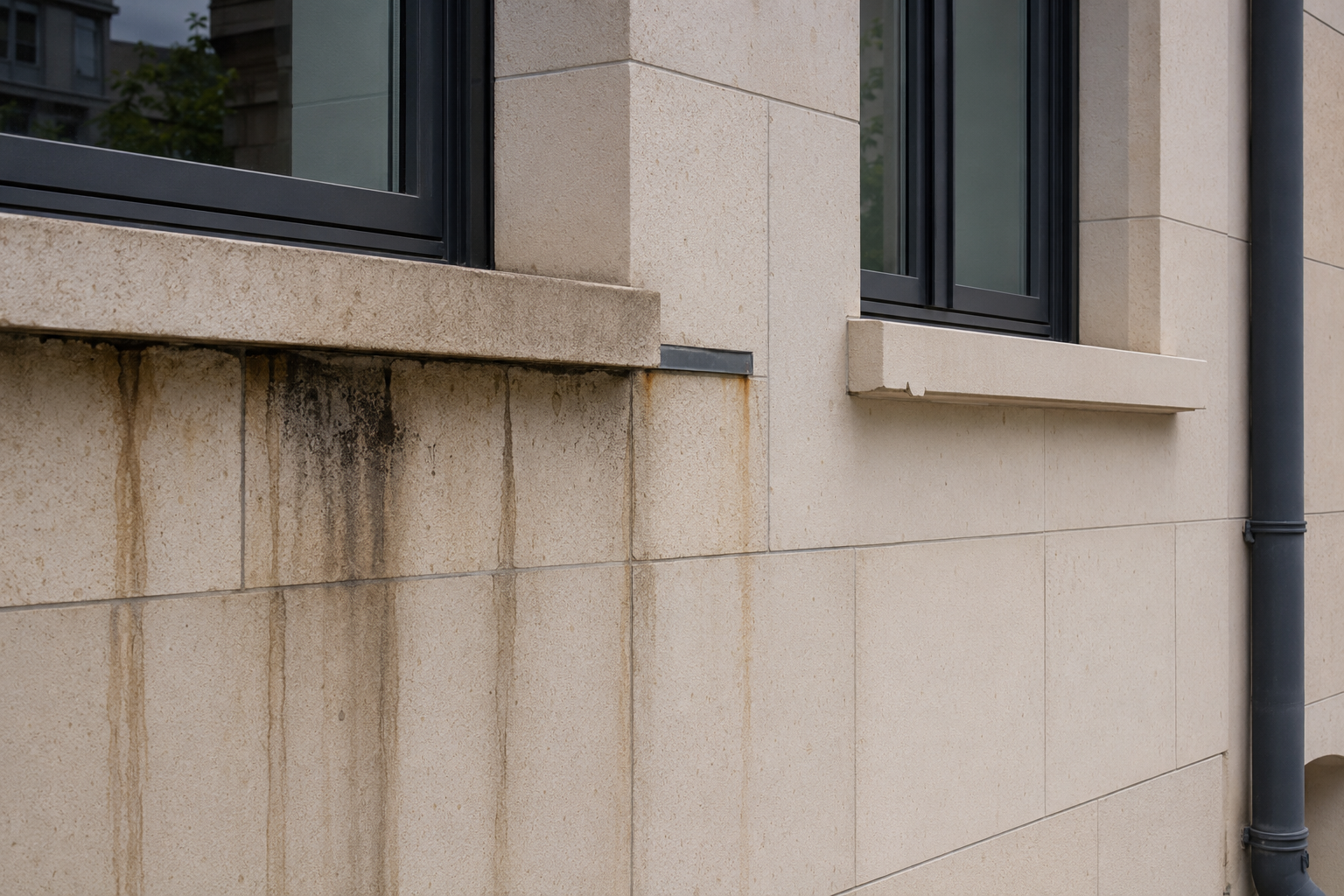
Diagnosis by Symptom
Diagnosis: Stained, Blackened or Run-Off-Marked Stone Façades
Read the pattern of soiling to distinguish run-off, pollution, corrosion, microorganisms, salts, coping defects and migration from joints or fixings.
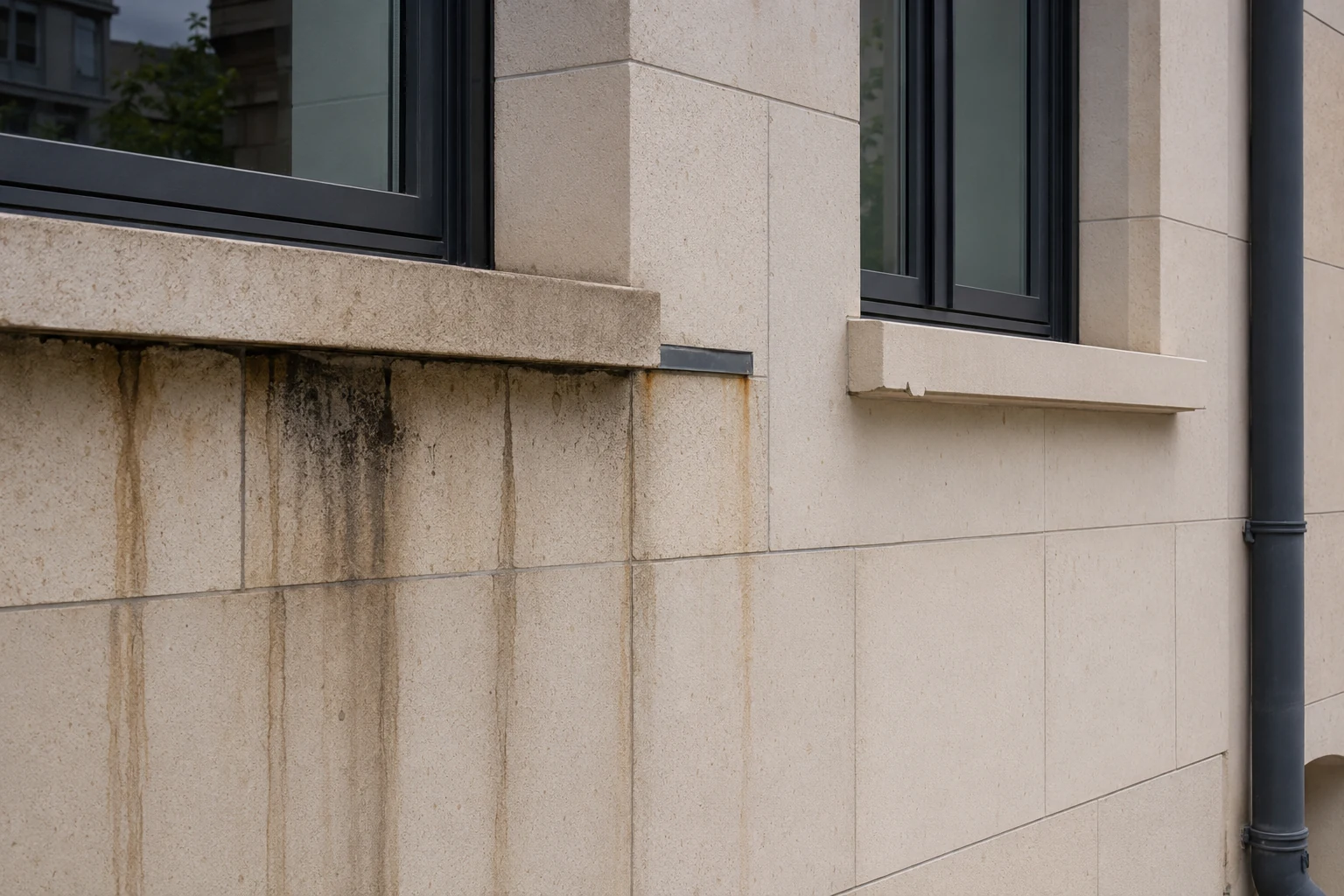
Identify the condition before treating it
The shape of a runoff mark often reveals its origin. A streak below a coping differs from a halo around a fixing, darkening beneath a cornice or biological growth in a damp, shaded area.
Map the staining and inspect the construction details before cleaning. A clean façade that remains poorly drained will soil again quickly, sometimes with even stronger contrasts.
| Observed sign | What it may indicate | First action |
|---|---|---|
| Vertical streaks below a coping | Concentrated runoff or a missing drip | Correct the detail |
| Orange halo around a fixing point | Corrosion of a fixing or adjacent metal | Prioritise a safety check |
| Dark deposits beneath sheltered areas | Pollution deposits deposits not washed by rain | Identify the deposit and stone |
| Green or brown growth in a damp area | Algae, moss or biofilm | Reduce moisture and shade where possible |
| White deposits around joints | Salts and moisture migration | Trace the path from behind the stone |
Using the shape of a mark as a diagnostic tool
A streak beginning directly below a joint or fixing indicates a probable source. Diffuse wind-oriented soiling suggests exposure. A clear difference between rain-washed and sheltered bands shows the combined effect of rainfall and pollution.
Cleaning trials should recover an appropriate texture and colour without opening the stone surface or creating an isolated over-cleaned patch that cannot be blended.
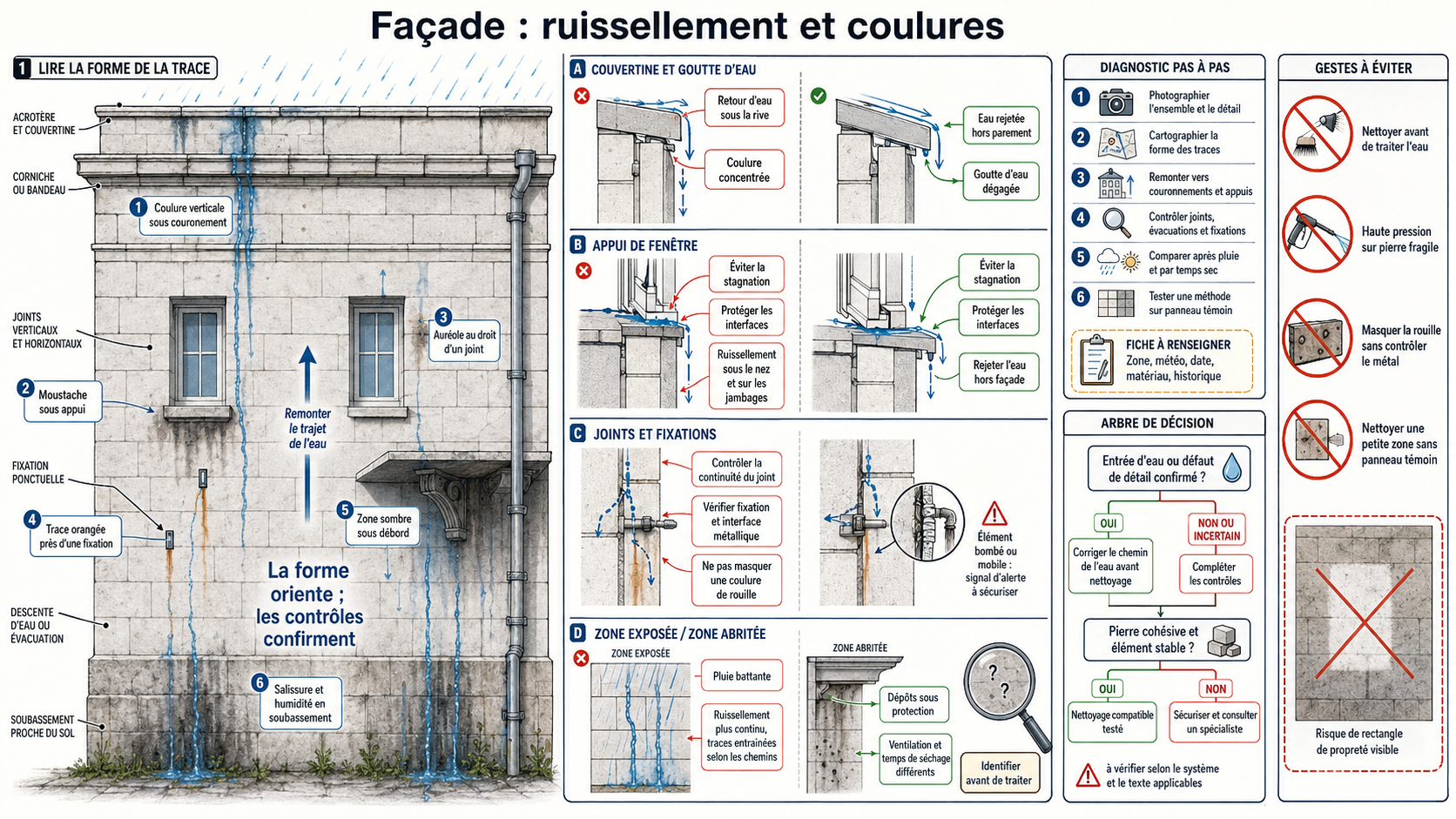
Checks that will not make the condition worse
| Check | How to proceed | How the result informs the diagnosis |
|---|---|---|
| Photographic mapping | Full elevation and located close-ups | Links staining with façade elements |
| Inspection of copings and parapets | Copings, joints, drips and edges | Identifies runoff paths |
| Fixing inspection | By a specialist where metal staining or movement is present | Rules out dangerous corrosion |
| Deposit sampling | Where crusts, salts or biological growth are uncertain | Informs the cleaning method |
| Test panels | Graduated pressure, water, chemistry and contact time | Confirms the result and degree of surface loss |
Step-by-step diagnosis
| Stage | Question to resolve | Decision |
|---|---|---|
| 1 | Does the mark indicate a fixing problem or falling hazard? | Make the area safe and obtain specialist advice |
| 2 | Is a detail concentrating the water? | Repair it before final cleaning |
| 3 | Is the deposit biological, mineral, metallic or pollution-related? | Select a targeted method |
| 4 | Can the stone tolerate the method? | Test texture and colour |
| 5 | How can the façade be blended without over-cleaning? | Define boundaries and acceptance criteria |
Treat the confirmed cause
| Confirmed cause | Treatment principle | Condition for success |
|---|---|---|
| Runoff | Correct the coping, joint, drip or drainage | Test under rain or controlled water exposure |
| Pollution deposits | Progressive cleaning suited to the deposit and stone | Approved sample panel |
| Biological growth | Compatible treatment followed by moisture reduction | Controlled contact time and rinsing |
| Corrosion | Repair or replace the metal and address migration | Design and compatibility confirmed |
What not to do
- Clean the entire façade before correcting water ingress.
- Use pressure that removes the stone’s surface layer.
- Hide a rust streak without inspecting the fixing.
- Apply a biocide without managing rinse water.
- Create isolated clean rectangles visible from ground level.
When to consult a specialist
- Work at height or above members of the public.
- Staining associated with a fixing, bulging, cracking or a moving element.
- A historic façade, black crust or fragile stone.
- Cleaning requiring containment, wastewater treatment or authorisation.
Preventing recurrence
- Design effective copings, upstands and drips.
- Select compatible metals and protect interfaces.
- Inspect joints and drainage to a planned maintenance schedule.
- Avoid permanent runoff from irrigation.
- Retain sample panels and cleaning records.
Frequently asked questions
| Question | Practical answer |
|---|---|
| Can a façade recover its original colour? | Often partially, but the result depends on how much surface is removed and on natural ageing. |
| Why are sheltered areas sometimes darker? | Rain does not wash them, while pollution particles continue to accumulate. |
| Will a water repellent prevent runoff marks? | Not when the cause is a detail concentrating water or corroding metal. |
Limits of remote diagnosis
This guide supports a methodical initial diagnosis. It does not replace an on-site investigation where stability, waterproofing, structure, public safety or professional liability may be involved.
Document the case with an overall view, a close-up with a scale, edges, joints, possible water paths and an unaffected comparison area. Record when it appeared, how it has changed, which products were used and any recent work.
Assess urgency before intervening
Read the pattern of soiling to distinguish run-off, pollution, corrosion, microorganisms, salts, coping defects and migration from joints or fixings.
The first objective is not to remove the visible mark immediately. Determine whether it is stable, progressive or hazardous. Historic dry soiling does not have the same priority as active ingress, a corroding fixing, moving stone or an element at risk of falling.
Begin by protecting people and the construction. Stop water sources where this can be done safely. Do not scrape, abrade or try a succession of cleaners. Dated elevation photographs and unaffected comparison areas usually provide better evidence than an aggressive trial.
Urgency increases when the mark changes rapidly, returns after cleaning, affects aligned elements, accompanies movement, occurs above the public or reveals active water ingress. Cosmetic cleaning must wait until safety, fixings and waterproofing have been assessed.
| Response level | Typical situation | Recommended action |
|---|---|---|
| Documented monitoring | Stable, dry appearance with no movement or hazard | Photograph, measure and compare before any treatment |
| Controlled local trial | Probable cause and non-hazardous surface | Test the method on a small, discreet area |
| Specialist assessment | Uncertain cause, recurrence, large area or sensitive stone | Have the complete assembly examined before treatment |
| Immediate safety measures | Movement, risk of falling material, active ingress or risk to the public | Isolate the area and contact the appropriate specialist immediately |
Diagnostic reasoning in typical cases
Vertical streaks below a coping suggest concentrated runoff or a missing drip. Inspect the coping, joints, falls and edges under controlled water exposure and correct the detail before cleaning.
An orange halo around a fixing point suggests corrosion of a fixing or adjacent metal. Prioritise a safety inspection before attempting to remove the staining.
Dark deposits beneath sheltered areas suggest pollution not washed by rain. Identify the crust and stone before selecting a cleaning method and avoid creating over-cleaned patches.
Green or brown growth in a damp area suggests algae, moss or biofilm. Reduce moisture and shade where possible and confirm a compatible treatment on a sample panel.
White deposits around joints suggest salts and moisture migration. Trace the path from behind the stone and correct the source before cleaning the surface.
Preparing an assessment request a specialist can use
A useful assessment request describes the building, suspected stone, façade system, age, orientation, height, date of appearance and recent work or cleaning. Include exposure to rain, wind, irrigation, pollution, frost and nearby metals.
Prepare an overall elevation, medium-distance views and close-ups with a scale. Photograph joints, edges, copings, sills, drainage, fixings and unaffected comparison areas under consistent lighting.
Attach cleaning-product references, the stone data sheet, façade and fixing drawings, water-management details and the repair history. State what has already been attempted and the result.
Choosing between monitoring, testing and treatment
Approve treatment only when it addresses the confirmed cause, respects the stone and can produce an acceptable appearance across the elevation. Sample panels verify texture, colour, drying and side effects and must be assessed from normal viewing distances.
Specialist involvement is essential for work at height or above the public; marks associated with fixings, bulging, cracks or movement; historic façades, black crusts or fragile stone; and cleaning requiring containment, wastewater treatment or authorisation. The diagnosis should state its limitations and any further investigation required.
| Stage | What the check is intended to establish | Possible decision |
|---|---|---|
| Photographic mapping | Full elevation and located close-ups | Links staining with façade elements |
| Inspection of copings and parapets | Copings, joints, drips and edges | Identifies runoff paths |
| Fixing inspection | By a specialist where metal staining or movement is present | Rules out dangerous corrosion |
| Deposit sampling | Where crusts, salts or biological growth are uncertain | Informs the cleaning method |
| Test panels | Graduated pressure, water, chemistry and contact time | Confirms the result and degree of surface loss |
| 1 | Does the mark indicate a fixing problem or falling hazard? | Make the area safe and obtain specialist advice |
Key concepts
Continue reading
Related guides
Natural-Stone Façades, Terraces and Exterior Applications
Exterior stone is a technical construction element. Frost, water, wind, fixings, slip resistance, falls, drainage, maintenance and applicable standards must be considered from the selection stage.
Mechanically Fixed Stone Façades: Fixings, Joints, Maintenance and Responsibilities
A natural-stone façade is never simply decorative cladding: it combines stone, fixings, substrate, ventilation, joints, water, wind, fire, seismic design, maintenance and defined responsibilities.
Stone Decay Caused by Salts, Moisture, Capillary Action, Black Crusts and Pollution deposits
Salts, moisture, capillary action, efflorescence, subflorescence, black crusts and pollution are major causes of natural-stone deterioration.
Maintenance Plans by Use: Homes, Hotels, Retail, Exteriors and Public Buildings
Natural-stone maintenance should reflect the setting: homes, hotels, restaurants, retail premises, shared buildings, façades, terraces, pools and public-access buildings require different protocols.
Diagnosis: Dull, Yellowed or Grey Marble
Distinguish a maintenance film, acid etching, moisture, oxidation, an ageing treatment and an actual change in the stone before attempting to clean or repolish it.
Diagnosis: Stains on Marble and Natural Stone
Identify the contaminant family, penetration depth and any chemical change before selecting absorption, poulticing, cleaning or surface restoration.