Art and craftsmanship
Marble Sculpture, Statuary and Artistic Stone Carving
Understand how sculptors select marble, read the block, develop form, carve details, finish surfaces and preserve artistic stonework.
Choosing a block for sculpture
Sculptural stone must be selected for scale, colour, grain, translucency and soundness. Veins and mineral features may enrich the work, but open fractures or weak planes can make slender forms unsafe.
Review every face, quarry orientation and sawn surface before committing the composition. For major work, reserve sufficient block volume for supports and later refinement.
From model to stone
Drawings, clay models, plaster casts, pointing, digital scans and enlarged templates can all transfer proportions. The method should preserve the artist’s intention while allowing the stone to influence final decisions.
Establish axes and key depths before removing large volumes. Once stone is cut away, the decision is irreversible.
Tools and stages of carving
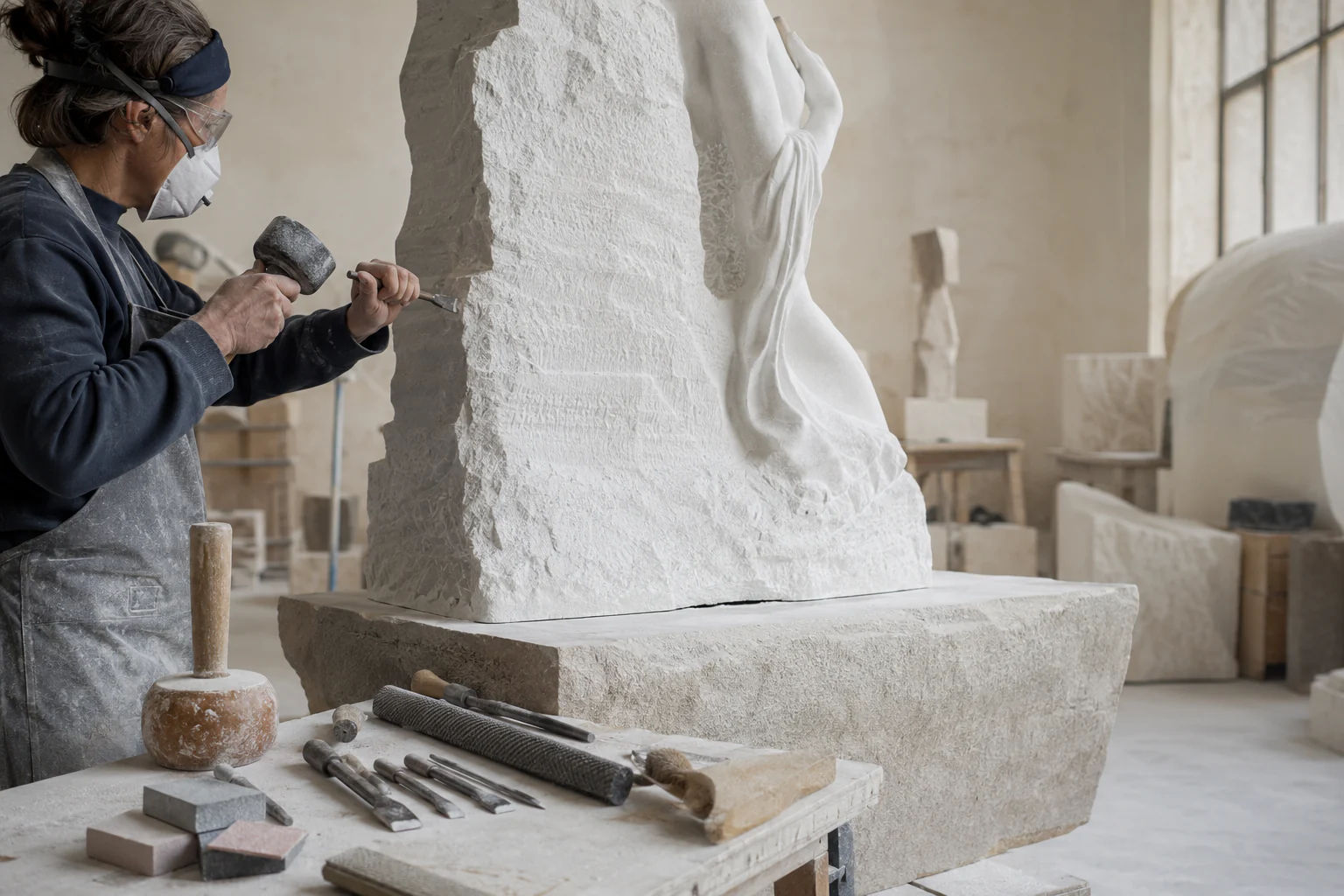
Sawing, drilling and pneumatic or CNC roughing can remove bulk material. Point chisels establish form; tooth chisels refine planes; flat chisels, rasps and abrasives develop detail and skin.
Tool direction follows grain and fragile edges. Final handwork restores the subtle transitions that machine paths cannot fully resolve.
| Stage | Purpose | Main risk |
|---|---|---|
| Roughing out | Establish mass and silhouette | Removing support too early |
| Methodlling | Define planes and anatomy | Losing reference points |
| Detailing | Create edges, folds and expression | Bruising fragile projections |
| Finishing | Control texture and reflected light | Over-polishing or erasing tool marks |
| Installation | Secure the completed work | Point loads and unsuitable metal |
Surface and light
Polishedshed areas deepen colour and translucency; matt and tool-finished surfaces scatter light. Contrasting finishes can make form legible without additional ornament.
Approve the intended appearance under lighting similar to the final location. Outdoor sculpture also requires consideration of water paths, frost and pollution.
Installation and conservation
Design bases, dowels and lifting points with the artwork, not after carving. Metals must resist corrosion and allow for movement without bursting the stone.
Conservation begins with documentation and gentle diagnosis. Preserve original tool marks and patina; repair only what is necessary for stability and understanding.
Need advice for a real project?
Marble Import supports international homeowners, architects and interior designers with stone selection, samples, technical feasibility and coordination of high-end stonework in France and across Europe.