Residential applications
Natural Stone for Kitchens, Bathrooms and Worktops
Select and detail marble or natural stone for demanding wet and working areas by coordinating use, cut-outs, edges, joints, waterproofing, cleaning and client expectations.
Start with the way the space will be used
A kitchen worktop receives food preparation, heat, oils, acids, impacts and repeated cleaning. A bathroom combines water, cosmetics, limescale, waterproofing and barefoot slip risk. These are different environments even when the same marble is proposed.
Discuss the client’s tolerance for patina and maintenance. Some owners welcome the evolving surface of honed marble; others expect an unchanged appearance and may prefer a less acid-sensitive stone.
Marble, granite, quartzite and other stones
Marble offers unique veining and a refined touch, but acids can etch calcite. Granitee is generally resistant to scratching and heat, although performance varies by material. True quartzite can combine hardness with expressive movement but may be difficult to fabricate.
Dense limestone, travertine, slate and soapstone each create a different balance of character and maintenance. Select the geological material, not a marketing label, and confirm current slabs.
| Use | Main risks | Design response |
|---|---|---|
| Kitchen worktop | Acids, oil, heat and impact | Suitable stone, tested sealer and practical care |
| Sink cut-out | Narrow bridges and water exposure | Rounded corners, reinforcement and support |
| Bathroom vanity | Cosmetics and limescale | Compatible cleaning and sealed interfaces |
| Shower wall | Water behind the finish | Complete waterproofing and correct adhesive |
| Shower floor | Slip, falls and drainage | Smaller formats, slope and verified finish |
Worktop cut-outs and weak points
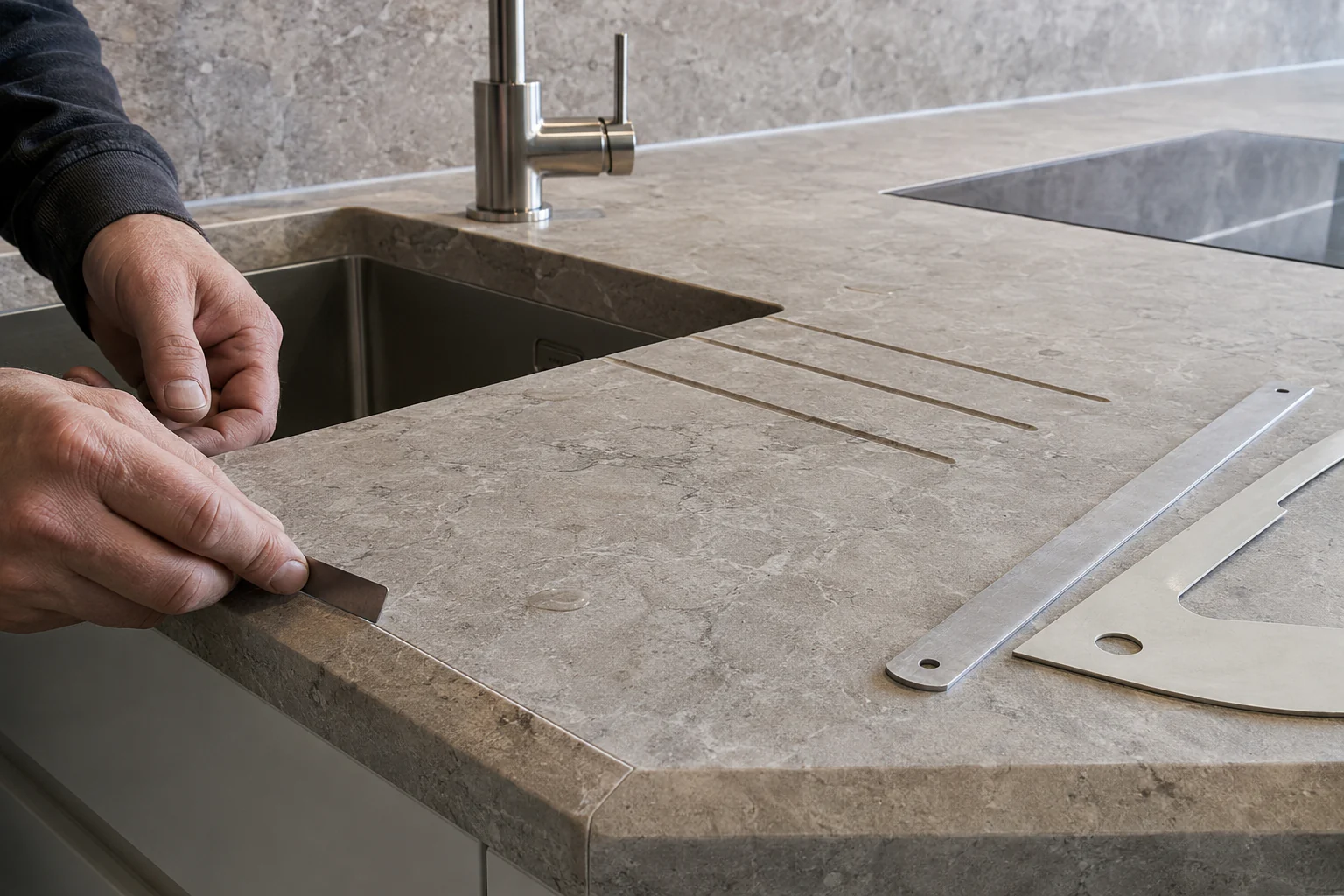
Sink and hob openings leave narrow stone bridges. Sharp internal corners concentrate stress, while large unsupported spans can flex during handling or use. Coordinate radii, reinforcement and cabinet support with the stone fabricator.
Avoid deciding cut-outs from appliance brochures alone. Verify actual appliance, tap, waste and cabinet dimensions, then template the installed furniture before final cutting.
Edges, mitres and joints
An edge profile changes both appearance and residual strength. Fine-looking mitred edges require accurate fabrication, stable support and carefully controlled adhesive lines. Thick laminated edges can create a monolithic effect but must be detailed at returns.
Place joints where slabs can be handled, supported and visually coordinated. Vein continuity is valuable, but it must not force an impractical piece size or a vulnerable joint next to a cut-out.
Wet areas need a complete waterproofing system
Stone and grout are not the waterproof layer. Showers require a compatible system behind the finish, correctly formed falls, sealed penetrations and drain integration. Product selection must consider stone moisture sensitivity.
Moisture trapped behind translucent or light stone can create darkening and staining. Use appropriate adhesives, allow the substrate to dry and follow system curing times before use.
Slip resistance and comfort
A highly polished floor may be unsuitable in a frequently wet area. Honed or textured finishes can improve grip, while smaller units increase the number of joints and follow shower falls more easily.
More texture is not always better: very rough stone can be uncomfortable barefoot and harder to clean. Approve a wet sample that balances grip, touch and maintenance.
Sealing, cleaning and patina
An impregnating sealer can reduce absorption and give more time to wipe spills, but it does not prevent acid etching or make the surface maintenance-free. Test the treatment on the actual finish.
Use pH-compatible cleaners and avoid vinegar, limescale remover and abrasive pads on acid-sensitive stone. Provide the client with a simple care guide and realistic advice for immediate spill removal.
Approval and installation sequence
Approve slabs and layout before cutting, especially for islands, splashbacks and book-matched walls. Confirm cabinet levels, supports, service penetrations and access before delivery.
At handover, inspect joints, drainage, silicone interfaces, cut-outs and dry appearance. Keep spare pieces where practical for future repairs or extensions.
Need advice for a real project?
Marble Import supports international homeowners, architects and interior designers with stone selection, samples, technical feasibility and coordination of high-end stonework in France and across Europe.