Diagnosis by Symptom
Diagnosis: Efflorescence, Damp Patches and Rising Moisture
Interpret white deposits, dark patches, salts, blistering and drying patterns to trace the path of moisture before cleaning or applying a water repellent.
Identify the condition before treating it
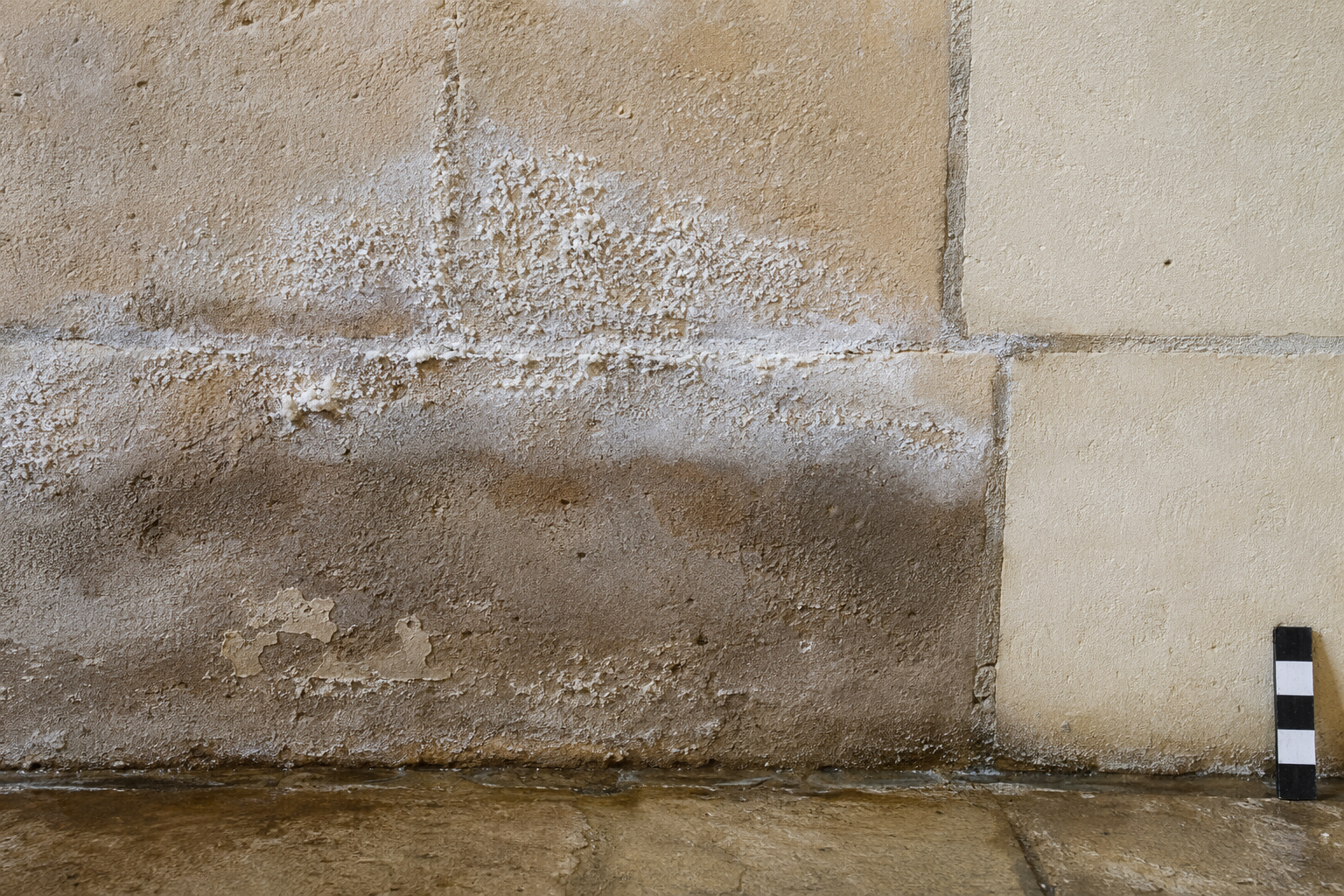
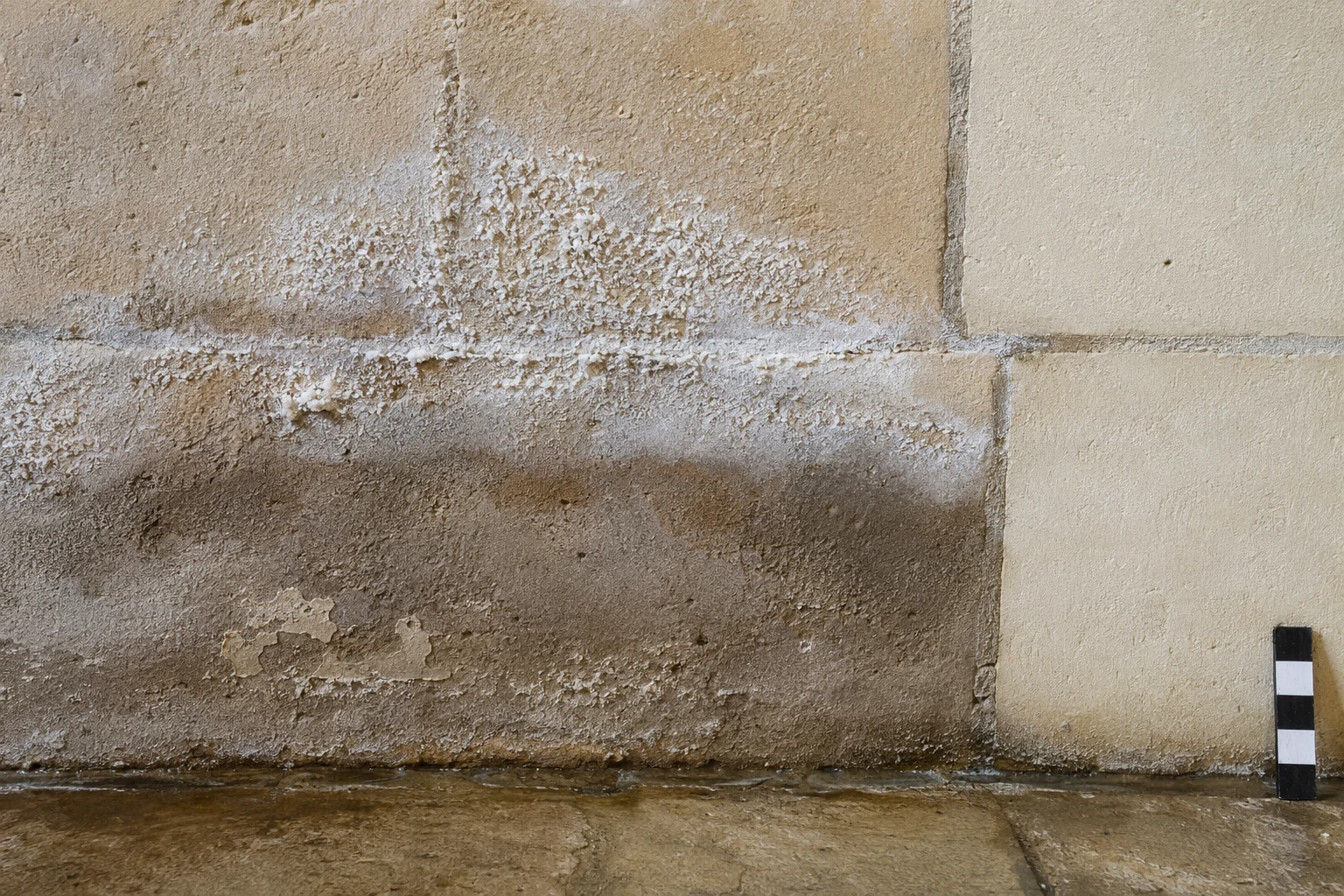
Efflorescence is a salt deposit left on the surface after water transport and evaporation. Subflorescence crystallises inside the pores and can be more destructive. A dark patch without powder often indicates that water or a contaminant is still present.
Removing salts without understanding the source of water treats only the symptom. Trace falls, joints, thresholds, upstands, services, sills, ground-bearing construction and interfaces between materials.
| Observed sign | What it may indicate | First action |
|---|---|---|
| Recurring dry white powder | Soluble salts carried by moisture | Locate the moisture path |
| Hard crust beneath a runoff path | Repeated mineral deposition | Assess the water and substrate before using chemicals |
| Dark stone at the base of a wall | Rising damp or inadequate drainage | Investigate the building and ground conditions |
| Sub-surface spalling | Internal salt crystallisation or frost | Assess material loss |
| Damp patch after rain or shower use | Water ingress, a failed joint or discontinuous waterproofing | Test the water path |
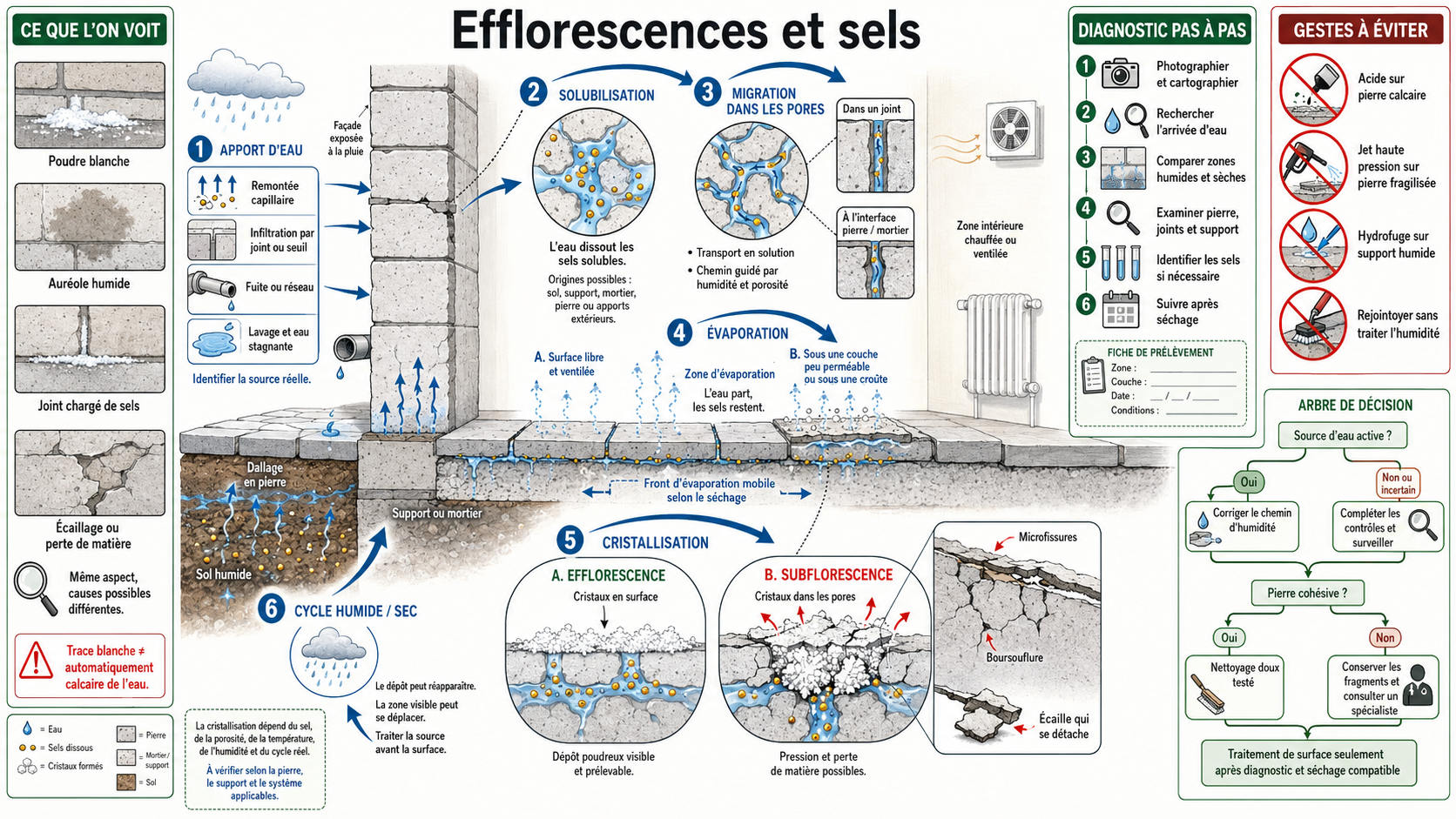
Understanding the water–salt cycle
Water dissolves salts in soil, mortar, concrete, stone or cleaning products. As it migrates and evaporates, it concentrates those salts. Repeated cycles move the crystallisation front and can disrupt the pore structure.
A water repellent applied while moisture is still entering can move evaporation towards joints, edges or the interior. Drying capacity must be considered together with removal of the source.
Checks that will not make the condition worse
| Check | How to proceed | How the result informs the diagnosis |
|---|---|---|
| Mapping after weather or use | Photograph before, during and after water exposure | Links the symptom to rain, services or cleaning |
| Falls and drainage | Check levels, drains, overflows and edges | Reveals ponding and backflow |
| Comparative measurements | Use the same instrument and conditions on affected and unaffected areas | Tracks a trend rather than relying on one value |
| Salt identification | Sampling and laboratory analysis where necessary | Helps identify the source and desalination method |
| Targeted opening-up | By a specialist at relevant interfaces | Checks waterproofing, drainage and substrate |
Step-by-step diagnosis
| Stage | Question to resolve | Decision |
|---|---|---|
| 1 | Is the moisture coming from above, below, the side or condensation? | Address the actual moisture path |
| 2 | Is the deposit superficial, or is the stone deteriorating? | Choose between cleaning and conservation treatment |
| 3 | Is moisture still carrying salts into the area? | Do not block evaporation |
| 4 | Can the substrate dry? | Provide ventilation and sufficient drying time |
| 5 | Does the cleaning test preserve the finish? | Approve it before treating a larger area |
Treat the confirmed cause
| Confirmed cause | Treatment principle | Condition for success |
|---|---|---|
| Leakage or runoff | Repair the service, edge, joint or fall | Recheck under controlled water exposure |
| Rising damp | Building investigation, drainage and a drying strategy | Compatibility with historic walls and salts |
| Light efflorescence after drying | Compatible brushing or cleaning, sometimes repeated | Dry stone and no continuing moisture source |
| Subflorescence and material loss | Specialist desalination and consolidation | Analysis and a conservation-led method |
What not to do
- Pressure-wash already weakened stone.
- Apply a water repellent to a damp substrate in an attempt to block water.
- Use acid on calcite-based stone or sensitive mortar.
- Assume that every white deposit is limescale from water.
- Repoint without allowing drying or addressing the moisture path.
When to consult a specialist
- Persistent moisture, rising damp or water ingress whose source has not been located.
- Stone that is scaling, sounds hollow or is losing material.
- A façade, a terrace above occupied space or an area with waterproofing.
- A historic building, monument or high salt loading.
Preventing recurrence
- Design falls, drips, upstands and accessible drainage.
- Do not trap moisture beneath low-permeability layers without assessment.
- Inspect joints, thresholds and services before the wet season.
- Adapt cleaning so the stone is not unnecessarily saturated.
- Monitor vulnerable areas with dated photographs.
Frequently asked questions
| Question | Practical answer |
|---|---|
| Will efflorescence disappear on its own? | Some deposits reduce after drying, but recurrence indicates a continuing moisture source. |
| Will a water repellent solve rising damp? | No. It may move the deterioration elsewhere and reduce drying. |
| Why analyse the salts? | Their composition helps identify the source and the risk to the stone. |
Limits of remote diagnosis
This guide supports a methodical initial diagnosis. It does not replace an on-site investigation where stability, waterproofing, structure, public safety or professional liability may be involved.
Document the case with an overall view, a close-up with a scale, edges, joints, possible water paths and an unaffected comparison area. Record when it appeared, how it has changed, which products were used and any recent work.
Assess urgency before intervening
Interpret white deposits, dark patches, salts, blistering and drying patterns to trace the path of moisture before cleaning or applying a water repellent.
The first objective is not to remove the visible deposit immediately. Determine whether the condition is stable, progressive or hazardous. A dry, historic mark does not have the same priority as active water ingress, moving stone or material loss.
Begin by protecting people and the construction. Stop sources of water or chemicals where this can be done safely. Do not scrape, sand or try a succession of cleaners. Dated photographs, moisture trends and an unaffected comparison area usually provide better evidence than an aggressive trial.
Urgency increases when the condition changes rapidly, returns after treatment, affects several aligned elements, accompanies movement, occurs on a façade or in a public area, or reveals active ingress. Cosmetic treatment must wait until safety, moisture and waterproofing issues have been assessed.
| Response level | Typical situation | Recommended action |
|---|---|---|
| Documented monitoring | Stable, dry appearance with no movement or hazard | Photograph, measure and compare before any treatment |
| Controlled local trial | Probable cause and non-hazardous surface | Test the method on a small, discreet area |
| Specialist assessment | Uncertain cause, recurrence, large area or sensitive stone | Have the complete assembly examined before treatment |
| Immediate safety measures | Movement, risk of falling material, active ingress or risk to the public | Isolate the area and contact the appropriate specialist immediately |
Diagnostic reasoning in typical cases
Recurring dry white powder makes soluble salts carried by moisture plausible. Trace the water path through edges, joints and adjacent materials before removing the deposit.
A hard crust beneath a runoff path suggests repeated mineral deposition. Assess the water and substrate before using chemical removal, especially on calcite-based stone.
Dark stone at the base of a wall suggests rising damp or inadequate drainage. Investigate ground conditions, wall build-up, finishes and drying paths before treatment.
Sub-surface spalling makes internal salt crystallisation or frost plausible. Assess material loss, moisture exposure and pore structure before consolidation or replacement.
A damp patch after rain or shower use suggests ingress through a joint or discontinuous waterproofing. Test the water path under controlled conditions before opening or resealing the assembly.
Preparing an assessment request a specialist can use
A useful assessment request describes the location, suspected stone, substrate, age of the installation, date of appearance and recent work or products. State whether the area is indoors or outdoors, exposed to rain, frost, ground moisture, plumbing, shower use or intensive cleaning.
Prepare an overall view, a medium-distance view and a close-up with a scale. Photograph joints, edges, drainage points, the underside where accessible and an unaffected area. Repeat images under comparable conditions to monitor drying and recurrence.
Attach product references, the stone data sheet where available, installation and waterproofing drawings, service information and repair history. State what has already been attempted and the observed result.
Choosing between monitoring, testing and treatment
Approve treatment only when it addresses the confirmed moisture source, is compatible with the stone and permits appropriate drying. A test area verifies cleaning, drying, colour and side effects and must be assessed after a meaningful interval.
Specialist involvement is particularly important for persistent moisture, rising damp or unlocated ingress; stone that is scaling, hollow-sounding or losing material; façades and terraces above occupied space; waterproofed areas; historic buildings; and high salt loading. The diagnosis should state its limitations and any further investigation required.
| Stage | What the check is intended to establish | Possible decision |
|---|---|---|
| Mapping after weather or use | Photograph before, during and after water exposure | Links the symptom to rain, services or cleaning |
| Falls and drainage | Check levels, drains, overflows and edges | Reveals ponding and backflow |
| Comparative measurements | Use the same instrument and conditions on affected and unaffected areas | Tracks a trend rather than relying on one value |
| Salt identification | Sampling and laboratory analysis where necessary | Helps identify the source and desalination method |
| Targeted opening-up | By a specialist at relevant interfaces | Checks waterproofing, drainage and substrate |
| 1 | Is the moisture coming from above, below, the side or condensation? | Address the actual moisture path |
Key concepts
Continue reading
Related guides
Stone Decay Caused by Salts, Moisture, Capillary Action, Black Crusts and Pollution deposits
Salts, moisture, capillary action, efflorescence, subflorescence, black crusts and pollution are major causes of natural-stone deterioration.
Substrates, Screeds, Levelling Compounds and Residual Moisture before Installation
The durability of a stone floor or wall depends on the substrate: flatness, cohesion, moisture, cracks, primers, existing finishes, underfloor heating and product compatibility.
Waterproofing beneath Stone: Showers, Steam Rooms and Critical Junctions
Natural stone in wet areas requires a complete system coordinating the substrate, falls, waterproofing, upstands, drainage, adhesive, joints, compatible stone, ventilation and maintenance.
Natural-Stone Terraces: Drainage, Frost, Pedestals, Falls and Exterior Maintenance
A natural-stone terrace must be designed around water management: falls, drainage, freeze-thaw exposure, joints, substrate, pedestals, slab thickness, slip resistance, cleaning and future slab replacement.
Diagnosis: Dull, Yellowed or Grey Marble
Distinguish a maintenance film, acid etching, moisture, oxidation, an ageing treatment and an actual change in the stone before attempting to clean or repolish it.
Diagnosis: Stains on Marble and Natural Stone
Identify the contaminant family, penetration depth and any chemical change before selecting absorption, poulticing, cleaning or surface restoration.