
Applications
Natural-Stone Terraces: Drainage, Frost, Pedestals, Falls and Exterior Maintenance
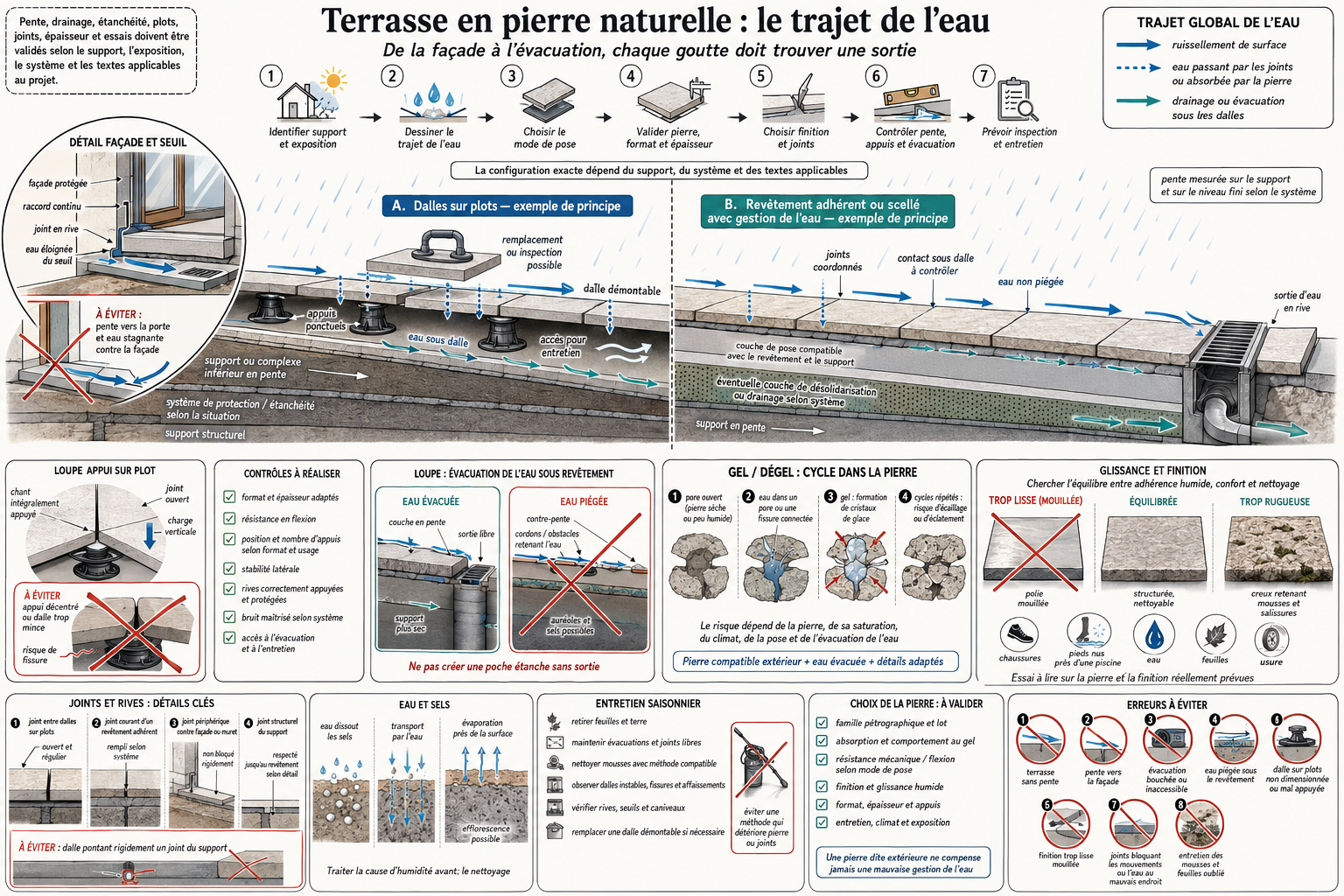
A natural-stone terrace must be designed around water management: falls, drainage, freeze-thaw exposure, joints, substrate, pedestals, slab thickness, slip resistance, cleaning and future slab replacement.
What this guide helps you resolve
Terraces are among the most popular and most exposed natural-stone applications. Material selection matters, but long-term performance depends above all on water management, the substrate, falls, freeze-thaw conditions, surface finish and seasonal maintenance.
At Marbre Import, this subject is treated as a decision-making framework linking the material, its intended use, site conditions, maintenance, risk and the evidence required. The purpose is not to accumulate information, but to clarify what must be confirmed before natural stone is selected, ordered, installed or maintained.
Questions to answer before making a decision
- Is the terrace ground-bearing, laid over a concrete slab or waterproofing system, or supported on pedestals?
- What is the actual fall, and where is the water discharged?
- Has the stone’s freeze-thaw suitability for exterior use been confirmed?
- Which finish is appropriate for shod or barefoot traffic?
- Which jointing system will be used?
- Can an individual slab be lifted and replaced?
Decision table
| Situation | Main risk | Marbre Import recommendation |
|---|---|---|
| Installation on pedestals | Slab too thin or unstable | Confirm slab thickness and format |
| Concrete slab | Trapped water and moisture migration | Falls, drainage and decoupling |
| Freeze-thaw climate | Spalling and salt damage | Verified freeze-thaw suitability and effective drainage |
| Pool surround | Barefoot slip risk | Tested finish and planned maintenance |
| Shaded terrace | Biological growth and soiling | Seasonal cleaning |
Common mistakes
- Laying paving flat without adequate falls.
- Assuming that an exterior-grade stone can compensate for poor drainage.
- Selecting a finish that is too smooth for a pool surround.
- Using joints that trap water within the build-up.
- Failing to remove leaves and biological growth regularly.
The Marbre Import approach
The method starts with the full water path: rainfall, run-off, potential ponding, evaporation and freezing. Only then should the stone, thickness, format, finish, joints and either pedestal, adhesive-fixed or mortar-bed installation be specified.
The final recommendation should always be expressed clearly for the client: what is feasible, what is recommended, what still requires verification, which natural variations must be accepted and which matters require an installer, engineer or other specialist.
Detailed technical guidance
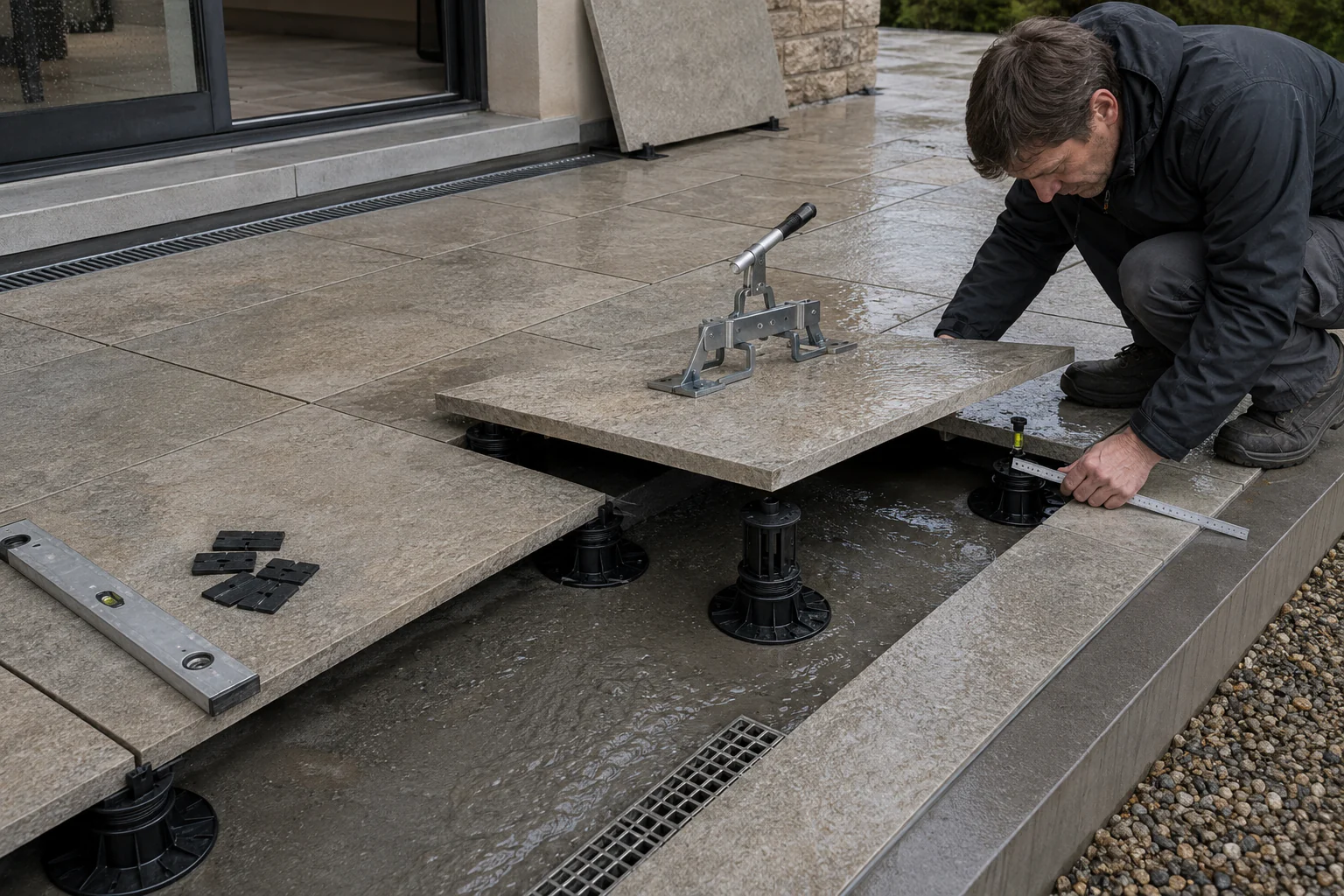
Standing water is the principal threat to a stone terrace. It carries salts and dirt, increases freeze-thaw stress, soils joints, encourages biological growth and may cause staining or tide marks. Pedestal installation makes slabs easier to lift, but requires compatible formats, thicknesses and support positions.
Professional guidance must distinguish general principles from project-specific conditions. Natural stone varies by geological family, batch, finish and thickness, while performance also depends on the substrate, environment and maintenance regime. The correct answer comes from assessing this complete combination.
Checks to document
| Check | Purpose | Evidence to retain |
|---|---|---|
| Falls | Discharge water effectively | Recorded level and fall check |
| Freeze-thaw exposure | Exterior durability | Technical data sheet |
| Thickness | Strength between supports | Format and support validation |
| Finish | Slip resistance and cleaning | Wet sample assessment |
| Drainage | Minimise standing water | Construction detail |
Wording for a quotation, technical schedule or French project specification (CCTP)
The written specification should identify the substrate, falls, water outlets, installation method, slab thickness and format, finish, joints, freeze-thaw conditions, maintenance requirements and any limitations relating to standing water or cleaning products.
Avoid vague performance claims. The document should identify the actual material, accepted batch or range, tolerances, available test evidence, limitations of use, exclusions and handover criteria.
Answers to common client questions
| Client question | Clear response |
|---|---|
| Can marble be used outdoors? | Yes, certain marbles can be suitable in specific settings, but freeze-thaw behaviour, finish, water management and maintenance must all be verified. |
| Are pedestals always the best solution? | They provide access and allow individual slabs to be lifted, but the slabs must be suitable and the supporting build-up correctly prepared. |
| Why is green growth appearing on my terrace? | Shade, persistent moisture and nearby vegetation encourage biological growth and soiling. Seasonal exterior cleaning is a normal part of maintenance. |
Practical summary
- Design the water path before selecting the stone.
- Confirm freeze-thaw suitability and slip resistance.
- Match slab thickness to format and support positions.
- Plan joints and future access or slab replacement.
- Establish an exterior maintenance programme.
Understanding the subject without unnecessary jargon
A natural-stone terrace must be designed around water management: falls, drainage, freeze-thaw exposure, joints, substrate, pedestals, slab thickness, slip resistance, cleaning and future slab replacement.
Assessment begins with the real setting: exterior exposure, water, traffic, frost, cleaning products, safety requirements and the expected appearance. Stone is not inherently good or bad; it is more or less appropriate for a defined combination of conditions.
This guide separates four questions. What are the actual site conditions? Which forces and exposures will affect the stone? Which solution is compatible with the complete terrace build-up? How will the project team demonstrate that the solution was understood and correctly installed? This framework prevents a stone, finish or construction method from being chosen on the strength of a single sales claim.
A non-specialist can make meaningful progress without knowing every standard at the outset. Begin by recording the location, use, moisture, traffic, exposure and desired appearance. Then identify the stone and substrate, gather the available technical information and list the points requiring a test, calculation or specialist opinion. The technical solution follows this assessment of need, never the other way around.
Worked examples
Consider a pedestal terrace. The main concern is a slab that is too thin or unstable. Appearance alone is not enough: confirm the support layout, validate the thickness and format, assess a representative sample and retain a record of the decision. This explains why two visually similar projects may require different specifications.
Consider paving over a concrete slab. The principal risk is trapped water and moisture migration through the build-up. Confirm the falls, drainage and any required decoupling system, assess a representative area and document the agreed solution.
Consider a freeze-thaw climate. Spalling and salt damage are key risks. Verify the stone’s freeze-thaw suitability and the effective discharge of water, assess a representative sample and keep the supporting technical evidence.
Consider a pool surround. Barefoot slip resistance is the main safety concern. Select and assess an appropriate finish in wet conditions, define the maintenance regime and record the basis for the decision rather than relying on appearance alone.
A practical decision-making method
The following method turns each project question into a verifiable decision. Every answer should be linked to an observation or document. Missing information must never be replaced by an unrecorded assumption; list it as a point requiring confirmation before ordering or starting work.
| Decision required | Assessment approach | Evidence to retain |
|---|---|---|
| Is the terrace ground-bearing, laid over a concrete slab or waterproofing system, or supported on pedestals? | Falls: discharge water effectively | Recorded level and fall check |
| What is the actual fall, and where is the water discharged? | Freeze-thaw exposure: exterior durability | Technical data sheet |
| Has the stone’s freeze-thaw suitability for exterior use been confirmed? | Thickness: strength between supports | Format and support validation |
| Which finish is appropriate for shod or barefoot traffic? | Finish: slip resistance and cleaning | Wet sample assessment |
| Which jointing system will be used? | Drainage: minimise standing water | Construction detail |
| Can an individual slab be lifted and replaced? | Falls: discharge water effectively | Recorded level and fall check |
Useful terminology
Technical vocabulary should describe a phenomenon or requirement accurately without becoming a barrier. The following terms help clients, suppliers, installers, architects and contractors distinguish the appearance of stone from its expected performance in the completed terrace.
| Term | Plain-English definition |
|---|---|
| Terrace | A term that must be defined in relation to the terrace build-up and exposure before it is used in a specification or site decision. |
| Falls | A term that must be defined in relation to the terrace build-up and exposure before it is used in a specification or site decision. |
| Drainage | The system used to collect and discharge water from within or beneath the terrace build-up. |
| Freeze-thaw exposure | A term that must be defined in relation to the terrace build-up and exposure before it is used in a specification or site decision. |
| Pedestal | A term that must be defined in relation to the terrace build-up and exposure before it is used in a specification or site decision. |
| Decoupling | A layer or system designed to limit the transfer of movement or stress from the substrate to the stone finish. |
| Permeable joint | A term that must be defined in relation to the terrace build-up and exposure before it is used in a specification or site decision. |
From selection to handover: who checks what?
The client defines the intended use, visual priorities, budget and acceptable maintenance. The designer or specifier turns these expectations into measurable criteria and coordinates the construction details. The supplier identifies the stone, batch and available performance data. The contractor checks the substrate, product compatibility and site conditions. At handover, the completed terrace is assessed against the approved sample, layout and stated tolerances.
These responsibilities do not mean that each party works in isolation. Information must circulate before the order is placed. Acceptance of natural variation, a reservation concerning substrate moisture or a maintenance limitation is useful only when it has been explained and recorded in writing.
| Project stage | Essential question | Expected outcome |
|---|---|---|
| Concept design | Is the proposed stone and terrace system compatible with the intended use and exposure? | Requirements recorded without ambiguity |
| Stone selection | Have the stone family, batch, finish and relevant performance characteristics been identified? | Approved sample and technical data linked to the project |
| Preparation | Have the substrate, products, water management, joints and construction details been coordinated? | Written method and inspection hold points |
| Installation | Do actual site conditions remain consistent with the approved solution? | Quality-control records and photographs |
| Handover | Are the appearance, geometry, performance and maintenance requirements understood? | Defects addressed and care instructions supplied |
Frequently asked questions
| Question | Explanation |
|---|---|
| Why should paving never be laid flat without adequate falls? | Because water must be directed to a defined outlet. Confirm the finished falls and record them through a level check, a representative trial area or an approved construction detail. |
| Why can an exterior-grade stone not compensate for poor drainage? | Because persistent saturation can carry salts, increase freeze-thaw stress and damage the entire build-up. Verify both the stone’s test data and the route by which water leaves the terrace. |
| Why should an overly smooth finish be avoided around a pool? | Because wet barefoot conditions change slip risk. Assess the proposed finish in representative wet conditions and retain the relevant test or sample approval. |
| Why must joints not trap water within the terrace build-up? | Because joints form part of the water-management system. Their permeability, movement capacity and position must be coordinated with the installation method and drainage detail. |
| Why is regular removal of leaves and biological growth important? | Because organic debris retains moisture, soils the surface and can reduce slip resistance. Seasonal cleaning and clear drainage outlets should form part of the care plan. |
Key concepts
From the Marbre Import blog
Related articles and completed projects
Freeze-thaw damage: avoiding mistakes with natural stone outdoors
Explore an additional guide, example or completed project from Marbre Import.
From exterior to interior: extending natural stone through fluid, biophilic architecture
Explore an additional guide, example or completed project from Marbre Import.
Travertine terraces: timeless elegance for exterior spaces
Explore an additional guide, example or completed project from Marbre Import.
Continue reading
Related guides
Diagnosis: Exterior Stone Spalling after Freeze-Thaw Exposure
Relate spalling to freeze-thaw cycles, water saturation, drainage, edge details, salts and the installation system rather than to minimum temperature alone.
Technical Guidance: Terraces, Balconies, Falls and Waterproofing
Define the complete system before specifying the stone: substrate, falls, waterproofing, drainage, thresholds, freeze-thaw exposure, joints and balcony safety.
Technical Guidance: NF DTU 52.2 and Adhesive-Fixed Natural Stone
A structured method for checking whether adhesive fixing is appropriate, including the substrate, stone, adhesive mortar, adhesive transfer, joints and site conditions.
Natural-Stone Finishes, Texture and Slip Resistance
A finish changes the stone’s colour, slip resistance, maintenance, texture, response to light, cleaning requirements and suitability. It deserves the same attention as the stone itself.
Natural-Stone Façades, Terraces and Exterior Applications
Exterior stone is a technical construction element. Frost, water, wind, fixings, slip resistance, falls, drainage, maintenance and applicable standards must be considered from the selection stage.
Stone Decay Caused by Salts, Moisture, Capillary Action, Black Crusts and Pollution
Salts, moisture, capillary action, efflorescence, subflorescence, black crusts and pollution are major causes of natural-stone deterioration.