Diagnosis and conservation
Stone Damage from Salts, Moisture, Rising Damp and Pollution deposits
Diagnose efflorescence, subflorescence, rising damp, black crusts and pollution by tracing water, soluble salts, evaporation and material interactions.
Water transports the problem
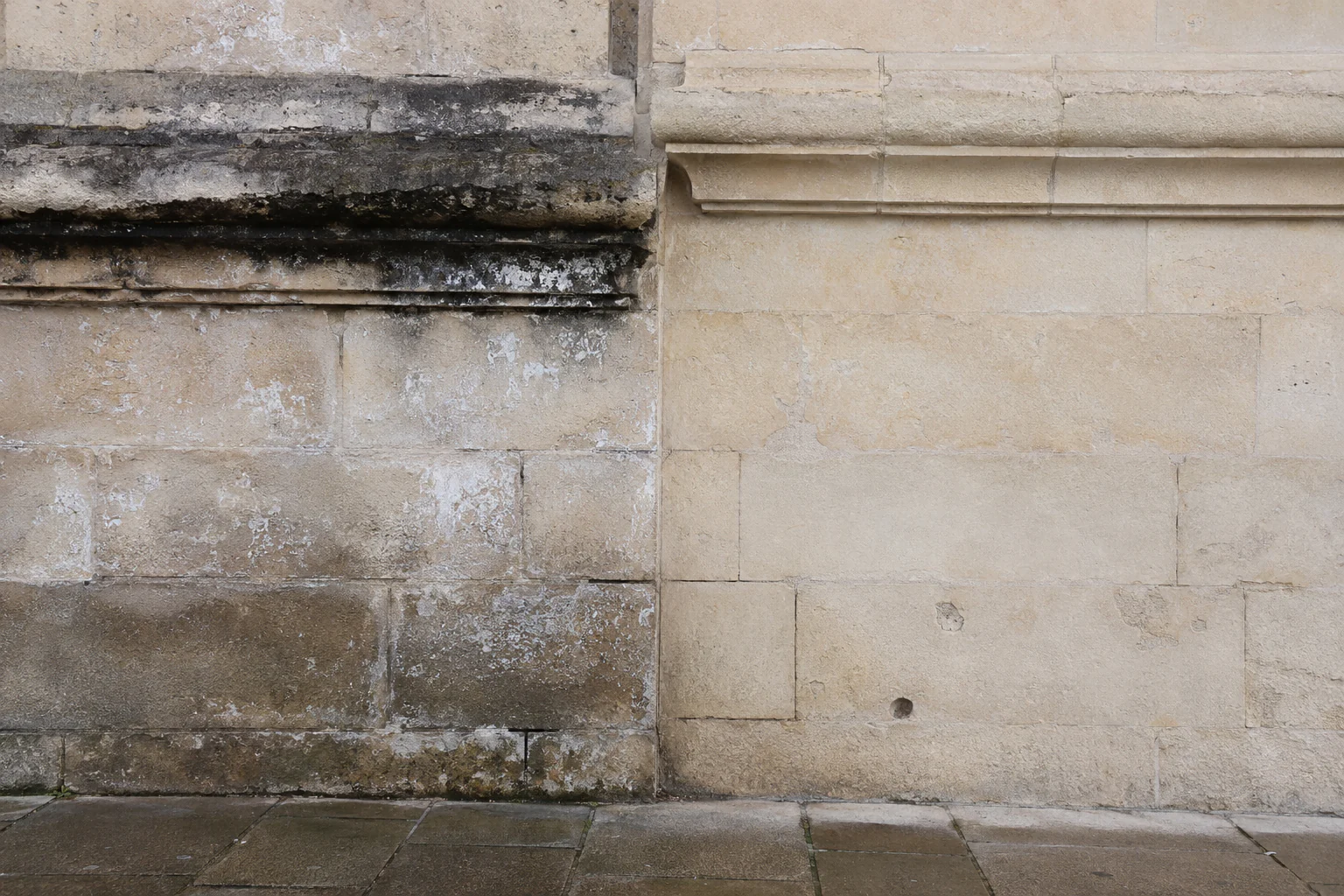
Moisture enters from ground, rain, leaks, condensation, cleaning or adjacent materials. It dissolves salts and carries them through pores toward evaporation zones.
A dry-looking surface does not prove the wall or floor is dry internally.
Efflorescence and subflorescence
Efflorescence crystallises visibly at the surface and may sometimes be brushed away after the source is controlled. Subflorescence crystallises beneath the surface and can detach grains, scales or crusts.
Salt type, concentration, pore size and drying cycle determine damage.
Rising damp and ground salts
Capillary moisture can rise through masonry and deposit salts in the evaporation band. Impermeable finishes may move the band higher or into more fragile stone.
Review ground levels, drainage, floors, wall build-up and historic changes before choosing intervention.
| Symptom | Possible mechanism | Evidence to collect |
|---|---|---|
| White crystals | Evaporating soluble salts | Sampling and moisture mapping |
| Powdering surface | Subsurface crystallisation | Microscopy and gentle probing |
| Dark damp band | Rising or trapped moisture | Levels and repeated measurements |
| Black crust | Pollution deposits plus wet sheltered surface | Deposit analysis and water paths |
| Orange staining | Iron mineral or corroding metal | Source investigation |
| Biological growth | Persistent moisture and nutrients | Exposure and drying conditions |
Black crusts and atmospheric pollution
Gypsum-rich black crusts often form where sulphur pollutants interact with carbonate stone in sheltered damp areas. They may contain particles and conceal weakened material.
Cleaning intensity must be tested so deposits are reduced without erasing sound stone or patina.
A staged treatment strategy
Make unstable areas safe, stop leaks and improve drainage before desalination or cleaning. Use poultices or other specialist methods only after diagnosis and trials.
Monitor drying and recurrence. Documentation and preventive maintenance are essential because salts can remain within the structure.
Need advice for a real project?
Marble Import supports international homeowners, architects and interior designers with stone selection, samples, technical feasibility and coordination of high-end stonework in France and across Europe.