Diagnosis and conservation
Diagnosis: Crumbling, Powdering or Delaminating Stone
Investigate stone that powders, flakes, crumbles or separates along layers by examining geology, moisture, salts, frost, fire, coatings and previous repairs.
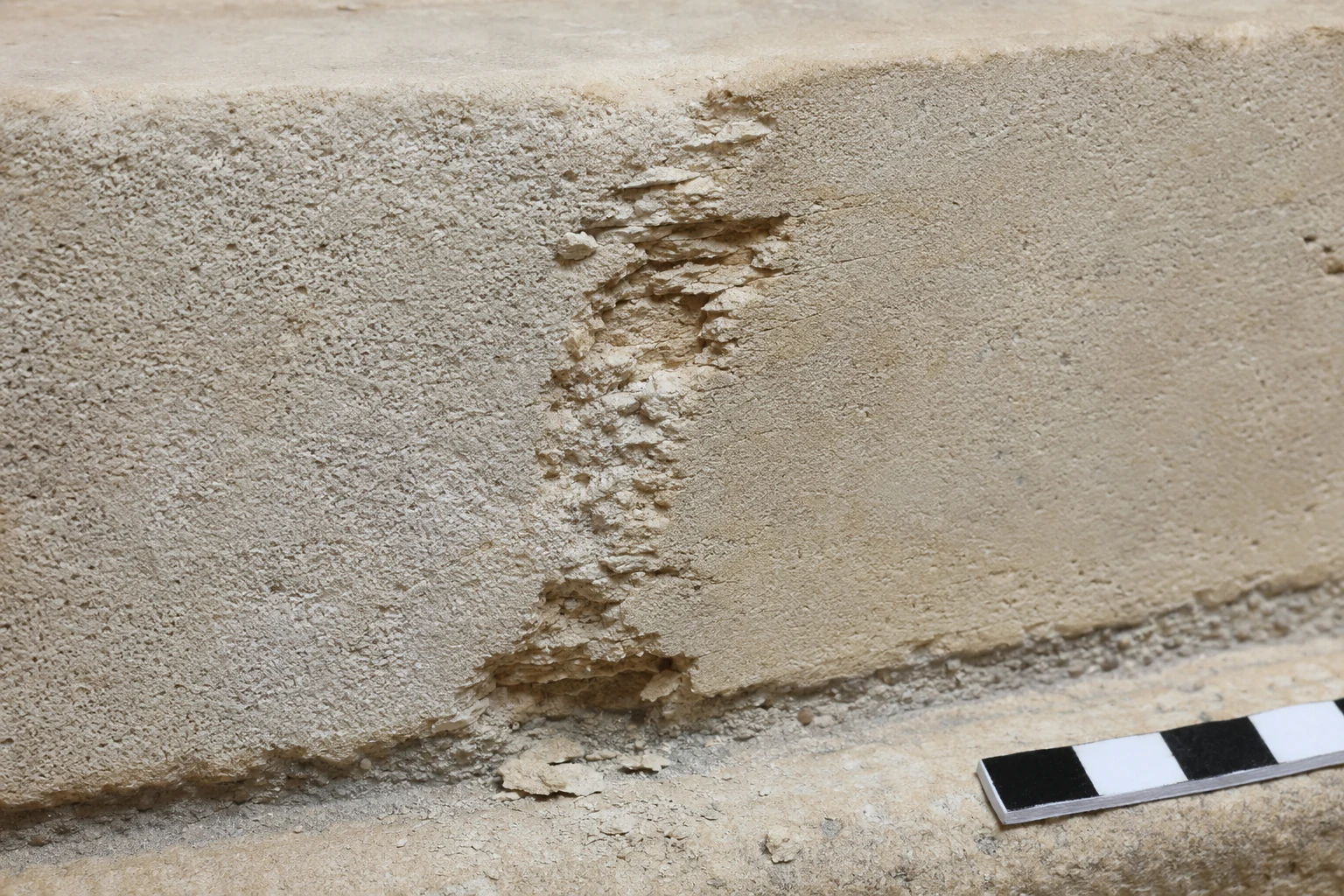
Describe the type of material loss
Powdering releases fine grains; scaling detaches thin surface layers; delamination follows bedding or another plane; spalling removes larger fragments. These patterns suggest different mechanisms.
Map extent, depth, orientation and rate of change before touching the surface.
Moisture and salts
Water carries soluble salts into pores. Repeated crystallisation beneath the surface can break grains and scales away, especially at evaporation fronts.
Find leaks, ground moisture, runoff and incompatible dense coatings before considering consolidation.
Material and exposure
Bedding, clay seams, altered minerals and weak crusts can create directional decay. Frost damages saturated stone; fire or heat can cause mineral expansion and microcracking.
Hard cement repairs may concentrate wetting and stress in adjacent softer stone.
| Pattern | Possible mechanisms | Evidence |
|---|---|---|
| Fine powder | Salt cycles, weak binder or chemical attack | Moisture and petrography |
| Parallel flakes | Bedding, coating or thermal stress | Recommended direction and section |
| Corner spalls | Impact, frost or corroding fixing | Geometry and metal check |
| Soft zone near ground | Rising damp and salts | Levels and moisture map |
| Decay beside repair | Incompatible hardness or permeability | Mortar and water-path review |
Test before treatment
Cleaning, desalination, mortar repair and consolidation require compatible trials. A consolidant cannot stabilise active salt or frost mechanisms permanently.
Assess penetration, colour, vapour behaviour and future retreatability.
Safety and repair
Make loose overhead or façade stone safe immediately. Retain sound original material and replace only portions beyond conservation.
Document lost depth, samples, trials and repair materials for future monitoring.
Need advice for a real project?
Marble Import supports international homeowners, architects and interior designers with stone selection, samples, technical feasibility and coordination of high-end stonework in France and across Europe.