Diagnosis by Symptom
Diagnosis: Dull, Yellowed or Grey Marble
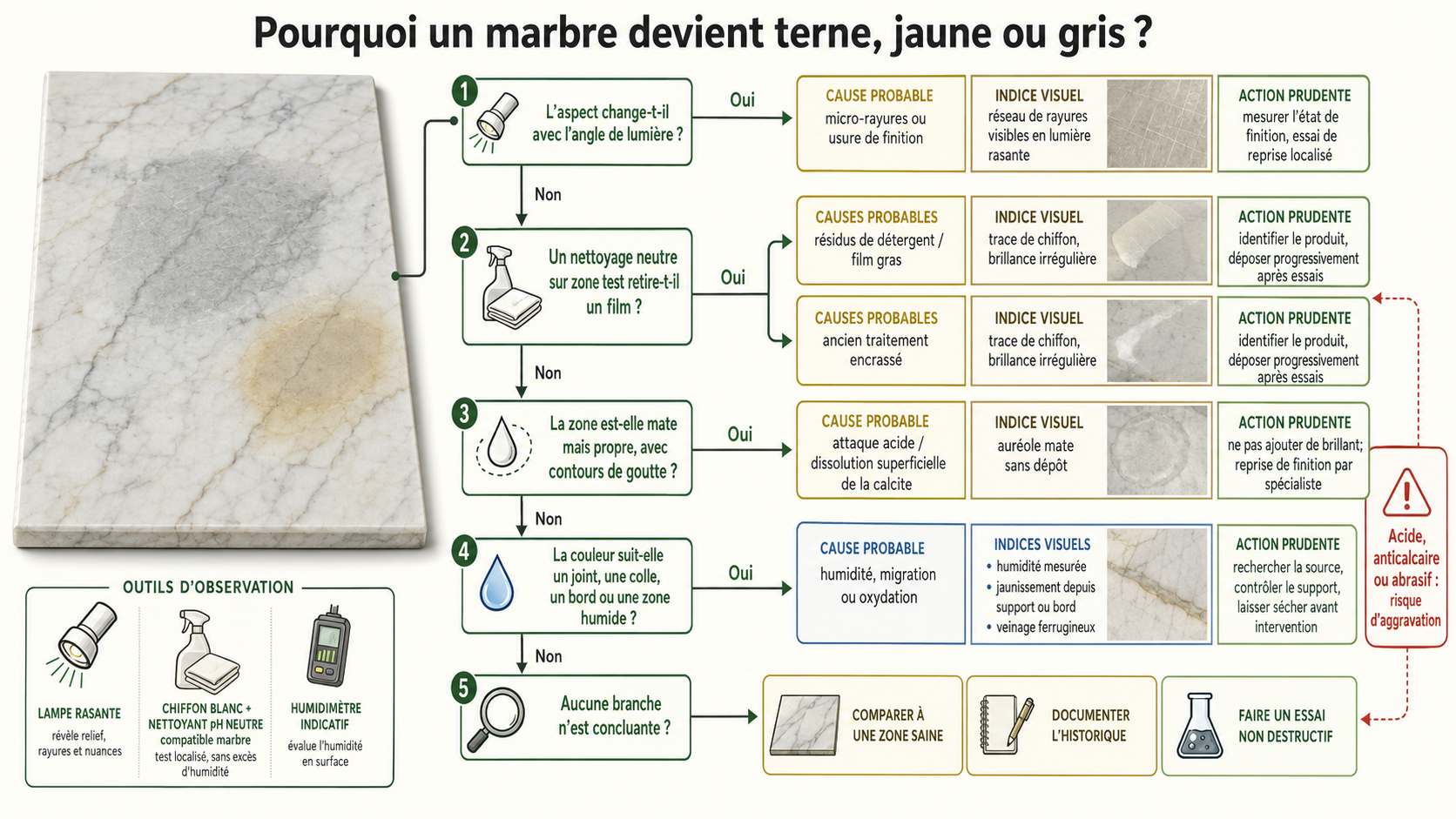
Distinguish a maintenance film, acid etching, moisture, oxidation, an ageing treatment and an actual change in the stone before attempting to clean or repolish it.
Identify the condition before treating it
Dull marble does not necessarily need a gloss-enhancing product. Loss of sheen may be caused by a greasy film, poorly rinsed detergent, acid etching of calcite, mechanical wear, persistent moisture or an old treatment that has become uneven. Yellowing may be superficial, migrate from adhesive or sealant, reveal mineral oxidation or accompany ageing resin.
Begin by checking whether the appearance changes with the lighting, moisture or neutral cleaning. A localised change around furniture, a rug, a joint or a wet area is unlikely to have the same cause as a uniform change across the entire room.
| Observed sign | What it may indicate | First action |
|---|---|---|
| Uniform film that marks when wiped | Soap, wax, polymer or detergent residue | Test clean a small area |
| Distinct dull mark after lemon, vinegar or limescale remover | Acid etching of a calcite-based surface | Stop using the products and assess the depth |
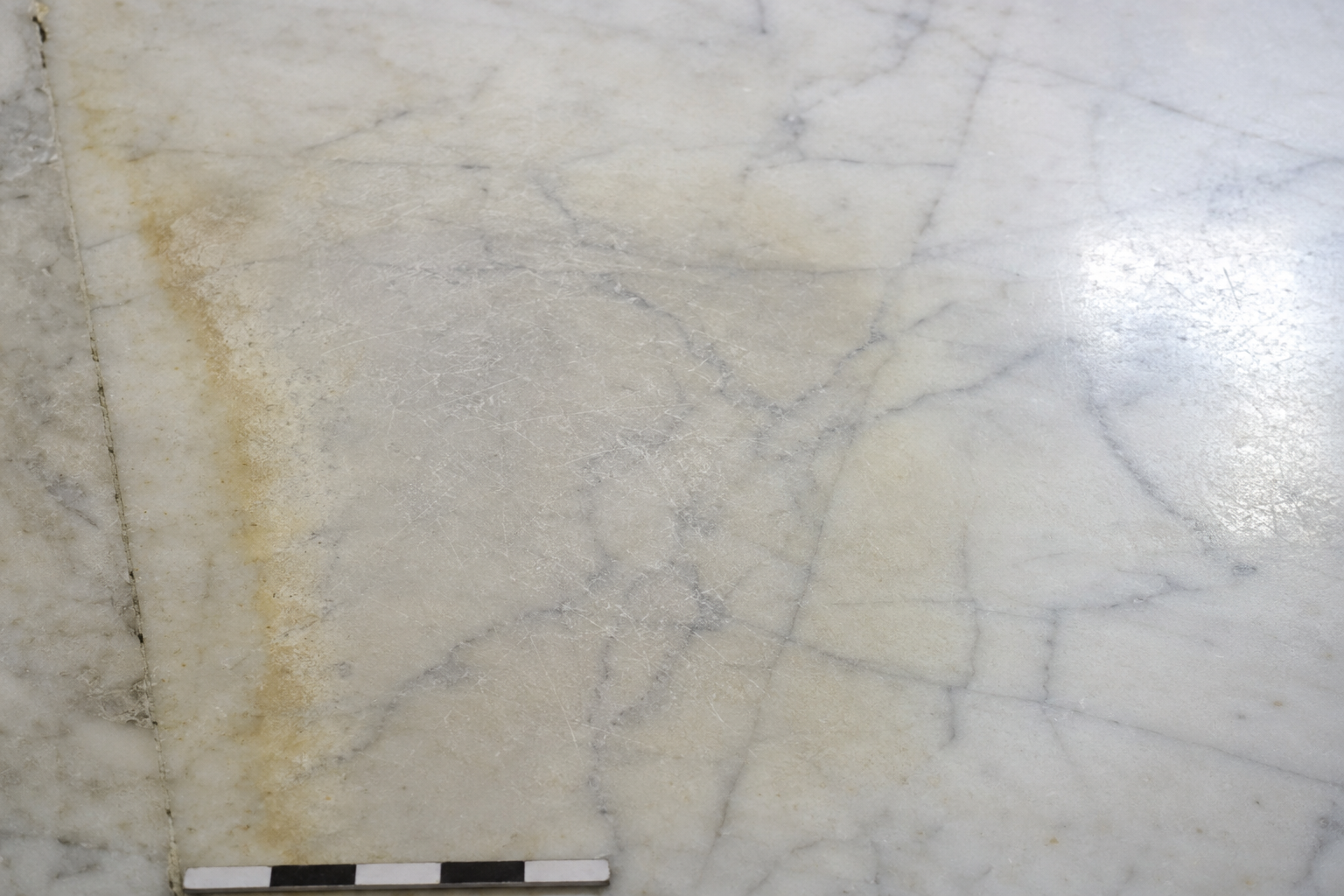
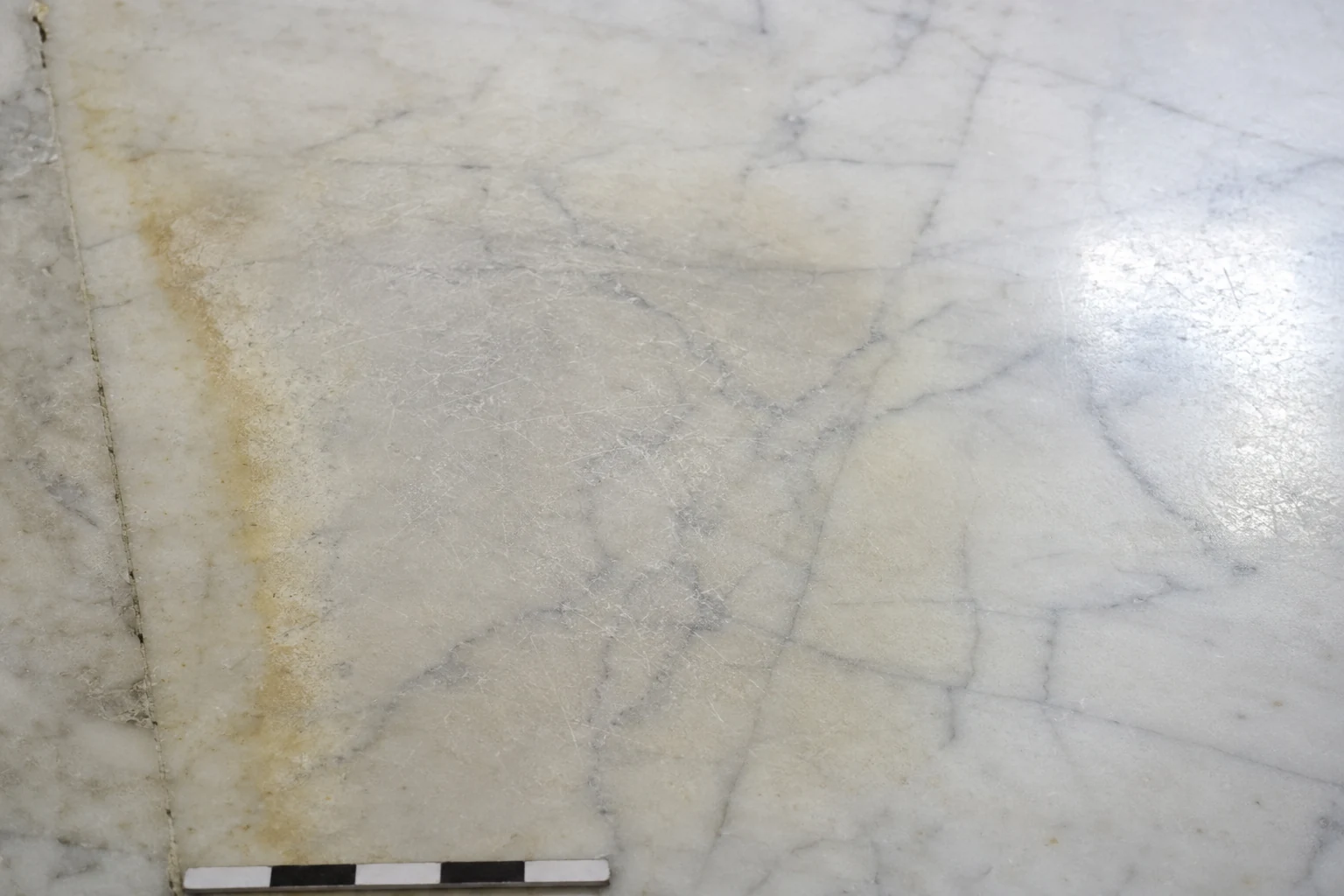
| Yellowing concentrated around joints, fissures or fixings | Migration, oxidation or an incompatible product | Find the source before restoration |
| Stone becomes darker when damp | Moisture in the stone or substrate | Investigate moisture and drying conditions |
| Grey, dull traffic lanes | Micro-scratches, abrasives and finish wear | Compare with a protected edge |
Dull, stained or etched: three different conditions
A deposit lies on top of the stone and can often be removed with a compatible method. A stain has penetrated the pores and requires identification of the contaminant family. Etching has changed the stone itself: further cleaning will not restore the polish and may enlarge the dull area.
Comparison with an area beneath furniture or at the perimeter helps distinguish normal wear from recent change. Raking light reveals micro-scratches and surface differences that diffuse light conceals.
Checks that will not make the condition worse
| Check | How to proceed | How the result informs the diagnosis |
|---|---|---|
| Clean-water test | Lightly dampen a small area, then dry it | If the sheen returns only while wet, the surface is probably worn or etched |
| Neutral-cleaner test | Use a pH-neutral product and clean microfibre, then rinse and dry | A film that disappears confirms a superficial deposit |
| Raking light | Observe from several angles | Reveals scratches, machine marks and differences in finish |
| Moisture mapping | Compare the affected and unaffected areas using a suitable method | Helps identify substrate moisture, a leak or insufficient drying |
| Product history | List waxes, strippers, crystallisation products and limescale removers | May reveal incompatibility or product build-up |
Step-by-step diagnosis
| Stage | Question to resolve | Decision |
|---|---|---|
| 1 | Is the change a film on top of the stone? | Carry out a compatible cleaning test |
| 2 | Has the surface been etched or scratched? | Plan a graduated mechanical restoration |
| 3 | Does the yellowing come from moisture, metal or resin? | Remove or stabilise the source before cosmetic correction |
| 4 | Is the stone calcite-based, siliceous or resin-treated? | Adapt chemicals, abrasives and working temperature |
| 5 | Does the test area achieve a consistent appearance? | Approve the process before treating the full area |
Treat the confirmed cause
| Confirmed cause | Treatment principle | Condition for success |
|---|---|---|
| Maintenance-product film | Gentle, progressive removal compatible with the stone | Testing, thorough rinsing and removal of residues |
| Light etching or wear | Local or full-area mechanical refinishing to the required finish | A visually acceptable transition confirmed on a test area |
| Moisture | Correct the leak, migration path or substrate issue, then allow the assembly to dry | Do not trap moisture beneath a new treatment |
| Oxidation or migration | Identify the compound, then use targeted extraction or local replacement | Source stabilised and material compatibility confirmed |
What not to do
- Apply wax to conceal acid etching.
- Use vinegar, limescale remover or abrasive powder on calcite-based marble.
- Crystallise a damp surface or one covered with residue.
- Treat only the yellow colour without investigating adhesive, metal, resin or moisture feeding it.
- Promise an invisible local repair without a test area.
When to consult a specialist
- Deep or progressive yellowing, especially when associated with fissures or moisture.
- A large polished area requiring flat, uniform refinishing.
- Resin-treated or translucent stone, or stone containing minerals liable to oxidise.
- Unidentified stone or an unknown chemical-treatment history.
Preventing recurrence
- Use a compatible cleaner at the correct dilution and rinse thoroughly.
- Wipe up acids, drinks, oils and cosmetics promptly.
- Use clean, non-staining mats and protective pads beneath furniture.
- Monitor moisture in sensitive areas before renewing a treatment.
- Retain a reference area and a record of the products used.
Frequently asked questions
| Question | Practical answer |
|---|---|
| Will a gloss-enhancing product solve the problem? | No. It may conceal the defect temporarily and make subsequent restoration more difficult. |
| Is yellowing always rust? | No. Wax, resin, moisture, adhesive, pollution and minerals can produce similar colours. |
| Can a single dull mark be repolished? | Sometimes, but the transition in sheen and flatness must be tested first. |
Limits of remote diagnosis
This guide supports a methodical initial diagnosis. It does not replace an on-site investigation where stability, waterproofing, structure, public safety or professional liability may be involved.
Document the case with an overall view, a close-up with a scale, edges, joints, possible water paths and an unaffected comparison area. Record when it appeared, how it has changed, which products were used and any recent work.
Assess urgency before intervening
Distinguish a maintenance film, acid etching, moisture, oxidation, an ageing treatment and an actual change in the stone before attempting to clean or repolish it.
The first objective is not to make the visible mark disappear immediately. Determine whether the condition is stable, progressive or hazardous. A long-standing dry change in appearance does not have the same priority as a moving slab, opening crack, active leak or element at risk of falling.
Begin by protecting people and the construction. Stop sources of water or chemicals where this can be done safely. Do not scrape, sand or try a succession of cleaners. Dated photographs, simple measurements and an unaffected comparison area often provide more useful information than an aggressive trial.
Urgency increases when the condition changes rapidly, returns after treatment, affects several aligned elements, accompanies movement, occurs on a façade or in a public area, or reveals water ingress. In these cases, cosmetic treatment must wait until safety, structural and waterproofing issues have been assessed.
| Response level | Typical situation | Recommended action |
|---|---|---|
| Documented monitoring | Stable, dry appearance with no movement or hazard | Photograph, measure and compare before any treatment |
| Controlled local trial | Probable cause and non-hazardous surface | Test the method on a small, discreet area |
| Specialist assessment | Uncertain cause, recurrence, large area or sensitive stone | Have the complete assembly examined before treatment |
| Immediate safety measures | Movement, risk of falling material, active ingress or risk to the public | Isolate the area and contact the appropriate specialist immediately |
Diagnostic reasoning in typical cases
If a uniform film marks when wiped, soap, wax, polymer or detergent residue is plausible but not yet proven. Compare it with other possible causes, inspect edges and joints and review how it changes over time. Begin with a small compatible cleaning test. A contradictory result means the diagnosis must be reconsidered rather than forcing the planned treatment.
If a distinct dull mark appeared after lemon, vinegar or limescale remover, acid etching of a calcite-based surface is plausible but must still be confirmed. Stop using the product, compare edges and unaffected areas and assess the depth. If the evidence conflicts, reconsider the diagnosis instead of forcing a polishing process.
If yellowing is concentrated around joints, fissures or fixings, migration, oxidation or an incompatible product is plausible but not proven. Inspect adjacent materials and water paths and monitor the change. Find and stabilise the source before restoring the appearance.
If the stone darkens with moisture, water in the stone or substrate is plausible but not proven. Compare wet and dry zones, inspect joints and possible sources and monitor drying. Diagnose the moisture path before applying any new treatment.
If traffic lanes have become grey and dull, micro-scratches, abrasive dirt and finish wear are plausible but not proven. Compare the area with a protected edge, review cleaning practices and inspect under raking light before specifying refinishing.
Preparing an assessment request a specialist can use
A useful assessment request describes the location, suspected stone, substrate, age of the installation, date of appearance and any recent work or products. State whether the area is indoors or outdoors, dry or wet, heated, exposed to frost, traffic or intensive cleaning. Without this context, a photograph may support several conflicting diagnoses.
Prepare an overall view, a medium-distance view and a close-up with a ruler or object for scale. Also photograph joints, edges, drainage points, the underside where accessible and an unaffected area. Use the same angle and lighting when monitoring change, and avoid filters that alter colour.
Attach invoices or references for products used, the stone data sheet where available, installation drawings and the repair history. State what has already been tried and the observed result. This prevents repetition of an incompatible test and helps the specialist prepare appropriate checks before visiting.
Choosing between monitoring, testing and treatment
Approve treatment only when it addresses the confirmed cause, is compatible with the stone and can produce an acceptable appearance across the complete area. A test area verifies the result, drying time, colour transition and side effects. Assess it after the relevant waiting period, not only while the surface is still wet.
Specialist involvement is particularly important for deep or progressive yellowing associated with fissures or moisture; large polished areas requiring flat, uniform refinishing; resin-treated or translucent stone; stone containing oxidisable minerals; or an unidentified stone with an unknown chemical history. The diagnosis should state its limitations and any further investigations required.
| Stage | What the check is intended to establish | Possible decision |
|---|---|---|
| Clean-water test | Lightly dampen a small area, then dry it | If the sheen returns only while wet, the surface is probably worn or etched |
| Neutral-cleaner test | Use a pH-neutral product and clean microfibre, then rinse and dry | A film that disappears confirms a superficial deposit |
| Raking light | Observe from several angles | Reveals scratches, machine marks and differences in finish |
| Moisture mapping | Compare the affected and unaffected areas using a suitable method | Helps identify substrate moisture, a leak or insufficient drying |
| Product history | List waxes, strippers, crystallisation products and limescale removers | May reveal incompatibility or product build-up |
| 1 | Is the change a film on top of the stone? | Carry out a compatible cleaning test |
Key concepts
Continue reading
Related guides
Marble and Natural-Stone Restoration
Restoring marble or natural stone begins with diagnosing its actual condition, selecting the right level of intervention and achieving a sound, consistent and durable surface without promising the impossible.
Care, Restoration and Stone Defects
Marble develops a patina, can be cleaned and protected, and may stain, scratch, polish or be restored. A sound diagnosis always comes before product selection.
Water and Oil Repellents: Protection, Limitations and Renewal
A treatment can provide partial protection against water or oil, but it cannot make stone immune to acids, scratches, heat, wear or unsuitable maintenance.
Natural-Stone Finishes, Tactile Qualities and Slip Resistance
A finish changes the stone’s colour, slip resistance, maintenance, feel, interaction with light, cleaning requirements and suitability. It deserves the same attention as the stone itself.
Diagnosis: Stains on Marble and Natural Stone
Identify the contaminant family, penetration depth and any chemical change before selecting absorption, poulticing, cleaning or surface restoration.
Diagnosis: Cracks, Chips and Breakage in Natural Stone
Determine whether the damage is confined to the stone or indicates substrate movement, stress, impact, handling damage or a design issue.