Stone in Use
Stain Removal and Cleaning Products by Stain and Stone Type
Cleaning natural stone requires identification of the stone, finish and type of mark: grease, rust, acid etching, limescale, grout haze, wine, coffee, soap and general soiling require different responses.
What this guide helps you resolve
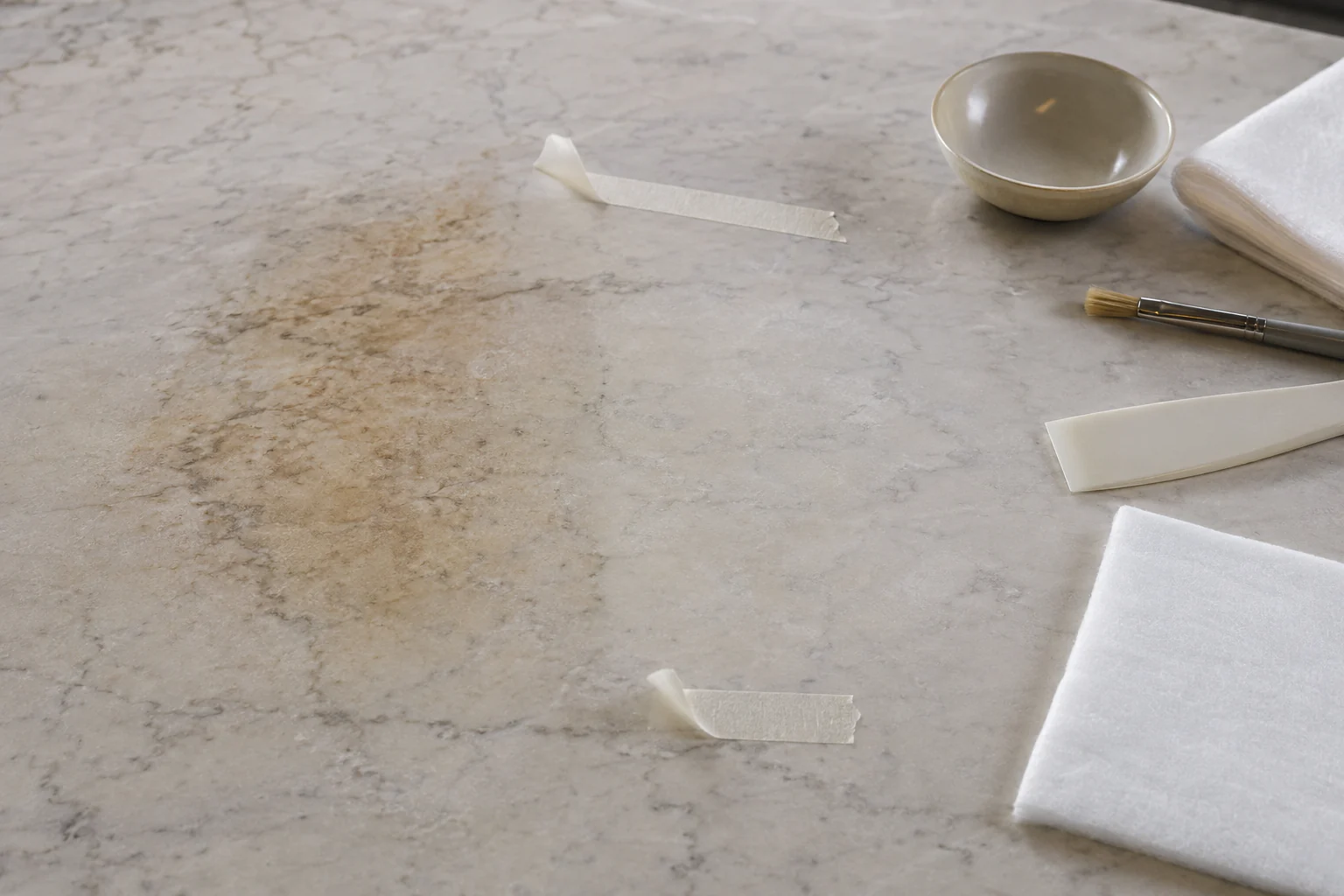
How to remove a stain from marble is one of the most common questions. The right answer rarely begins with a product; it begins by identifying the stone, finish and nature of the mark.
Marble Import approaches accessibility as a decision framework linking the material, intended use, site conditions, maintenance, risk and required evidence. The aim is to clarify what must be approved before natural stone is selected, ordered, installed or maintained.
Questions to answer before making decisions
- Which stone?
- Which finish?
- A stain or acid etching?
- How long has it been present?
- Which products have already been tried?
- Is the area wet or exposed to grease?
- Is there an existing treatment?
Decision table
| Situation | Primary risk | Marble Import recommendation |
|---|---|---|
| Grease | Penetration into pores | Suitable poultice |
| Acid | Loss of polish | Mechanical refinishing |
| Rust | Metal migration | Stone-compatible specialist product after testing |
| Grout or cement haze | Acid cleaner may damage the stone | Use a stone-compatible method |
| Limestone | Limescale remover is unsuitable for marble | Repeated gentle cleaning |
Common mistakes
- Use vinegar on marble.
- Scrub with a hard abrasive.
- Treat acid etching as if it were a stain.
- Use an untested rust remover.
- Try one product after another without a diagnosis.
The Marble Import approach
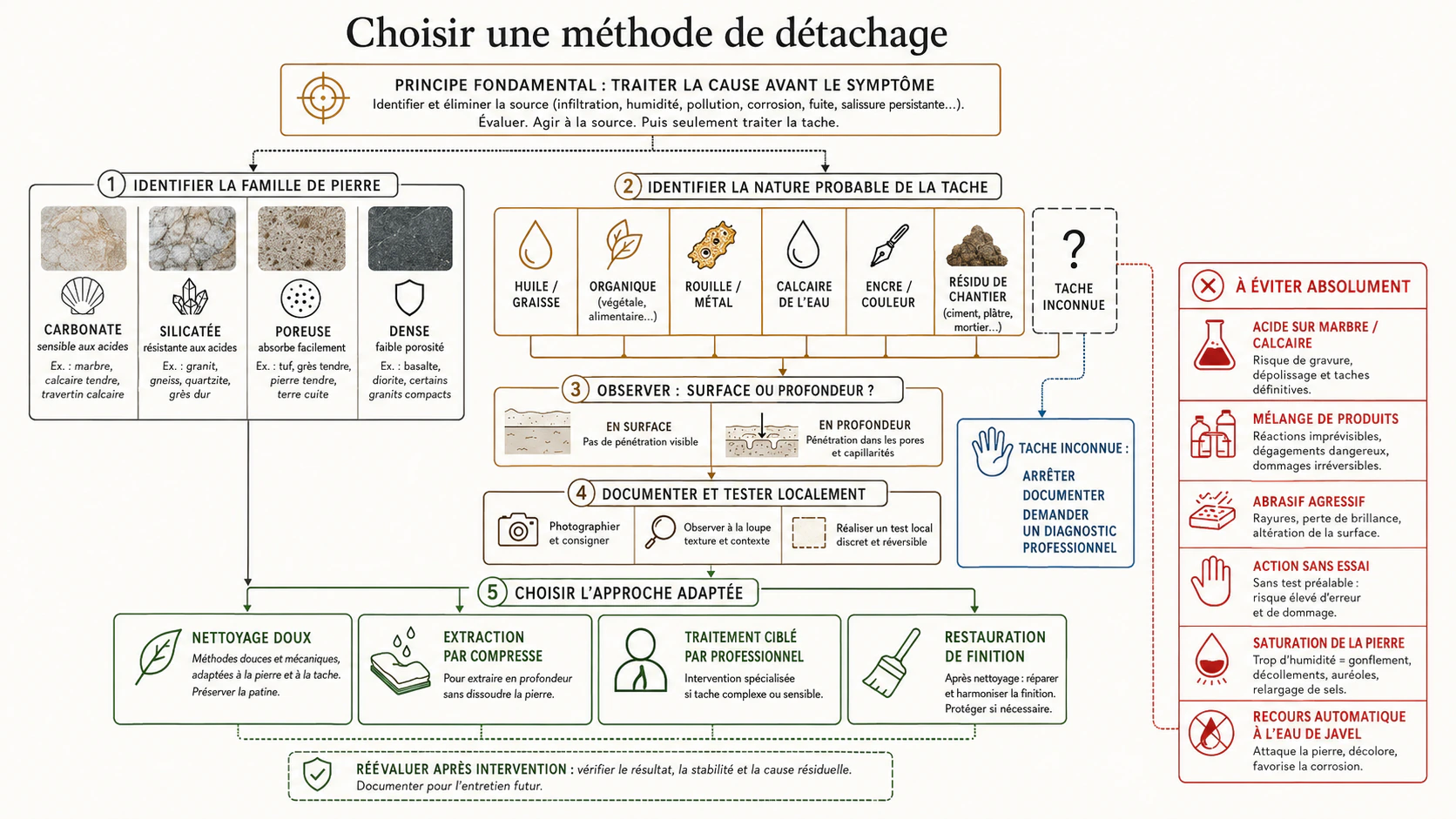
Identify the stone and mark, test in a discreet area, treat progressively, neutralise where required, allow to dry and adapt maintenance to prevent recurrence.
The final recommendation should be expressed clearly for the client: what is feasible, what is advisable, what requires verification, which natural variations must be accepted and which matters require a qualified professional or design specialist.
Detailed technical guidance
A stain adds a contaminant; acid etching removes or changes the surface. This distinction changes the treatment: a stain may be extracted, whereas etching requires surface restoration.
General guidance must be distinguished from project-specific assessment. Natural stone varies by stone family, batch, finish, thickness, substrate, environment and maintenance regime. Suitability depends on that complete combination.
Checks to document
| Check | Purpose | Useful evidence |
|---|---|---|
| Stone | Sensitivity | Stone family |
| Finish | Visible reaction | Polishedshed or honed |
| Stain | Suitable product | Diagnosis |
| Test | Avoid damage | Discreet test area |
| After treatment | Prevention | Care guidance |
Writing the quotation, specification or method statement
Stain-removal guidance should identify prohibited products, preliminary tests, limitations, situations requiring a specialist and preventive measures.
Written documents should avoid vague promises. They should identify the actual material and approved batch or range, tolerances, available tests or evidence, limits of use, exclusions and acceptance conditions.
Answers to common client questions
| Question or concern | Clear response |
|---|---|
| Why does vinegar damage marble? | Because calcite in marble reacts with acids. |
| Why does the mark remain after cleaning? | It may be surface etching rather than a stain. |
| Would a water repellent have prevented it? | No. It can slow some penetration but does not protect against acids. |
Practical summary
- Identify before acting.
- Distinguish staining from etching.
- Always test first.
- Avoid acids on calcite-based stone.
- Prevent recurrence through suitable care.
Understanding accessibility without jargon
Cleaning natural stone requires identification of the stone, finish and type of mark: grease, rust, acid etching, limescale, grout haze, wine, coffee, soap and general soiling require different responses.
Stone changes through exposure to water, salts, chemicals, abrasion, light and maintenance. Understanding this helps distinguish normal ageing, misuse, substrate defects and the treatment actually required.
This guide separates four questions. Is the mark a deposit, stain or surface change? Which stone and finish are involved? Which method is compatible? How will a test demonstrate that it works without causing damage? This prevents product selection based on a single claim.
Begin by recording the location, use, moisture, traffic, exposure and appearance. Identify the stone and finish, list products already used and note which points require testing or specialist advice before treatment.
Worked project scenarios
For grease, penetration into the pores is the key issue. Identify the contaminant and stone, then test a suitable poultice and allow full drying before judging the result.
For acid damage, loss of polish is a change to the stone surface rather than a stain. Neutral cleaning cannot restore it; controlled mechanical refinishing may be required.
For rust, investigate metal migration and the moisture source before using a specialist remover. Some products can alter the stone, so a test is essential.
For cement or grout haze, conventional acid cleaners can etch calcite-based stone. Identify both the residue and stone and select a compatible method.
A structured decision method
The method below turns cleaning questions into decisions that can be checked. Link every answer to an observation, product record or test and treat missing information as a point to confirm before intervention.
| Question to resolve | How to assess it | Simple evidence to retain |
|---|---|---|
| Which stone? | Stone: sensitivity | Stone family |
| Which finish? | Finish: visible reaction | Polishedshed or honed |
| A stain or acid etching? | Stain: compatible product | Diagnosis |
| How long has it been present? | Test: avoid damage | Discreet test area |
| Which products have already been tried? | After treatment: prevention | Care guidance |
| Is the area wet or exposed to grease? | Stone: sensitivity | Stone family |
Useful terminology
These terms help clients and specialists distinguish contaminants, chemical alteration and surface finishing without treating every visible mark as the same problem.
| Term | Plain-English definition |
|---|---|
| Stain removal | A cleaning or treatment term whose suitability depends on the identified stone, finish, contaminant and approved test. |
| Poultice | A stain-extraction method using an absorbent paste applied locally to an identified contaminant. |
| pH-neutral | A cleaning or treatment term whose suitability depends on the identified stone, finish, contaminant and approved test. |
| Acid | A cleaning or treatment term whose suitability depends on the identified stone, finish, contaminant and approved test. |
| Rust | A cleaning or treatment term whose suitability depends on the identified stone, finish, contaminant and approved test. |
| Grease | A cleaning or treatment term whose suitability depends on the identified stone, finish, contaminant and approved test. |
| Grout or cement haze | A surface film or deposit left after installation or grouting, requiring a removal method compatible with the stone. |
From selection to handover: who checks what?
The client describes use, appearance priorities and cleaning history. The specialist identifies the stone, finish and mark, verifies product compatibility and tests a method. Acceptance compares the dry treated area with an agreed reference.
Information must circulate before treatment. Product history, test results, limitations and maintenance changes should be explained and retained in writing.
| Project stage | Essential question | Expected outcome |
|---|---|---|
| Concept design | Has the stone, finish and nature of the mark been identified before selecting a product? | Requirements described without ambiguity |
| Stone selection | Have the stone family, batch, finish and available performance data been identified? | Sample and data sheet linked to the project |
| Preparation | Have the substrate, products, water exposure, joints and details been coordinated? | Written method and hold points |
| Installation | Do the actual site conditions remain consistent with what was approved? | Quality checks and photographs |
| Handover | Are the appearance, geometry, function and maintenance requirements understood? | Snagging resolved and maintenance information provided |
Common questions
| Question | Explanation |
|---|---|
| Why must vinegar not be used on marble? | Because acids react with calcite and etch the surface. Identify the stone and test a compatible method instead. |
| Why avoid hard abrasives? | Because appearance cannot override accessible passage. Coordinate the threshold height, slope, joints and finish, then record the approved detail before fabrication. |
| Why must acid etching not be treated as a stain? | Because etching has altered the stone itself. More cleaning cannot restore the polish and may enlarge the mark. |
| Why test a rust remover first? | Because rust removers can affect colour, minerals, resin and finish. Confirm compatibility on a discreet test area. |
| Why avoid trying one product after another? | Because mixtures and repeated applications can create new reactions and obscure the original diagnosis. Record every product used. |
Key concepts
From the Marble Import blog
Related articles and completed projects
What Can Stain Marble?
Explore an additional guide, example or completed project from Marble Import.
How to Protect Marble from Limescale
Explore an additional guide, example or completed project from Marble Import.
Choosing, Protecting and Caring for a Marble Table
Explore an additional guide, example or completed project from Marble Import.
Continue reading
Related guides
Diagnosis: Stains on Marble and Natural Stone
Identify the contaminant family, penetration depth and any chemical change before selecting absorption, poulticing, cleaning or surface restoration.
Diagnosis: Dull, Yellowed or Grey Marble
Distinguish a maintenance film, acid etching, moisture, oxidation, an ageing treatment and an actual change in the stone before attempting to clean or repolish it.
Water and Oil Repellents: Protection, Limitations and Renewal
A treatment can provide partial protection against water or oil, but it cannot make stone immune to acids, scratches, heat, wear or unsuitable maintenance.
Care, Restoration and Stone Defects
Marble develops a patina, can be cleaned and protected, and may stain, scratch, polish or be restored. A sound diagnosis always comes before product selection.
Maintenance Plans by Use: Homes, Hotels, Retail, Exteriors and Public Buildings
Natural-stone maintenance should reflect the setting: homes, hotels, restaurants, retail premises, shared buildings, façades, terraces, pools and public-access buildings require different protocols.
Stone Decay Caused by Salts, Moisture, Capillary Action, Black Crusts and Pollution deposits
Salts, moisture, capillary action, efflorescence, subflorescence, black crusts and pollution are major causes of natural-stone deterioration.