Architecture and Interior Design
Historical Atlas of Marble Styles, Periods, Monuments and Uses
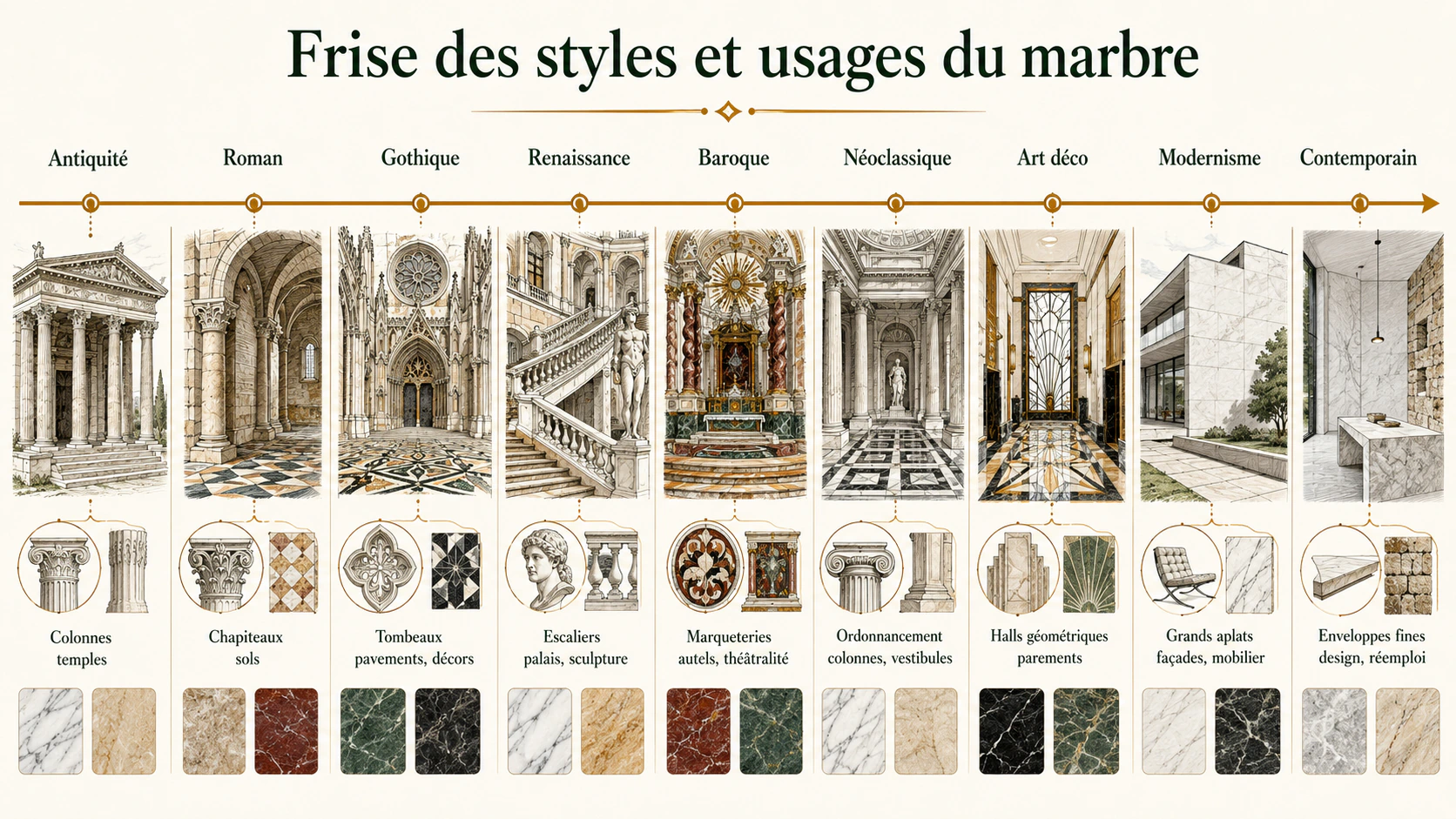
Understanding marble in Antiquity, Rome, Byzantium, the Renaissance, Baroque, Art Deco and modern design supports more informed and culturally appropriate specification.

What this guide helps you resolve
Marble carries a powerful cultural memory. Ancient monuments, palaces, basilicas, baths, villas, Art Deco halls and contemporary hotels reveal different ways of using stone through mass, colour, light, symbolism, order and luxury.
Marble Import approaches accessibility as a decision framework linking the material, intended use, site conditions, maintenance, risk and required evidence. The aim is to clarify what must be approved before natural stone is selected, ordered, installed or maintained.
Questions to answer before making decisions
- Which historical reference inspires the project?
- Should the result feel monumental or restrained?
- Should colour make a statement or create calm?
- What role do joints and symmetry play?
- How can pastiche be avoided?
- Which stone best expresses the intended style?
Decision table
| Situation | Primary risk | Marble Import recommendation |
|---|---|---|
| Antiquity and Rome | Polychromy and prestige | Opus work work, columns and floors |
| Byzantium | Light and mosaic | Gold, onyx and coloured marbles |
| Renaissance | Order and proportion | Symmetry and mouldings |
| Baroque | Movement and theatricality | Expressive veining |
| Art Deco | Contrast and geometry | Black, white, green and gold tones |
Common mistakes
- Copy a style without understanding its proportions.
- Use a highly expressive stone everywhere.
- Ignore the actual lighting.
- Confuse reference with pastiche.
- Neglect joints and details.
The Marble Import approach
Begin with the stylistic intention, then translate it into colour, format, finish, layout, edges, lighting and maintenance.
The final recommendation should be expressed clearly for the client: what is feasible, what is advisable, what requires verification, which natural variations must be accepted and which matters require a qualified professional or design specialist.
Detailed technical guidance
Historical styles use stone as an architectural language: ceremonial floors, columns, plinths, veneers, inlay, fireplaces, staircases, thresholds, friezes and sculpture. The material supports the overall composition.
General guidance must be distinguished from project-specific assessment. Natural stone varies by stone family, batch, finish, thickness, substrate, environment and maintenance regime. Suitability depends on that complete combination.
Checks to document
| Check | Purpose | Useful evidence |
|---|---|---|
| Style | Avoid inconsistency | Reference mood board |
| Proportion | Visual balance | Elevation and stone layout |
| Colour | Atmosphere | Material palette |
| Finish | Period reference and use | Samples |
| Detail | Quality | Profilee and edge |
Writing the quotation, specification or method statement
A historically inspired project should describe its reference without demanding a copy. Documents should translate the style into controllable choices: stone, finish, format, joints, symmetry and details.
Written documents should avoid vague promises. They should identify the actual material and approved batch or range, tolerances, available tests or evidence, limits of use, exclusions and acceptance conditions.
Answers to common client questions
| Question or concern | Clear response |
|---|---|
| Must classical marble design look old? | No. It can feel highly contemporary when proportions and details are well judged. |
| Can different styles be combined? | Yes, when there is a clear hierarchy. |
| Why study historical examples? | Because they reveal materials and details that age with dignity. |
Practical summary
- Use styles as design tools.
- Interpret rather than copy.
- Create a hierarchy between stone and light.
- Design the details and joints.
- Use restraint where it strengthens the composition.
Understanding accessibility without jargon
Understanding marble in Antiquity, Rome, Byzantium, the Renaissance, Baroque, Art Deco and modern design supports more informed and culturally appropriate specification.
Decorative effect does not come from colour alone. It depends on scale, light, veining, joint size, edge design, historical context and the way stone supports the architecture.
This atlas separates four questions. Which historical language is being referenced? Which aspects are essential to its character? How can they be translated into a contemporary project? Which drawings, samples and approvals will preserve the design intent?
Begin by describing the place, use, light, scale and desired atmosphere. Identify the stone and construction, assemble references and samples, and note the points requiring technical testing or specialist input. Historical inspiration must still satisfy present-day performance and maintenance needs.
Worked project scenarios
For Antiquity and Rome, polychromy and prestige are central. Study how opus work, columns and floors organise colour and hierarchy rather than applying several marbles without compositional order.
For Byzantinee references, light and mosaic are central. Gold, onyx and coloured marbles work through reflection, translucency and repeated modules, so lighting and viewing distance must be tested.
For Renaissance references, order and proportion matter more than decorative excess. Use symmetry, mouldings and measured relationships to organise the stone.
For Baroque references, movement and theatricality are central. Expressive veining should be composed deliberately with light, symmetry and focal points.
A structured decision method
The method below turns a historical reference into decisions that can be checked. Link each choice to a visual reference, drawing, sample or mock-up and record unresolved points before ordering.
| Question to resolve | How to assess it | Simple evidence to retain |
|---|---|---|
| Which historical reference inspires the project? | Style: avoid inconsistency | Reference mood board |
| Should the result feel monumental or restrained? | Proportion: visual balance | Elevation and stone layout |
| Should colour make a statement or create calm? | Colour: atmosphere | Material palette |
| What role do joints and symmetry play? | Finish: period reference and use | Samples |
| How can pastiche be avoided? | Detail: quality | Profilee and edge |
| Which stone best expresses the intended style? | Style: avoid inconsistency | Reference mood board |
Useful terminology
These terms help clients, designers, suppliers and craftspeople describe historical references precisely without confusing visual inspiration with technical performance.
| Term | Plain-English definition |
|---|---|
| Classical Antiquity | A historical or design term that should be linked to specific visual references, proportions, materials and details rather than used as a vague label. |
| Roman | A historical or design term that should be linked to specific visual references, proportions, materials and details rather than used as a vague label. |
| Byzantine | A historical or design term that should be linked to specific visual references, proportions, materials and details rather than used as a vague label. |
| Renaissance | A historical or design term that should be linked to specific visual references, proportions, materials and details rather than used as a vague label. |
| Baroque | A historical or design term that should be linked to specific visual references, proportions, materials and details rather than used as a vague label. |
| Art Deco | A historical or design term that should be linked to specific visual references, proportions, materials and details rather than used as a vague label. |
| Opus work | A historical or design term that should be linked to specific visual references, proportions, materials and details rather than used as a vague label. |
From selection to handover: who checks what?
The client defines use, atmosphere, budget and acceptable maintenance. The designer translates the reference into proportions, details and measurable criteria. The supplier identifies the stone and batch. Fabricators and installers coordinate the buildable details. Handover compares the work with approved drawings, samples and layouts.
These parties must exchange information before ordering. Acceptance of colour, veining, proportions, sample details and maintenance limitations only has value when explained and recorded.
| Project stage | Essential question | Expected outcome |
|---|---|---|
| Concept design | Has the historical reference been translated into a coherent, buildable and maintainable contemporary design? | Requirements described without ambiguity |
| Stone selection | Have the stone family, batch, finish and available performance data been identified? | Sample and data sheet linked to the project |
| Preparation | Have the substrate, products, water exposure, joints and details been coordinated? | Written method and hold points |
| Installation | Do the actual site conditions remain consistent with what was approved? | Quality checks and photographs |
| Handover | Are the appearance, geometry, function and maintenance requirements understood? | Snagging resolved and maintenance information provided |
Common questions
| Question | Explanation |
|---|---|
| Why avoid copying a style without understanding its proportions? | Because proportions organise the entire composition. Use measured references and test them in the actual space. |
| Why avoid using highly expressive stone everywhere? | Because hierarchy is lost when every surface competes for attention. Reserve strong veining or colour for intentional focal points. |
| Why must the actual lighting be considered? | Because colour, translucency, polish and veining change under daylight and artificial light. Review large samples in representative conditions. |
| Why distinguish historical reference from pastiche? | Because appearance cannot override accessible passage. Coordinate the threshold height, slope, joints and finish, then record the approved detail before fabrication. |
| Why must joints and details not be neglected? | Because joint widths, edges, stops and transitions determine whether the design feels resolved. Approve full-size details where needed. |
Key concepts
From the Marble Import blog
Related articles and completed projects
Marble in Churches: Heritage, Spirituality and Restoration
Explore an additional guide, example or completed project from Marble Import.
The role of marble in religious architecture.
Explore an additional guide, example or completed project from Marble Import.
Heritage Restoration in France: The Role of Marble and Natural Stone
Explore an additional guide, example or completed project from Marble Import.
Continue reading
Related guides
Marble, Architecture and Interior Design: Understanding Outstanding Projects
Marble becomes remarkable when it serves an intention: bringing light, rhythm, prestige, softness, contrast or a sense of place. This guide explains how major decorative choices can be translated into contemporary projects.
Marble Sculpture, Statuary and Artistic Carving
Marble and natural-stone sculpture transforms material into volume, light, gesture and memory. Statues, busts, reliefs, columns, capitals, mouldings and carved objects require an understanding of the block, grain, veins, tools, finish and conservation.
Natural-Stone Mosaics, Opus work Work, Inlay and Marquetry
Mosaic, opus sectile, marble marquetry and inlay turn small stone pieces into decorative, geometric or figurative compositions. They can also make valuable use of offcuts when selection, thickness, compatibility and use are controlled.
The Symbolism of Marble and Natural Stone across Cultures
Marble has never been merely a material: it can symbolise light, permanence, power, the sacred, memory, purity, luxury and craftsmanship. Understanding this cultural meaning supports more thoughtful selection and communication.
Historical Atlas of Marbles, Stones and Provenance
From ancient quarries to today’s production regions: understand deposits, extraction and trade routes, and distinguish geological origin, quarry, bed, historical name and actual batch.
Atlas of Marble and Natural-Stone Edges and Profilees
The edge is the visible third dimension of stone. Square, chamfered, rounded, bevelled, moulded, tapered or built up, it changes the design, tactile quality, impact resistance, cost and fabrication method.