Decorative stonework
Natural-Stone Mosaics, Opus work, Marquetry and Inlays
Design mosaics and stone inlays by coordinating material palette, scale, cutting, backing, joints, installation, polishing and repair.
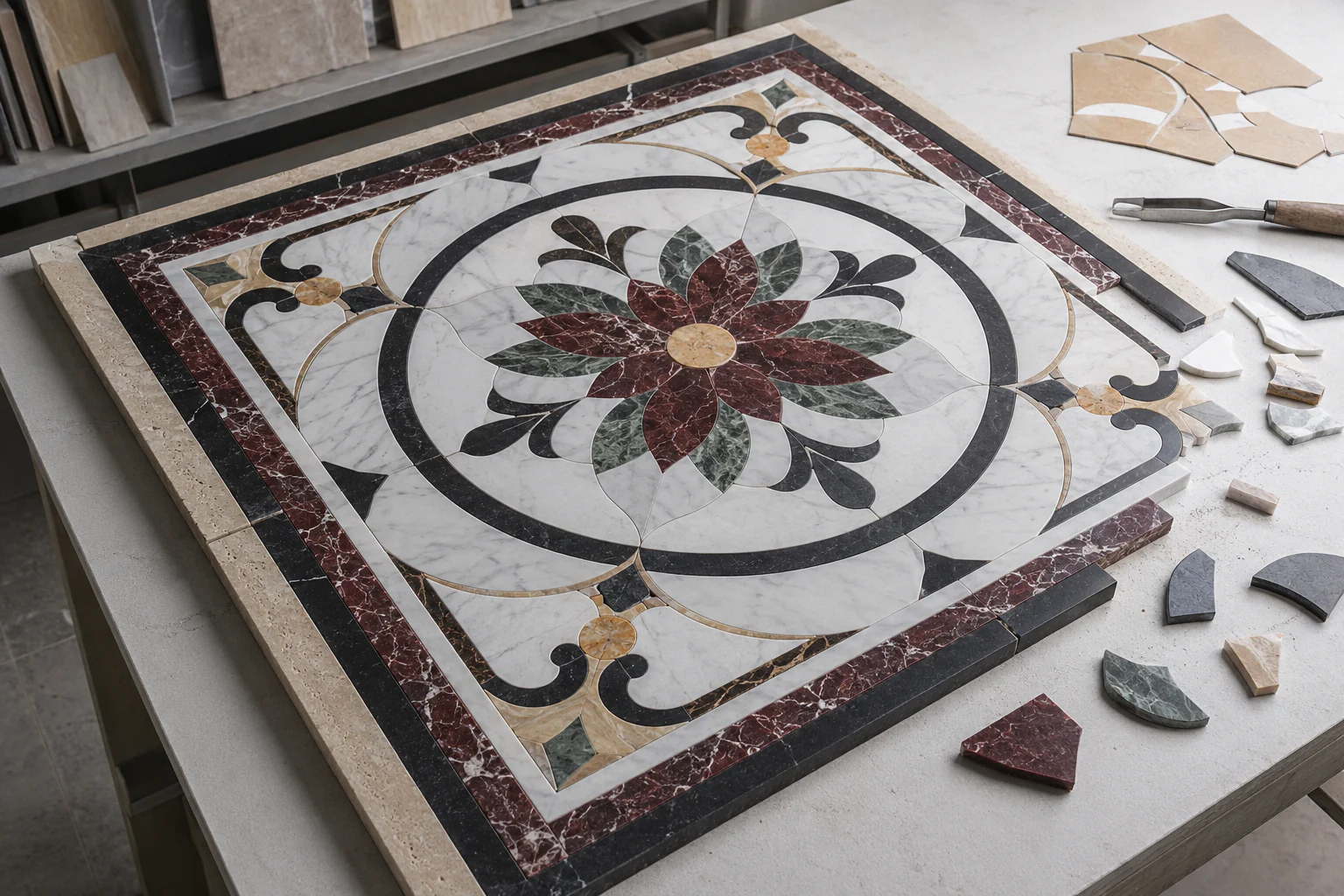
Many traditions, one principle
Tessellated mosaics, opus sectile, geometric pavements, pictorial marquetry and fine inlays all compose an image from separate pieces. Scale, joint and colour relationships are as important as the individual stones.
Historic terminology varies by period and country. Define the actual geometry, materials and assembly rather than relying on a style name alone.
Building the material palette
Select stones for colour, grain, translucency, cutting response and compatible wear. Highly contrasting stones may age or polish differently.
Work from current samples and enough material for repairs. Wet and dry appearances should be compared before approval.
Cutting and workshop assembly
Waterjet and CNC methods can produce complex repeated pieces; hand cutting and fitting remain essential for fine joints and artistic adjustment. Number components and retain a full-size assembly drawing.
Dry-assemble panels to verify pattern, joint width and colour distribution. Backing systems must suit the final environment.
| Method | Character | Control |
|---|---|---|
| Tesserae | Rhythmic small units | Size and joint consistency |
| Opus work sectile | Larger shaped pieces | Templates and edge fit |
| Marquetry | Fine pictorial composition | Fragile parts and colour balance |
| Inlay | Material inserted into a recess | Depth, bonding and flush finish |
| Prefabricated panel | Workshop-controlled assembly | Backing and site joints |
Installation and polishing
The substrate must be flat, stable and compatible with the chosen adhesive or mortar. Waterproofing remains independent in wet areas.
Final grinding or polishing can unify a floor but may expose lippage, soft fillers or differential wear. Agree the finishing sequence before installation.
Cleaning and repair
Mixed stones require the cleaning method of the most sensitive component. Acids can etch marble even when adjacent granite is unaffected.
Record patterns and spare materials. Local replacement is possible when pieces, colours and joint character are carefully matched.
Need advice for a real project?
Marble Import supports international homeowners, architects and interior designers with stone selection, samples, technical feasibility and coordination of high-end stonework in France and across Europe.