Practical identification
Applied Petrography: Field and Laboratory Identification Sheets
Build a repeatable field and laboratory record for natural stone, from site observations and sampling to petrographic classification and project decisions.
Start with the purpose of identification
Identification may support a new specification, diagnose deterioration, match a historic stone or investigate a supply dispute. The record should state the question before collecting data.
Do not infer an exact quarry from appearance alone. Separate observations, test results and interpretations.
Field identification sheet
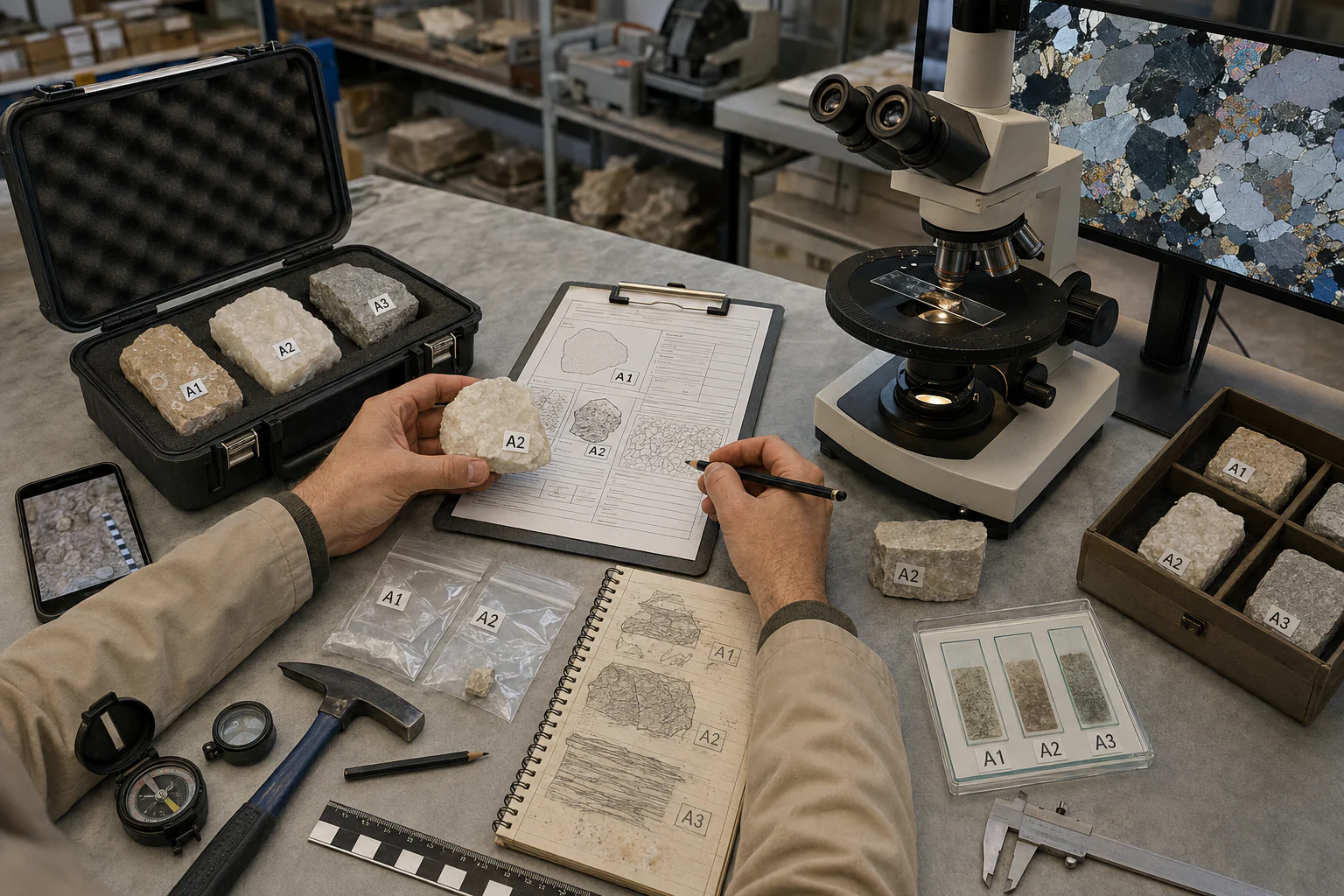
Record location, element, orientation, dimensions, finish, exposure, moisture, staining, cracks, previous repairs and surrounding materials. Photograph overall context and close details with a scale and reference number.
Describe colour on clean dry and fresh surfaces where permitted. Note bedding, veins, fossils, pores and any metallic or clay-rich features.
| Field | Minimum information |
|---|---|
| Sample reference | Unique code linked to drawings and photographs |
| Location | Building, level, elevation and exact element |
| Condition | Sound, cracked, scaled, stained, damp or repaired |
| Fabric | Grain, bedding, veins, fossils and pores |
| Exposure | Interior, exterior, wetting, salts, frost and pollutants |
| Sampling | Method, orientation, depth and permissions |
Laboratory identification sheet
Record specimen preparation, macroscopic description, mineral composition, texture, pore types, microcracks, alteration and classification. State methods and limits.
If physical tests are performed, link every result to the sample orientation and conditioning. Avoid combining values from unrelated sources as if they described one material.
Chain of custody and traceability
Seal and label samples, keep a register of transfers and retain offcuts where possible. For heritage or dispute work, an auditable chain prevents confusion between similar specimens.
Digital files should use the same codes as bags, slides, photographs, drawings and reports.
Turning observations into decisions
Conclude at the level supported by evidence: geological family, probable source region, compatibility or need for further testing. State uncertainty explicitly.
Use the record to guide selection, repair mortar, cleaning trials, replacement stone or engineering assessment. Identification is the foundation of the decision, not the decision itself.
Need advice for a real project?
Marble Import supports international homeowners, architects and interior designers with stone selection, samples, technical feasibility and coordination of high-end stonework in France and across Europe.