Furniture and product design
Marble Furniture, Objects and Decorative Pieces
Create marble tables, furniture and decorative objects by coordinating stone selection, weight, supports, edges, joints, fabrication and everyday care.
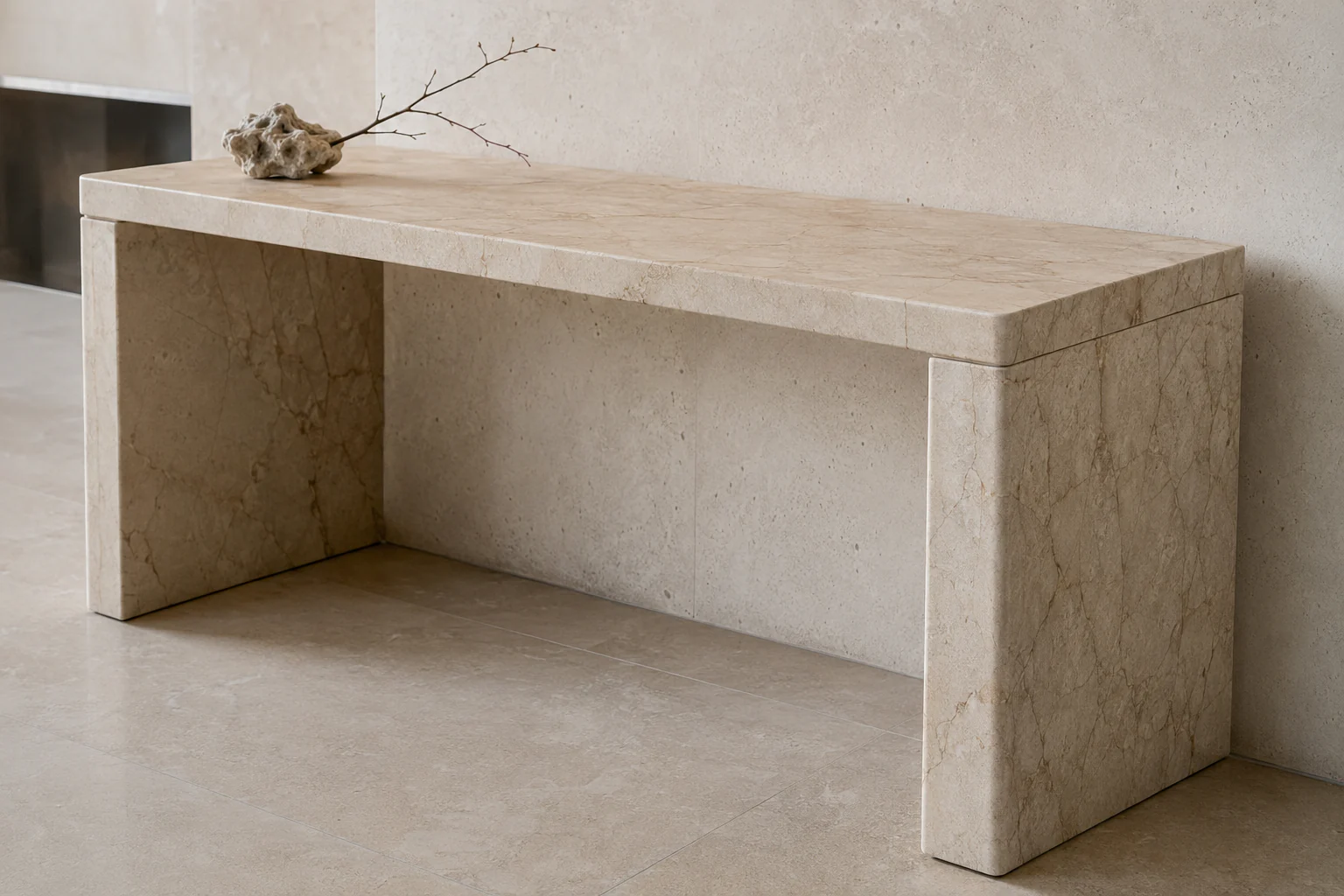
Stone behaves differently from timber
Stone is strong in compression but vulnerable to bending, impact and concentrated support. A tabletop must be designed for its span, thickness, cut-outs, vein direction and base geometry.
Weight affects delivery, floor loading, movement and future maintenance. Resolve access before fabrication.
Selecting slabs and composing the object
Current slabs determine the visual character of a table or cabinet. Place expressive veins deliberately and keep weak features away from narrow sections or unsupported corners.
Book-matching, mitred edges and wrapped veins require numbered layouts and accurate finished dimensions.
Bases, fixings and interfaces
Metal, timber and stone move differently. Provide broad stable bearings, discreet movement allowance and corrosion-resistant fixings.
Adhesive alone should not carry a heavy component where failure could cause injury. Design mechanical restraint where required.
| Object | Main risk | Design response |
|---|---|---|
| Dining table | Long span and movement | Suitable thickness, support and handling |
| Console | Overturning and wall interface | Anchorage and stable base |
| Coffee table | Edge impact | Robust profile and protected corners |
| Shelving | Bending and point support | Limited span and continuous bearings |
| Decorative vessel | Thin walls and water | Sound stone and controlled fabrication |
Edges and fabrication
A fine edge can look elegant but leaves less material around veins and cut-outs. Mitred returns create visual thickness yet require precise bonding and internal support.
Approve profiles at full scale and inspect the first piece for finish, flatness and joint visibility.
Use, care and repair
Explain acid etching, oil, heat and patina according to the stone and finish. Sealers reduce absorption but do not make marble acid-proof.
Keep offcuts for future repairs. Many chips and dull areas can be professionally repaired or refinished when the original geometry is documented.
Need advice for a real project?
Marble Import supports international homeowners, architects and interior designers with stone selection, samples, technical feasibility and coordination of high-end stonework in France and across Europe.