
Project Planning and Decisions
Natural-Stone Quotations, Pricing, Warranties and Commercial Limitations
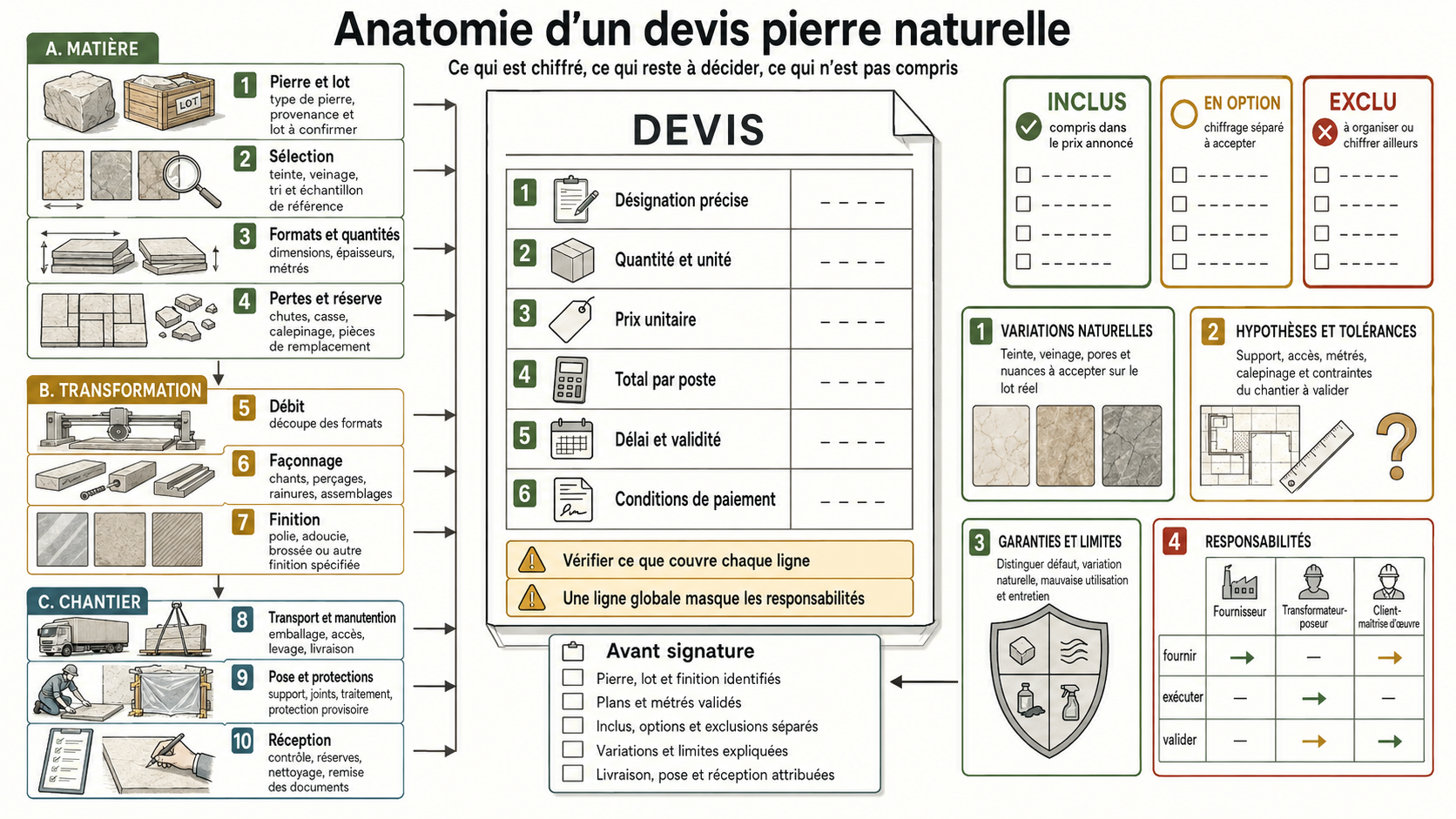
A reliable natural-stone quotation defines the material, quantities, wastage, tolerances, delivery, installation, maintenance, natural variation, warranties and limits of use.


What this guide helps you resolve
A quotation is both a technical and commercial document. For natural stone, it should protect the client and supplier by making variation, limitations and responsibilities explicit.
Marble Import approaches accessibility as a decision framework linking the material, intended use, site conditions, maintenance, risk and required evidence. The aim is to clarify what must be approved before natural stone is selected, ordered, installed or maintained.
Questions to answer before making decisions
- Does the price include material, cutting, finishing, delivery and installation?
- What material allowance is included?
- Which tolerances apply?
- Who is responsible for handover?
- What is excluded?
- Which warranty applies to the intended use?
Decision table
| Situation | Primary risk | Marble Import recommendation |
|---|---|---|
| Bespoke project | Omitted services | Itemise the scope line by line |
| Natural stone | Disputed variation | Written acceptance clause |
| Installation included | Non-compliant substrate | Substrate reservation |
| Delivery | Unclear unloading responsibility | Written delivery point |
| Maintenance | Unsuitable use | Provide care and use guidance |
Common mistakes
- A lump-sum price without a defined scope.
- No reservation concerning the substrate.
- No natural-variation acceptance clause.
- Omitting delivery and handling.
- Failing to state incompatible products and uses.
The Marble Import approach
Break the project down into material, selection, formats, cutting, finishes, installation, delivery, protection, maintenance, tolerances, exclusions and handover.
The final recommendation should be expressed clearly for the client: what is feasible, what is advisable, what requires verification, which natural variations must be accepted and which matters require a qualified professional or design specialist.
Detailed technical guidance
Pricing depends on material yield, waste, edge complexity, cut-outs, breakage risk, slab layout, transport, handling and the required finish.
General guidance must be distinguished from project-specific assessment. Natural stone varies by stone family, batch, finish, thickness, substrate, environment and maintenance regime. Suitability depends on that complete combination.
Checks to document
| Check | Purpose | Useful evidence |
|---|---|---|
| Measured quantities | Pricing basis | Drawing or site survey |
| Waste allowance | Material yield | Percentage or spare quantity |
| Finishes | Cost and suitability | Written description |
| Delivery | Responsibility | Written condition |
| Handover | Disputes | Handover record or photographs |
Writing the quotation, specification or method statement
The quotation should define what is included and excluded, the indicative nature of samples, tolerances, substrate conditions, handover arrangements and maintenance limitations.
Written documents should avoid vague promises. They should identify the actual material and approved batch or range, tolerances, available tests or evidence, limits of use, exclusions and acceptance conditions.
Answers to common client questions
| Question or concern | Clear response |
|---|---|
| Why does bespoke marble cost more? | Because it includes selection, material loss, fabrication, risk, finishing and responsibility. |
| Why include reservations and qualifications? | To avoid promising a result that the substrate or intended use cannot support. |
| Does the warranty cover staining? | Not when staining results from an incompatible use or product that was clearly explained. |
Practical summary
- Define the scope.
- Record variation and tolerances.
- Include waste and spare material.
- Define delivery and handover.
- State the limits of use.
Understanding accessibility without jargon
A reliable natural-stone quotation defines the material, quantities, wastage, tolerances, delivery, installation, maintenance, natural variation, warranties and limits of use.
A reliable decision turns an aesthetic intention into verifiable information: intended use, dimensions, quantity, batch, tolerances, technical evidence, accepted limits and handover criteria. Moving from an idea to a written record prevents most misunderstandings.
This guide separates four questions. What is actually included? Which constraints affect the stone and scope? Which proposal is compatible with the complete project? How will the team demonstrate that the scope, limitations and acceptance criteria were understood? This framework prevents decisions based on price alone.
You can review a quotation before mastering every standard. Start by defining the location, use, exposure, dimensions, expected appearance and division of responsibilities. Then identify the stone and substrate, gather drawings and data sheets and list the points requiring a test, calculation or specialist opinion.
Worked project scenarios
For a bespoke project, omitted services are a major risk. Itemise selection, templating, fabrication, edges, cut-outs, delivery, handling, installation, protection and handover so that visually similar projects can be compared on the same basis.
For natural stone, disputed variation is a foreseeable risk. Define the status of samples and slab photographs, the approved batch and the range of natural characteristics accepted by the client.
Where installation is included, a non-compliant substrate can change the method, programme and price. State the assumed substrate condition, inspection process and procedure for notifying additional preparation.
For delivery, ambiguous unloading responsibility causes delay, damage and disputes. Record access constraints, lifting equipment, unloading responsibility, delivery point, inspection and storage conditions.
A structured decision method
The method below turns quotation questions into decisions that can be checked. Link every answer to a drawing, survey, sample, technical document or written assumption. Missing information must be recorded as a point to confirm before ordering or work begins.
| Question to resolve | How to assess it | Simple evidence to retain |
|---|---|---|
| Does the price include material, cutting, finishing, delivery and installation? | Measured quantities: pricing basis | Drawing or site survey |
| What material allowance is included? | Waste: material yield | Percentage or spare quantity |
| Which tolerances apply? | Finishes: cost and suitability | Written description |
| Who is responsible for handover? | Delivery: responsibility | Written condition |
| What is excluded? | Handover: dispute prevention | Handover record or photographs |
| Which warranty applies to the intended use? | Measured quantities: pricing basis | Drawing or site survey |
Useful terminology
The following vocabulary helps clients, suppliers, installers and designers define scope, cost, acceptance and responsibility precisely without allowing commercial terminology to obscure technical limitations.
| Term | Plain-English definition |
|---|---|
| Measurement or bill quantity | A term whose exact contractual meaning must be defined in the quotation and project documents rather than assumed. |
| Tolerance | A term whose exact contractual meaning must be defined in the quotation and project documents rather than assumed. |
| Spare material | A defect or outstanding item recorded at handover that must be addressed and formally closed. |
| Warranty | A term whose exact contractual meaning must be defined in the quotation and project documents rather than assumed. |
| Exclusion | A term whose exact contractual meaning must be defined in the quotation and project documents rather than assumed. |
| Additional charge | A term whose exact contractual meaning must be defined in the quotation and project documents rather than assumed. |
| Material allowance | A term whose exact contractual meaning must be defined in the quotation and project documents rather than assumed. |
From selection to handover: who checks what?
The client defines the intended use, appearance priorities, budget and acceptable maintenance. The designer converts these expectations into measurable criteria. The supplier identifies the stone, batch and available performance data. The contractor verifies the substrate and installation conditions. At handover, the work is compared with the approved sample, layout and stated tolerances.
These responsibilities require information to circulate before the order. Acceptance of natural variation, reservations concerning the substrate and maintenance limitations are meaningful only when explained and retained in the written commercial and technical record.
| Project stage | Essential question | Expected outcome |
|---|---|---|
| Concept design | Does the quotation reflect the intended use, complete scope and allocation of risk? | Requirements described without ambiguity |
| Stone selection | Have the stone family, batch, finish and available performance data been identified? | Sample and data sheet linked to the project |
| Preparation | Have the substrate, products, water exposure, joints and details been coordinated? | Written method and hold points |
| Installation | Do the actual site conditions remain consistent with what was approved? | Quality checks and photographs |
| Handover | Are the appearance, geometry, function and maintenance requirements understood? | Snagging resolved and maintenance information provided |
Common questions
| Question | Explanation |
|---|---|
| Why avoid a lump-sum price without a defined scope? | Because it prevents meaningful comparison and leaves essential services open to interpretation. Confirm quantities and itemise inclusions, options and exclusions. |
| Why record assumptions about the substrate? | Because an unseen or non-compliant substrate can change preparation, method, programme and price. Define the inspection and notification process. |
| Why include a natural-variation clause? | Because samples cannot represent an entire batch. Link acceptance to the actual material, photographs or slabs and record the agreed range. |
| Why must delivery and handling be defined? | Because access, unloading, lifting, storage and protection can materially affect cost, safety and breakage risk. |
| Why state incompatible products and maintenance limits? | Because misuse after handover can damage the stone and create avoidable disputes. Provide clear care instructions and retain acknowledgement. |
Key concepts
From the Marble Import blog
Related articles and completed projects
Marble Import Stock: a sourcing and decision platform for natural stone
Explore an additional guide, example or completed project from Marble Import.
Three Advantages of Buying Marble
Explore an additional guide, example or completed project from Marble Import.
Why Choose Marble for Your Project?
Explore an additional guide, example or completed project from Marble Import.
Continue reading
Related guides
Technical Guidance: Handover, Reservations, Insurance and Warranties for Stonework
Understand formal handover, traceable reservations, warranties and the documents that protect both client and contractor.
Technical Guidance: Understanding Regulations, Standards, NF DTU, CPT and Responsibilities
A practical framework for distinguishing regulatory obligations, product standards, installation rules, assessed systems and contractual commitments.
Natural-Stone Standards, Specifications and French CCTP Documents
Standards are useful only when linked to a defined construction. The specification should turn the material into clear requirements for stone, finish, format, installation, testing, tolerances, care and approval.
Buying Stone Batches: Natural Variation, Future Matching and Samples
Natural stone varies. The relationship between a sample, slab, block and batch—and the limits of future matching—must be explained and accepted before an order is placed.
Natural-Stone Logistics, Storage, Handling and Site Safety
Natural stone is heavy, vulnerable to incorrect support and sensitive to impact before installation. Plan delivery, packaging, storage, handling, access, inspection and protection to avoid breakage, staining, accidents and disputes.
Project Checklists for Homeowners, Architects, Installers, Stonemasons, Hotels and Designers
Role-specific checklists turn the encyclopedia into a working tool: questions to ask, documents to assemble, risks to approve and decisions to record.