Geology and materials
How Marble and Natural Stone Are Formed
Understand the geological processes that create marble, limestone, granite, quartzite, travertine, onyx, sandstone and slate—and why formation governs appearance and performance.
The rock cycle
Natural stone records repeated cycles of melting, cooling, sedimentation, burial, pressure, heat, uplift and erosion. These processes create three broad geological families: igneous, sedimentary and metamorphic rocks.
Commercial names sometimes blur these boundaries. A project should therefore combine the accepted trade name with a geological description and material-specific performance information.
Sedimentary stones
Limestone forms mainly from carbonate sediments, shells and chemical precipitation. Bedding, fossils, stylolites and pores reflect the environment in which it formed. Travertinee precipitates around mineral springs and commonly contains directional cavities.
Sandstone is made from cemented grains, often quartz. Its performance depends on the grains, cement, porosity and bedding orientation rather than colour alone.
Metamorphism: from limestone to marble
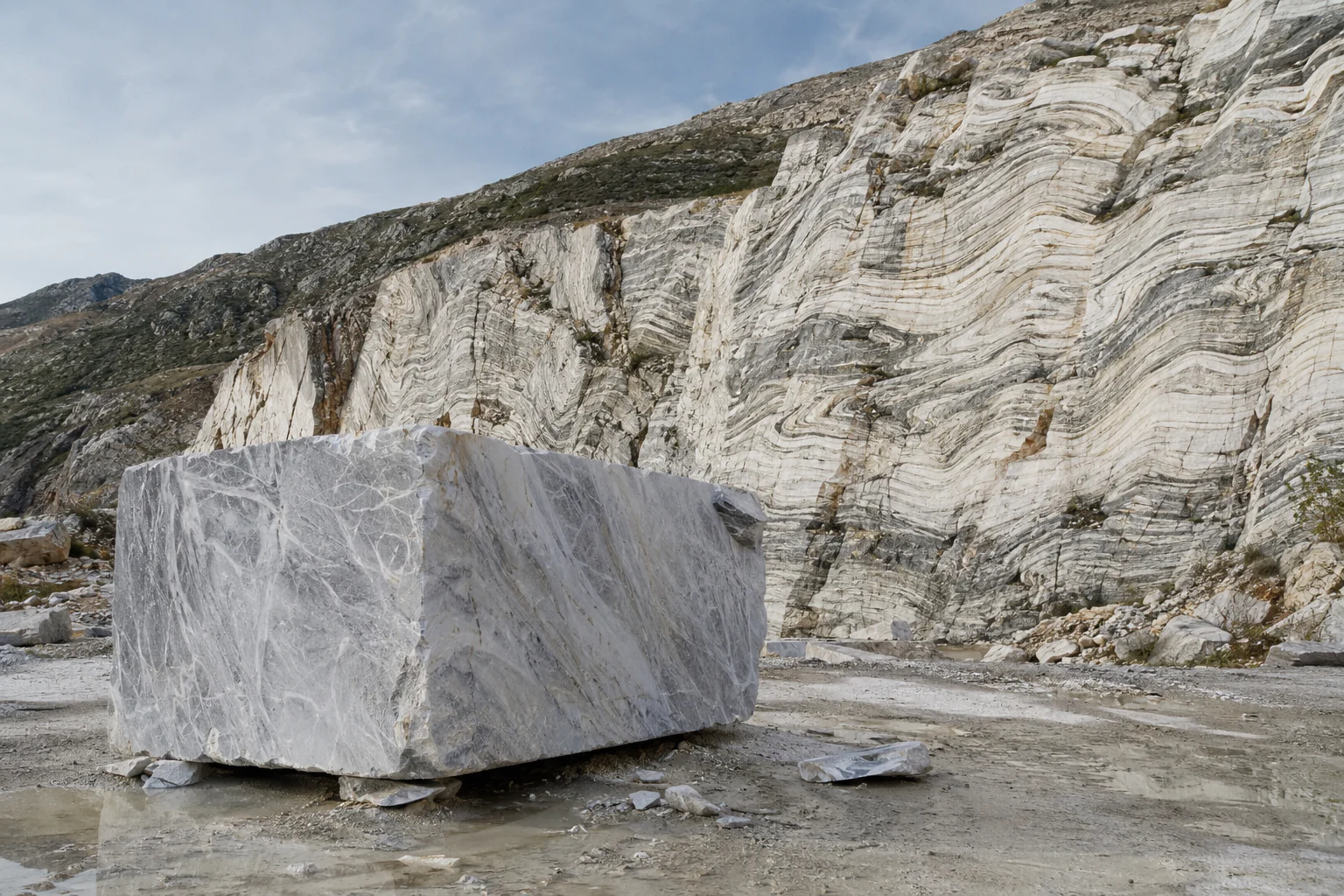
Heat and pressure recrystallise limestone or dolostone into marble. The calcite or dolomite crystals grow and the original fabric may be transformed, while impurities create veins, clouds and colour.
Folding, fracturing and mineral circulation can produce dramatic veining and brecciation. These features are part of the stone identity, but their soundness and orientation must be assessed for the intended detail.
| Stone family | Formation | Typical features |
|---|---|---|
| Marble | Metamorphosed limestone or dolostone | Crystalline texture, veins and polish |
| Quartzite | Metamorphosed quartz-rich sandstone | High quartz content and hardness |
| Slate | Low-grade metamorphism of fine sediments | Cleavage and thin splitting |
| Gneiss | High-grade metamorphism | Mineral banding and directional fabric |
Igneous stones
Granitee and related rocks crystallise slowly at depth, producing visible interlocking minerals. Basalt and other volcanic rocks cool more rapidly at or near the surface and generally have a finer texture.
The word granite is used broadly in the stone trade. Mineralogy, alteration, fissures, grain size and test data are needed to understand the actual material.
From geology to specification
Formation influences absorption, strength, abrasion, acid sensitivity, frost response, cutting direction and finish. No geological family is universally suitable or unsuitable.
Identify the exact stone and quarry batch, then connect its characteristics to location, exposure, thickness, format, fixing and maintenance. Representative samples and declared tests complete the geological reading.
Need advice for a real project?
Marble Import supports international homeowners, architects and interior designers with stone selection, samples, technical feasibility and coordination of high-end stonework in France and across Europe.