Sourcing and provenance
Marble Geography, Quarries and Stone Names
Understand how geology, quarry basins, trade traditions and changing commercial names shape the identity and traceability of marble and natural stone.
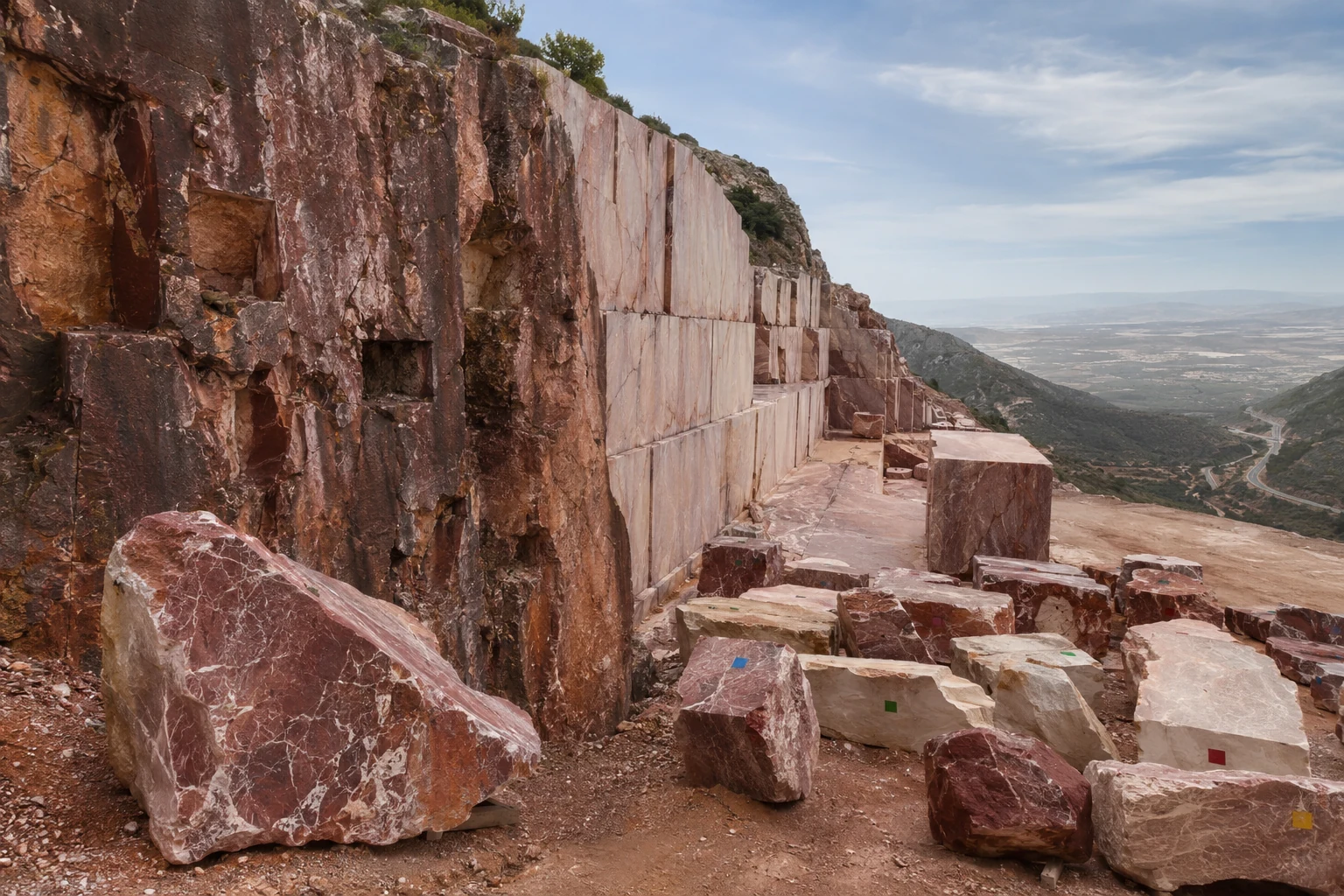
A name can describe several realities
A stone name may refer to a quarry, village, geological basin, colour, historic monument or distributor brand. The same material can travel under several names, while one familiar name may cover different beds or sources.
International documentation should therefore connect the trade name with geological family, quarry or region, supplier and approved batch.
Major European quarry regions
Italy remains closely associated with Carrara whites, coloured marbles, travertines and a dense fabrication network. Greece supplies luminous white and coloured marbles; Spain and Portugal offer limestones, granites and expressive coloured stones.
France has diverse limestone and marble traditions, from Burgundy and the Paris Basin to Provence and the Pyrenees. Regional stone is inseparable from local construction and heritage.
A global stone market
Turkey, India, Brazil, China and many other countries supply major international ranges. New quarry faces and marketing names regularly enter the market. Country of origin alone is not a performance classification.
Evaluate the specific material and supply chain: quarry continuity, block size, processing quality, documentation, transport and replacement potential.
| Information | Why it matters | How to record it |
|---|---|---|
| Commercial name | Communication and market recognition | Use consistently with supplier reference |
| Geological family | Material behaviour | Petrographic description |
| Quarry or basin | Traceability and future matching | Location and operator |
| Batch or block | Current appearance | Slab numbers and photographs |
| Processing location | Quality and logistics | Fabricator and finish reference |
Protected names and misleading certainty
Most commercial stone names are not protected geographical designations. A prestigious name should not be presented as proof of exact origin unless documentation supports the claim.
For restoration, a visual resemblance is not enough. Petrographic, physical and weathering compatibility may be more important than repeating the historic name.
A robust provenance record
Keep supplier declarations, current samples, slab photographs, test documents, cutting orientation and delivery references. State clearly when origin is a quarry, a basin or only a trade convention.
This record supports honest client communication, responsible sourcing and more reliable future additions or repairs.
Need advice for a real project?
Marble Import supports international homeowners, architects and interior designers with stone selection, samples, technical feasibility and coordination of high-end stonework in France and across Europe.