Project Planning and Decisions
Buying Stone Batches: Natural Variation, Future Matching and Samples
Natural stone varies. The relationship between a sample, slab, block and batch—and the limits of future matching—must be explained and accepted before an order is placed.
What this guide helps you resolve
Natural stone is not a printed product. Two slabs sold under the same name may differ according to the block, quarry bed, extraction period, finish and commercial selection.
Marble Import approaches accessibility as a decision framework linking the material, intended use, site conditions, maintenance, risk and required evidence. The aim is to clarify what must be approved before natural stone is selected, ordered, installed or maintained.
Questions to answer before making decisions
- Is the sample contractually binding?
- Has the batch been reserved?
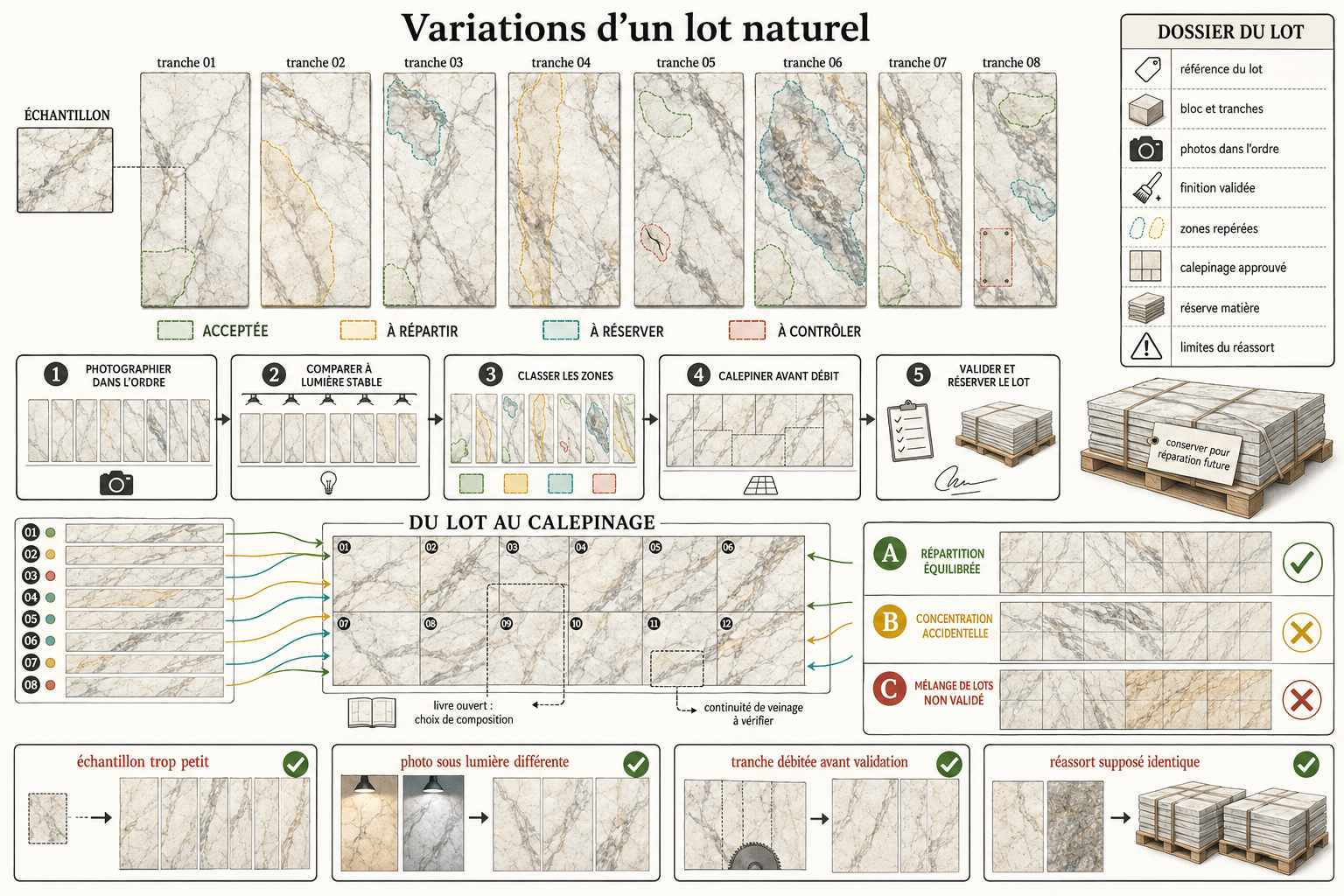
- Have the actual slabs been photographed?
- Has the client accepted the natural variation?
- Should spare material be included?
- Will future matching be possible?
Decision table
| Situation | Primary risk | Marble Import recommendation |
|---|---|---|
| Small sample | False impression of uniformity | Explain its limitations |
| Large floor | Visible variation | Batch photographs and considered blending |
| Bookmatching | Actual slabs are essential | Reserve and approve the slabs |
| Future matching | Original batch no longer available | Order spare material |
| Strongly veined stone | Uncontrolled visual result | Approve the stone layout |
Common mistakes
- Presenting a sample as a complete representation of the stone.
- Failing to reserve the approved batch.
- Omitting the cutting and selection allowance.
- Mixing batches without approval.
- Promising an identical future match.
The Marble Import approach
Show the range of variation, approve the actual batch, record what has been accepted, include spare material and plan the slab layout before cutting.
The final recommendation should be expressed clearly for the client: what is feasible, what is advisable, what requires verification, which natural variations must be accepted and which matters require a qualified professional or design specialist.
Detailed technical guidance
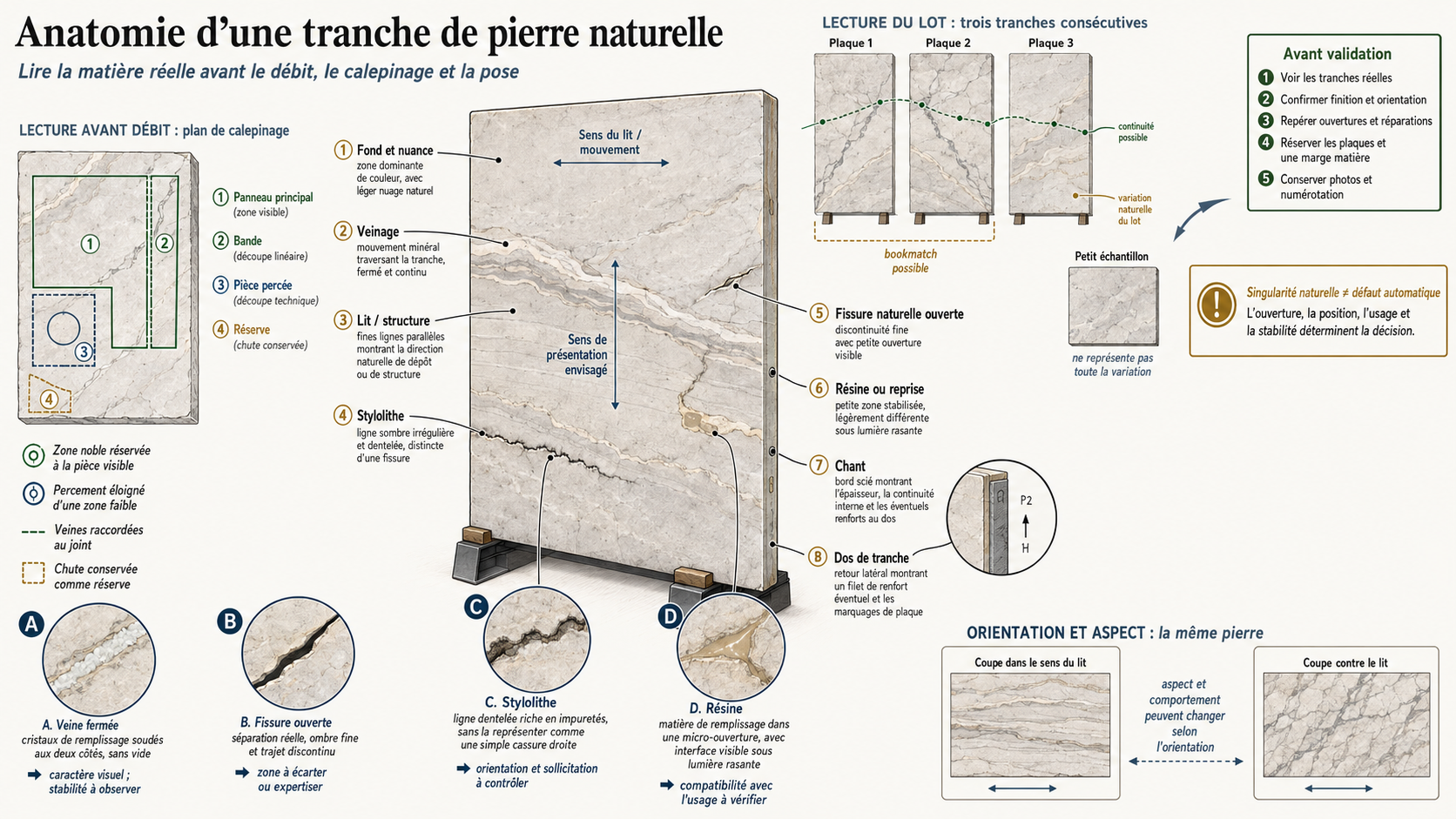
Variation may affect colour, veining, fossils, clouding, natural repairs, background tone, polish intensity or filling. It can be a defining asset when anticipated and a disappointment when left uncontrolled.
General guidance must be distinguished from project-specific assessment. Natural stone varies by stone family, batch, finish, thickness, substrate, environment and maintenance regime. Suitability depends on that complete combination.
Checks to document
| Check | Purpose | Useful evidence |
|---|---|---|
| Sample | Basis for discussion | Dated photograph |
| Batch | Actual material | Reservation confirmation |
| Slabs | Final appearance | Visual approval |
| Spare material | Offcuts and future maintenance | Defined quantity |
| Future matching | Future availability | Written limitation |
Writing the quotation, specification or method statement
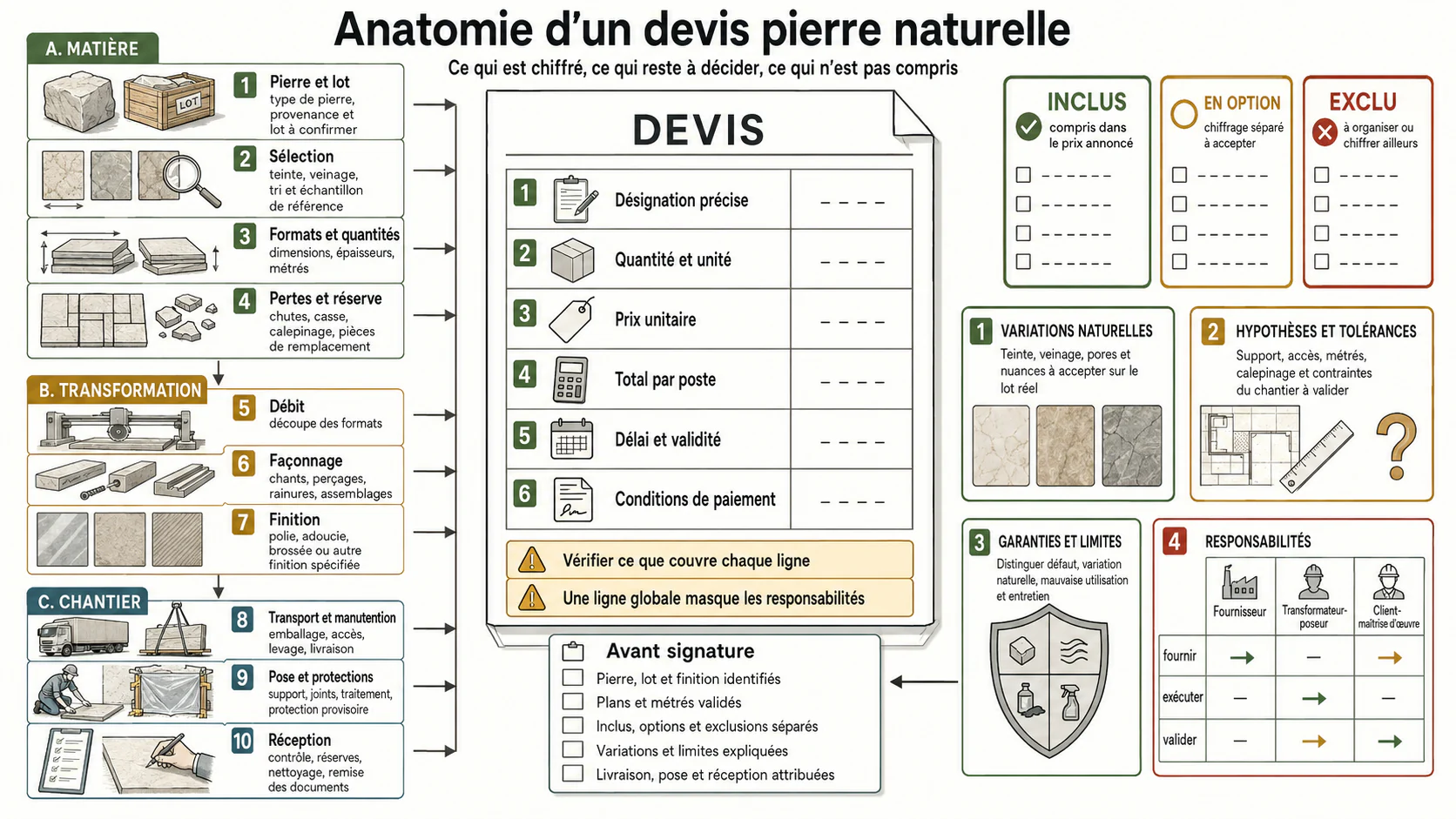
The quotation should distinguish between an indicative sample and an approved reserved batch, and should define slab photographs, accepted variation, cutting allowance, spare material and the limits of future matching.
Written documents should avoid vague promises. They should identify the actual material and approved batch or range, tolerances, available tests or evidence, limits of use, exclusions and acceptance conditions.
Answers to common client questions
| Question or concern | Clear response |
|---|---|
| Why does the delivered stone differ from the sample? | Because a sample shows only a very small part of a naturally variable material. |
| Can the colour be matched exactly? | The closest control is achieved within the same reserved batch, but natural variation will still remain. |
| Why order spare material? | To cover cutting, breakage, selection and future repairs when the same batch may no longer be available. |
Practical summary
- Explain natural variation.
- Approve the actual batch.
- Reserve the approved slabs.
- Record the agreed limitations.
- Plan spare material and the slab layout.
Understanding accessibility without jargon
Natural stone varies. The relationship between a sample, slab, block and batch—and the limits of future matching—must be explained and accepted before an order is placed.
A reliable decision turns an aesthetic intention into verifiable information: intended use, dimensions, quantity, batch, tolerances, technical evidence, accepted limits and handover criteria. Moving from an idea to a written record prevents most misunderstandings.
This guide separates four questions. What is actually visible in the batch? Which project constraints affect the stone? Which selection and layout are compatible with the complete project? How will the team demonstrate that the decision was understood and correctly implemented? This framework prevents choices based on a single sample or sales claim.
You can make progress before mastering every technical standard. Start by describing the setting, intended use, moisture, traffic, exposure and desired appearance. Then identify the stone and available batch, assemble the relevant documents and note the points requiring a test, calculation or specialist opinion. Technical choices follow the definition of the need, never the reverse.
Worked project scenarios
Consider a small sample. The risk is a false impression of uniformity. Explain that it cannot show the full batch, review representative slabs and retain a record of approval. Two visually similar projects can require different selections because their quantities and layouts differ.
Consider a large floor. Variation becomes more visible across a broad area. Review batch photographs, plan how tones and veins will be blended and approve the layout before cutting or installation.
Consider a bookmatched composition. The exact slab sequence is essential. Reserve and approve the actual slabs, orientation, joint positions and cutting plan before fabrication.
Consider a possible future extension or repair. The original batch may be exhausted, so include labelled spare material in the initial order rather than assuming an identical match will remain available.
A structured decision method
The method below turns batch-selection questions into decisions that can be checked. Link every answer to an observation or document. Missing information must be recorded as a point to confirm before ordering or fabrication, never replaced by an unspoken assumption.
| Question to resolve | How to assess it | Simple evidence to retain |
|---|---|---|
| Is the sample contractually binding? | Sample: basis for discussion | Dated photograph |
| Has the batch been reserved? | Batch: actual material | Reservation confirmation |
| Have the actual slabs been photographed? | Slabs: final appearance | Visual approval |
| Has the client accepted the natural variation? | Spare material: offcuts and future repairs | Defined quantity |
| Should spare material be included? | Future matching: availability limitations | Written limitation |
| Will future matching be possible? | Sample: basis for discussion | Dated photograph |
Useful terminology
Technical vocabulary should describe the material and approval process precisely without becoming a barrier. The following terms help clients, suppliers, installers and designers distinguish the appearance of the stone from the contractual status of the selected batch.
| Term | Plain-English definition |
|---|---|
| Batch | A defined quantity of stone selected together because it shares a traceable commercial and visual origin; the precise scope of a batch should be recorded for the project. |
| Block | A large mass extracted from the quarry and subsequently sawn into slabs. |
| Slab | A flat stone panel sawn from a quarry block. |
| Quarry bed | A defined quantity of stone selected together because it shares a traceable commercial and visual origin; the precise scope of a batch should be recorded for the project. |
| Sample | A defined quantity of stone selected together because it shares a traceable commercial and visual origin; the precise scope of a batch should be recorded for the project. |
| Future matching | A defined quantity of stone selected together because it shares a traceable commercial and visual origin; the precise scope of a batch should be recorded for the project. |
| Shade or tone | A defined quantity of stone selected together because it shares a traceable commercial and visual origin; the precise scope of a batch should be recorded for the project. |
From selection to handover: who checks what?
The client defines the intended use, appearance priorities, budget and acceptable maintenance. The designer converts these expectations into measurable criteria and coordinates the stone layout. The supplier identifies the stone, block or batch and available performance data. The fabricator and installer verify compatibility and execution conditions. At handover, the completed work is compared with the approved slabs, layout and stated tolerances.
These responsibilities do not mean that each party works in isolation. Information must circulate before the order is placed. Acceptance of natural variation, approval of a batch and any limitation concerning future matching are meaningful only when they are explained and recorded in writing.
| Project stage | Essential question | Expected outcome |
|---|---|---|
| Concept design | Have the intended use, quantity, acceptable variation and batch-selection process been defined? | Requirements described without ambiguity |
| Stone selection | Have the stone family, batch, finish and available performance data been identified? | Sample and data sheet linked to the project |
| Preparation | Have the substrate, products, water exposure, joints and details been coordinated? | Written method and hold points |
| Installation | Do the actual site conditions remain consistent with what was approved? | Quality checks and photographs |
| Handover | Are the appearance, geometry, function and maintenance requirements understood? | Snagging resolved and maintenance information provided |
Common questions
| Question | Explanation |
|---|---|
| Why must a sample not be presented as the complete truth? | Because a small sample cannot show the range present across actual slabs. Use it to begin the discussion, then approve representative material and record the limitations in writing. |
| Why reserve the approved batch? | Because approval has little value if the selected material can be sold or substituted. Link the approval to an identified quantity and reservation confirmation. |
| Why include a material allowance? | Because cutting, breakage, vein selection and the layout can all reduce usable yield. Calculate the allowance from the actual slabs and fabrication plan. |
| Why must different batches not be mixed without approval? | Because batches may differ markedly in tone, veining, finish or filling. If blending is necessary, review the materials together and approve the proposed distribution. |
| Why must an identical future match never be promised? | Because a future extraction or block can differ even when sold under the same name. Retain labelled spare material when future repairs or extensions are foreseeable. |
Key concepts
From the Marble Import blog
Related articles and completed projects
Marble Import Stock: a sourcing and decision platform for natural stone
Explore an additional guide, example or completed project from Marble Import.
Three Advantages of Buying Marble
Explore an additional guide, example or completed project from Marble Import.
Why Choose Marble for Your Project?
Explore an additional guide, example or completed project from Marble Import.
Continue reading
Related guides
Marble Quality and Selection Criteria
Selecting marble involves more than appearance: assess the batch, finish, thickness, stability, acceptable characteristics, test data, quantity and suitability for the intended use.
Marble Geography, Quarries and Trade Names
A trade name never tells the complete story. Geological origin, quarry, bed, block and batch help explain variations in colour, veining, quality, availability and performance.
Natural-Stone Colour, Veining and Light
Stone colour is not merely decorative. It reflects geology, changes with the finish and influences maintenance, spatial perception and layout decisions.
Historical Atlas of Marbles, Stones and Provenance
From ancient quarries to today’s production regions: understand deposits, extraction and trade routes, and distinguish geological origin, quarry, bed, historical name and actual batch.
Natural-Stone Quotations, Pricing, Warranties and Commercial Limitations
A reliable natural-stone quotation defines the material, quantities, wastage, tolerances, delivery, installation, maintenance, natural variation, warranties and limits of use.
Natural-Stone Data Sheets, Declarations of Performance and CE Marking
Understanding data sheets, Declarations of Performance, CE marking, tests and product standards connects appearance and intended use with supporting evidence.