Selection and quality control
How to Assess and Select Quality Marble and Natural Stone
Assess aesthetic, technical and fabrication quality together, then approve the right batch, slabs and finishes for the actual use—not simply the most attractive sample.
Quality depends on the intended use
There is no universal first-grade stone independent of context. A highly expressive marble may be ideal for a feature wall but unsuitable for a thin exterior panel. A robust granite may perform well on a worktop yet fail the visual brief.
Define location, loads, moisture, exposure, cleaning, desired finish and acceptable variation before discussing quality. The best material is the one whose known characteristics fit the project.
Three dimensions of quality
Aesthetic quality covers colour, veining, grain, pattern, finish and the way slabs relate to one another. Technical quality covers relevant performance such as strength, absorption, abrasion, slip resistance and frost durability.
Fabrication quality concerns thickness, flatness, dimensions, edges, cut-outs, reinforcement, finish consistency and repair workmanship. A project succeeds only when all three are coordinated.
| Quality dimension | Questions to ask | Evidence |
|---|---|---|
| Aesthetic | Does the batch match the approved range? | Current slabs, samples and layout |
| Technical | Is it suitable for exposure and loads? | Declarations, tests and project assessment |
| Fabrication | Can details be made reliably? | Shop drawings, prototype and inspection |
| Installation | Are substrate and fixing compatible? | Method statement and site checks |
| Maintenance | Can the client care for it realistically? | Written care plan and test area |
Natural features and genuine defects
Veins, fossils, pores, stylolites, colour movement and brecciation may be essential to a stone identity. They should not automatically be called defects. Their acceptability depends on soundness, position, finish and use.
Open cracks, loose fragments, unstable repairs, significant bowing, damaged edges or contamination require investigation. Agree acceptance language with photographs so natural variation is not confused with workmanship problems.
Resin, mesh and reinforcement
Many marbles and exotic stones are resin-treated, filled or mesh-backed to improve processing and surface cohesion. This is not automatically a sign of poor quality; it may be a normal part of making the material usable.
Check resin colour, ultraviolet exposure, heat, moisture, adhesive compatibility and the appearance of filled areas after finishing. Reinforcement must not conceal a slab that is unsuitable for the proposed detail.
Slab inspection and layout approval
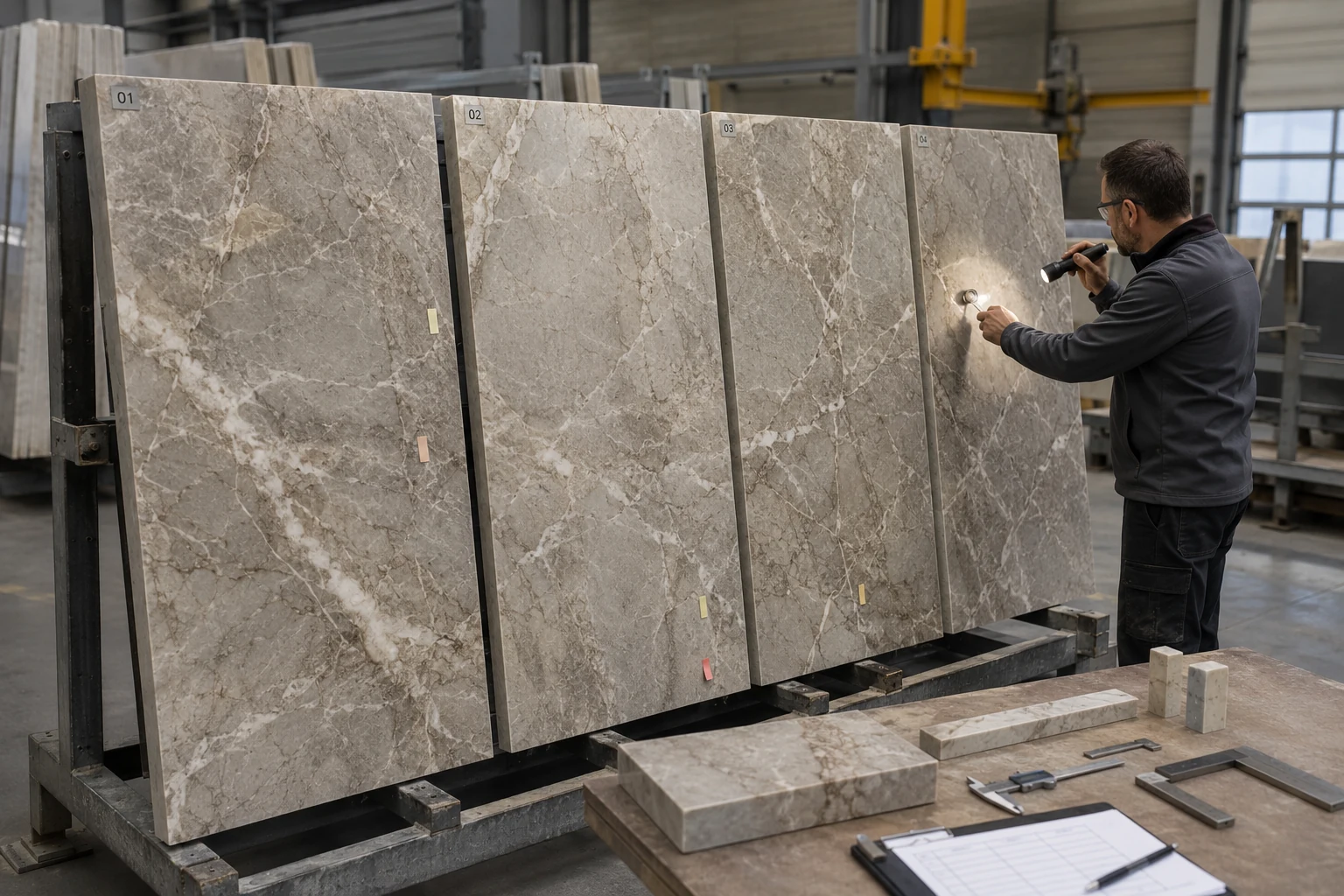
Inspect slabs dry, clean and under neutral light. Record overall views and close-ups, dimensions, slab numbers and sequence. Mark unacceptable areas and identify where strong features should be placed.
For book-matched walls, long worktops and patterned floors, approve a digital or physical layout before cutting. A sample cannot replace approval of the batch when visual continuity is critical.
Finish and edge quality
Polishedshed, honed, brushed and textured finishes reveal different characteristics and require different tolerances. Compare sheen and texture across pieces after they are fully dry.
Edges, mitres, sink cut-outs and narrow strips concentrate risk. Verify minimum residual thickness, reinforcement, corner radii and handling method before fabrication.
Testing without misusing numbers
Test results are meaningful only when the method, specimen orientation, declared range and intended use are understood. A single compressive-strength figure does not validate a façade fixing or a wet-area floor.
Select tests that answer project questions. Combine documents with petrographic understanding, supplier experience, representative samples and professional design.
A practical acceptance process
Write the visual range, permitted natural features, repair policy, finish reference and dimensional tolerances into the order. Approve one representative panel or first-off piece when repetition matters.
Inspect at key stages: batch selection, cutting layout, workshop fabrication, delivery and finished installation. Record decisions so that every party judges the work against the same evidence.
Need advice for a real project?
Marble Import supports international homeowners, architects and interior designers with stone selection, samples, technical feasibility and coordination of high-end stonework in France and across Europe.