Materials and interior design
Natural-Stone Colour, Veining and Light
Choose marble and natural stone by understanding how geology, batch variation, finish, slab layout and changing light transform colour and veining in a real interior.
Colour begins with geology
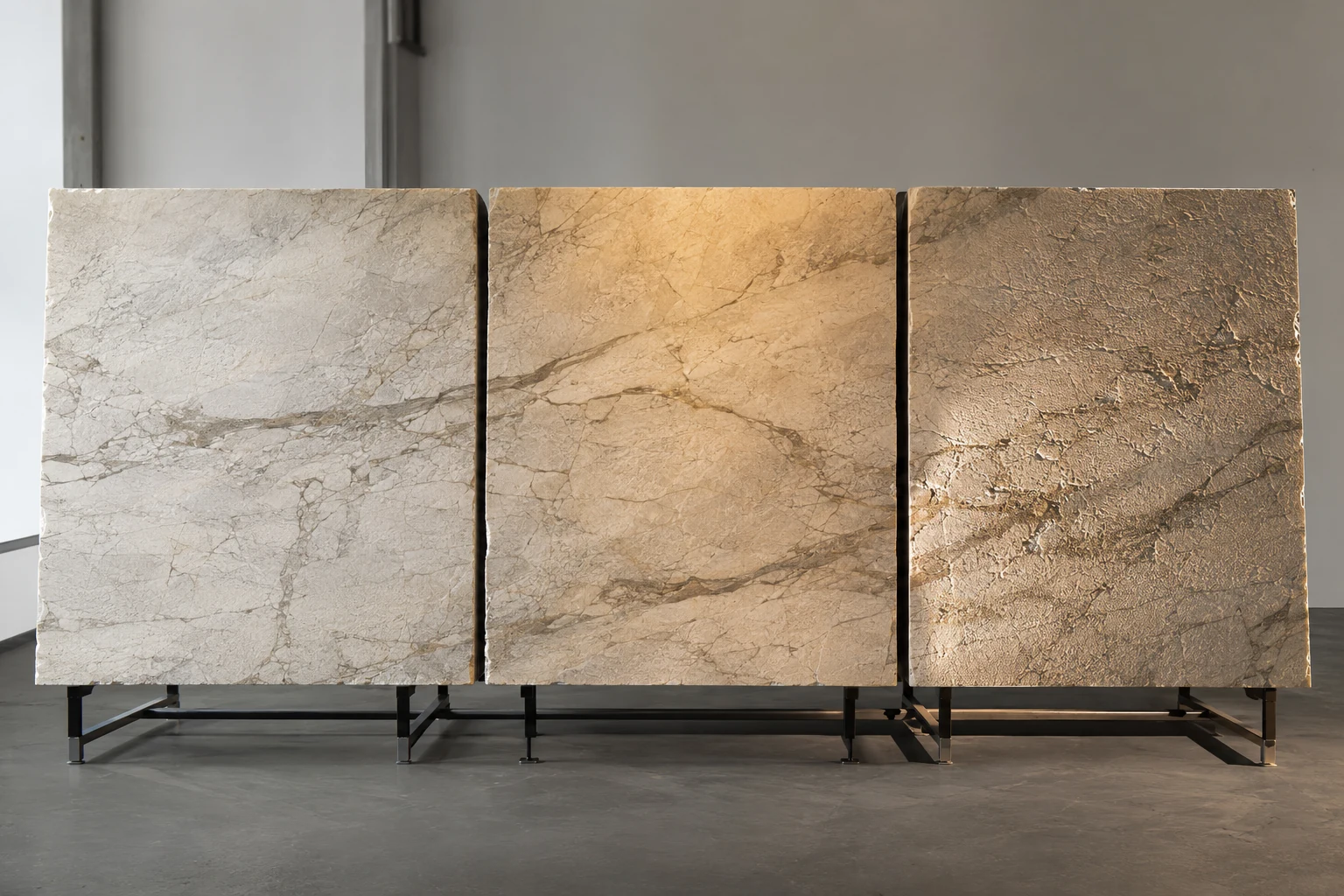
Stone colour comes from mineral composition and geological history. Pure calcite tends towards white; iron can create yellows and reds; carbonaceous matter deepens greys and blacks; silicates and serpentine minerals introduce greens and complex patterns.
Colour is never only a catalogue label. Grain, fossils, clasts, pores, veins and microcracks determine how the eye reads a surface and how the material responds to cutting and finishing.
Veins are structure as well as drawing
Veins may record mineral infill, deformation, stylolites or brecciation. Some are sound and integral; others contain open fissures, weak material or resin. Their appearance must be considered alongside mechanical behaviour.
The cutting direction changes the picture. Vein-cut slabs can show long linear movement, while cross-cut faces may reveal clouds, fragments or concentric forms. The approved sample should therefore state cutting orientation.
| Visual feature | Design opportunity | Point to verify |
|---|---|---|
| Fine linear veining | Calm continuity across panels | Cutting direction and slab sequence |
| Bold diagonal veins | Strong focal point or book-match | Weak planes and joint locations |
| Brecciation | Pictorial depth and variation | Resin, voids and edge integrity |
| Fossils or shells | Material history and texture | Scale, finish and intended use |
| Translucency | Backlit or luminous effects | Thickness, support and heat source |
Natural variation and the batch
A sample communicates a family of appearance, not an exact promise for every slab. The selected batch may be warmer, cooler, quieter or more strongly veined. For important areas, review current slab photographs or inspect the material in person.
Define acceptable variation before fabrication. Separate true defects from natural features, and decide whether strong slabs should become focal points, be distributed evenly or be reserved for secondary areas.
Finish changes colour
Polishedshing usually deepens colour and increases contrast. Honing softens reflections and often makes a stone appear lighter. Brushed, sandblasted or flamed finishes scatter light and reveal texture, but can retain dirt differently.
Compare finishes on the actual stone, not on generic photographs. Sealer, wax, water and cleaning products can also temporarily or permanently alter tone, especially on porous limestone and honed dark stone.
Daylight is never fixed
North light is often cooler and more even; direct sun is warmer and reveals relief. Morning and evening light shift colour, while a stone beside a large window may read differently at each end of the room.
Evaluate full slabs vertically and horizontally where possible. A small sample held under showroom lighting cannot predict a large surface viewed in grazing daylight.
Artificial light and colour rendering
Warm light can enrich cream, red and brown stone, while cool light may emphasise blue-grey notes. Colour-rendering quality matters: poor light can flatten subtle mineral differences and make whites look dull or green.
Use lighting mock-ups for luxury projects. Coordinate source temperature, beam angle, glare and dimming with the finish. Polishedshed stone can reflect bright points; honed stone gives a quieter, broader response.
Slab layout: continuity, book-match and rhythm
Book-matching mirrors adjacent slabs, while vein matching seeks continuity across joints. Both require numbered slab photographs, accurate finished dimensions and agreement on cuts before production.
Do not force every stone into symmetry. Some materials are more convincing as a sequential geological landscape. The layout should suit the architecture, openings, furniture and principal viewpoints.
Approving colour for an international project
Use calibrated photographs as a coordination aid, but recognise that screens differ. For high-value decisions, send physical samples from the current lot and identify which aspects they represent.
Record slab numbers, finish, orientation, lighting assumptions and the approved layout. This shared visual record reduces misunderstandings between client, designer, fabricator and installer.
Need advice for a real project?
Marble Import supports international homeowners, architects and interior designers with stone selection, samples, technical feasibility and coordination of high-end stonework in France and across Europe.