Materials and selection
Natural-Stone Families: Marble, Granitee, Limestone and More
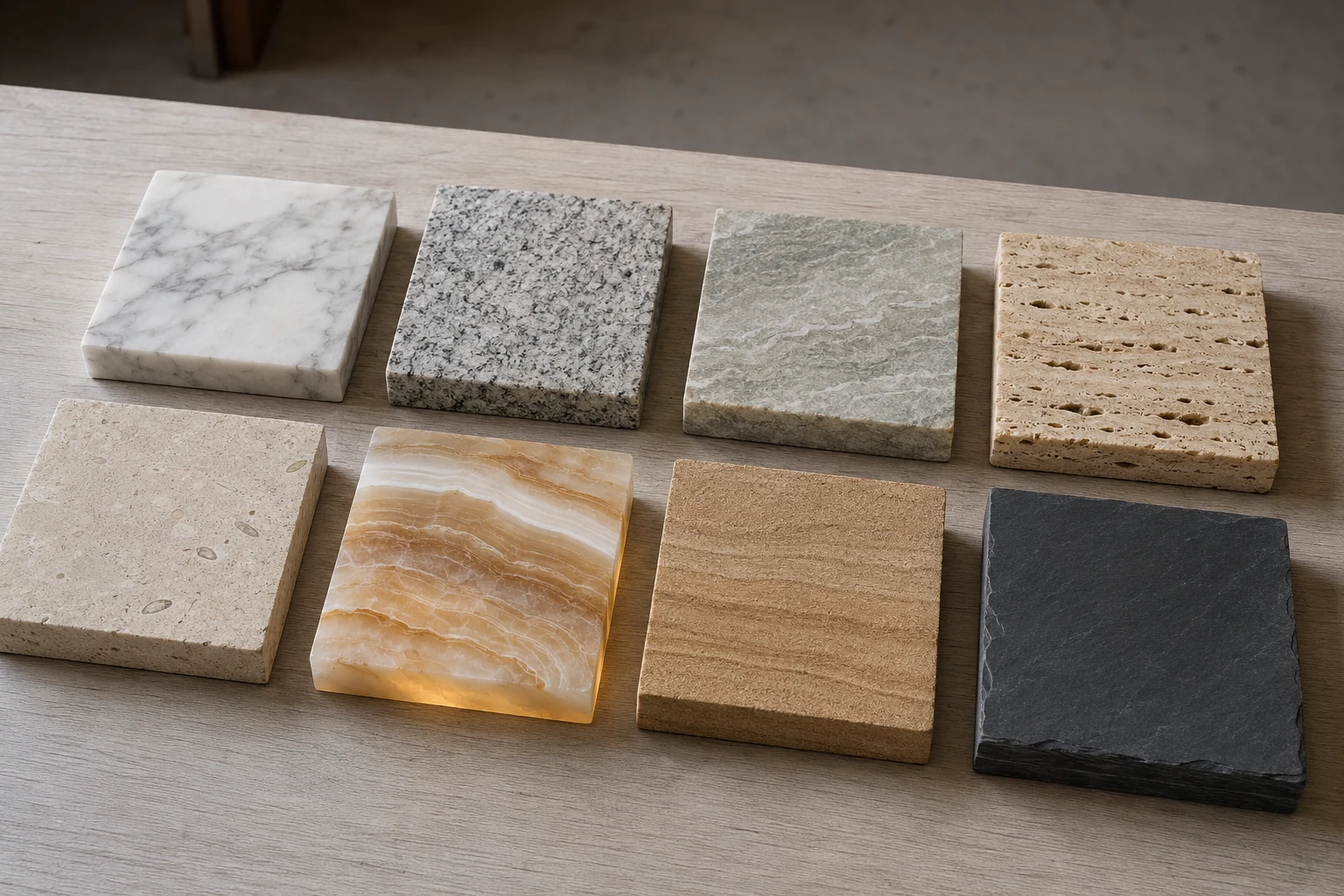
Compare the principal natural-stone families through geology, appearance, performance, finishing and typical applications.
Why the family matters
A commercial colour name cannot explain how a stone will react to acids, water, abrasion, heat or frost. Geological family provides a first framework, but variation within each family remains significant.
Use family classification to ask better questions, then confirm the precise material, quarry, finish and declared performance.
Marble and dense decorative limestone
True marble is recrystallised carbonate stone and can take a deep polish. It is valued for veining, translucency and carving, but calcite-rich surfaces can be etched by common acids.
Some dense limestones are historically sold as marbles because they polish well. They may remain sedimentary and show fossils or stylolites, so geological and commercial descriptions should both be recorded.
Granitee, gneiss and quartzite
Granitee contains interlocking minerals and is commonly selected for demanding worktops, floors and exteriors. Gneiss has a directional banded structure that can affect cutting and visual movement.
Quartzite is a metamorphosed quartz-rich stone, often hard and abrasion resistant. Materials marketed as soft quartzite may belong to a different family, making correct identification important.
| Family | Typical strength | Main vigilance |
|---|---|---|
| Marble | Carving, polish and decorative depth | Acids, veins and maintenance expectations |
| Limestone | Warm texture and architectural versatility | Porosity, frost and staining |
| Granitee | Hardness and broad exterior use | Cracks, mineral alteration and finish |
| Quartzite | Hardness and strong pattern | Fabrication difficulty and correct identification |
| Travertinee | Linear pores and distinctive character | Filling, voids and freeze–thaw exposure |
| Slate | Cleavage and low-profile texture | Splitting direction and mineral inclusions |
Travertinee, onyx, sandstone and slate
Travertinee has open or filled pores and can be vein-cut or cross-cut. Calcite onyx is translucent and decorative, but often better suited to protected interiors than heavy-use areas.
Sandstone behaviour depends on grains and cement; slate splits along cleavage planes. Both require attention to orientation, surface finish and exposure.
Choosing across families
Start with use, loads, moisture, climate, cleaning and desired appearance. Compare only stones whose verified characteristics answer those conditions.
Approve a current batch and finish rather than relying on a generic sample. The final decision should integrate design ambition, fabrication, installation and realistic long-term care.
Need advice for a real project?
Marble Import supports international homeowners, architects and interior designers with stone selection, samples, technical feasibility and coordination of high-end stonework in France and across Europe.