Marble and natural-stone restoration in Bordeaux
Grinding, honing, polishing, crystallisation, deep cleaning, finish changes and repairs for marble and natural-stone surfaces in Bordeaux, Gironde and South-West France.
Has your marble become dull or scratched? Is your travertine ingrained with dirt or developing open holes? Has an outdoor natural-stone surface lost its original appearance? Would you like to change a glossy finish to a softer matt or honed finish — or restore the polish of an older marble floor?
Marbre Import assesses and restores surfaces in marble, travertine, granite, quartzite, onyx, terrazzo and other mineral materials.
Depending on the stone and its condition, our work may include grinding, honing, polishing, crystallisation, deep cleaning, changing the finish, filling holes and cracks, repairing chips, and applying suitable water- or oil-repellent protection.
Every stone and every defect requires a specific solution. Scratched marble is not treated in the same way as dull granite, ingrained travertine or exterior stone exposed to weather and heavy use.
For that reason, a sound restoration project always begins with identifying the stone, assessing its current condition and agreeing the intended finish.
Not sure which treatment is suitable for your stone?
Send us photographs, the project location and an approximate surface area in square metres (sqm). We can carry out an initial assessment and recommend the most appropriate next step.

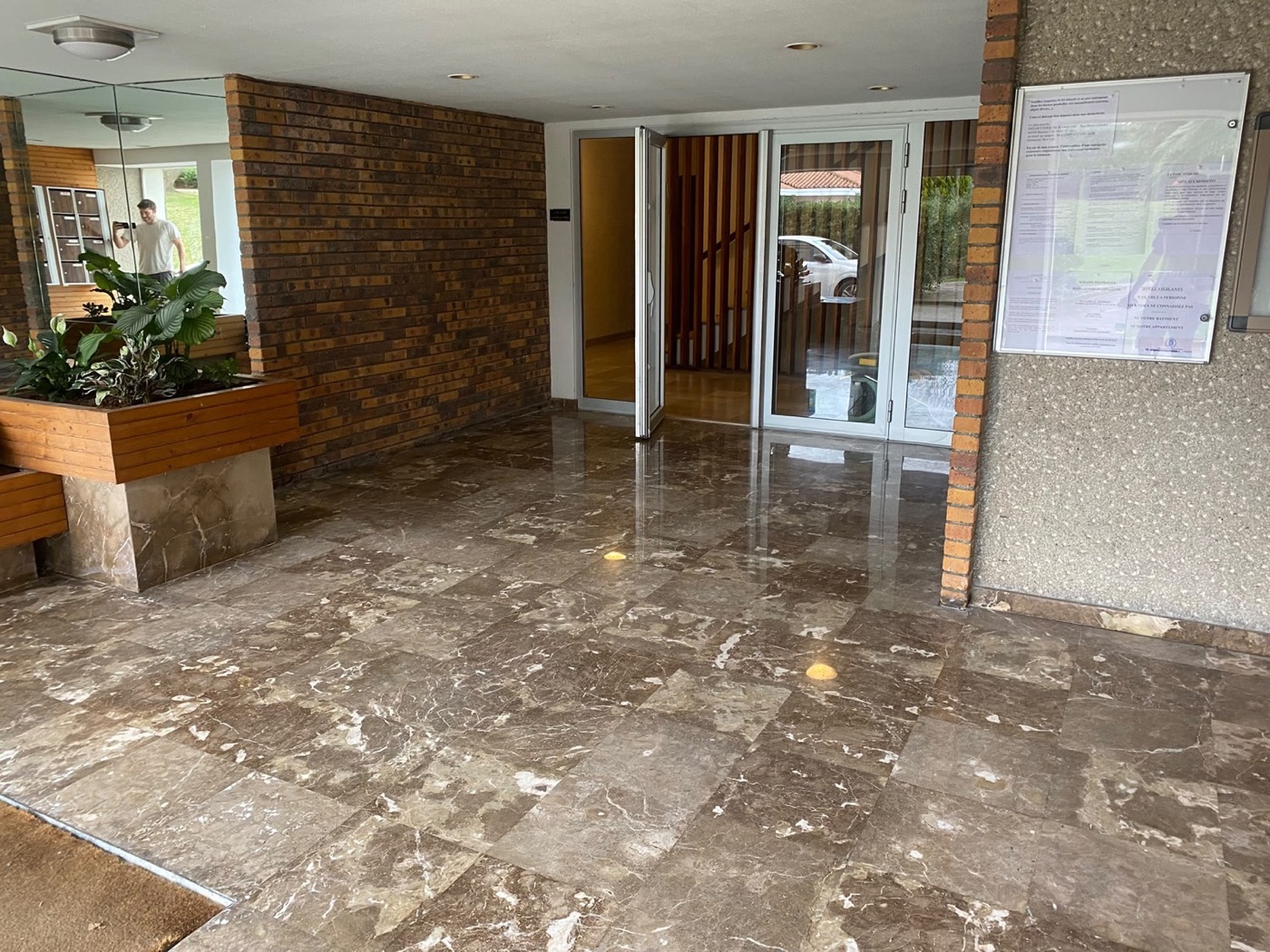
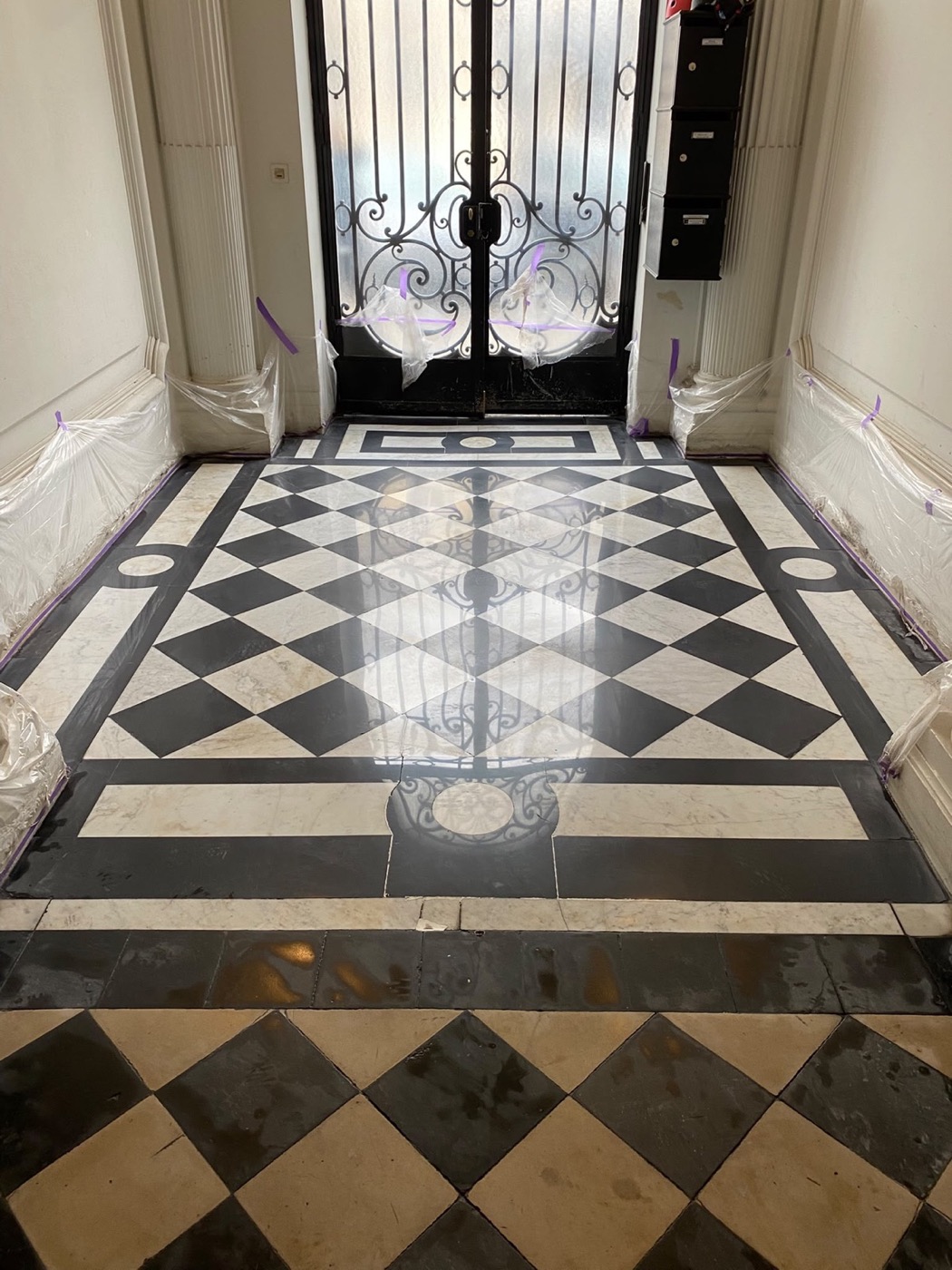
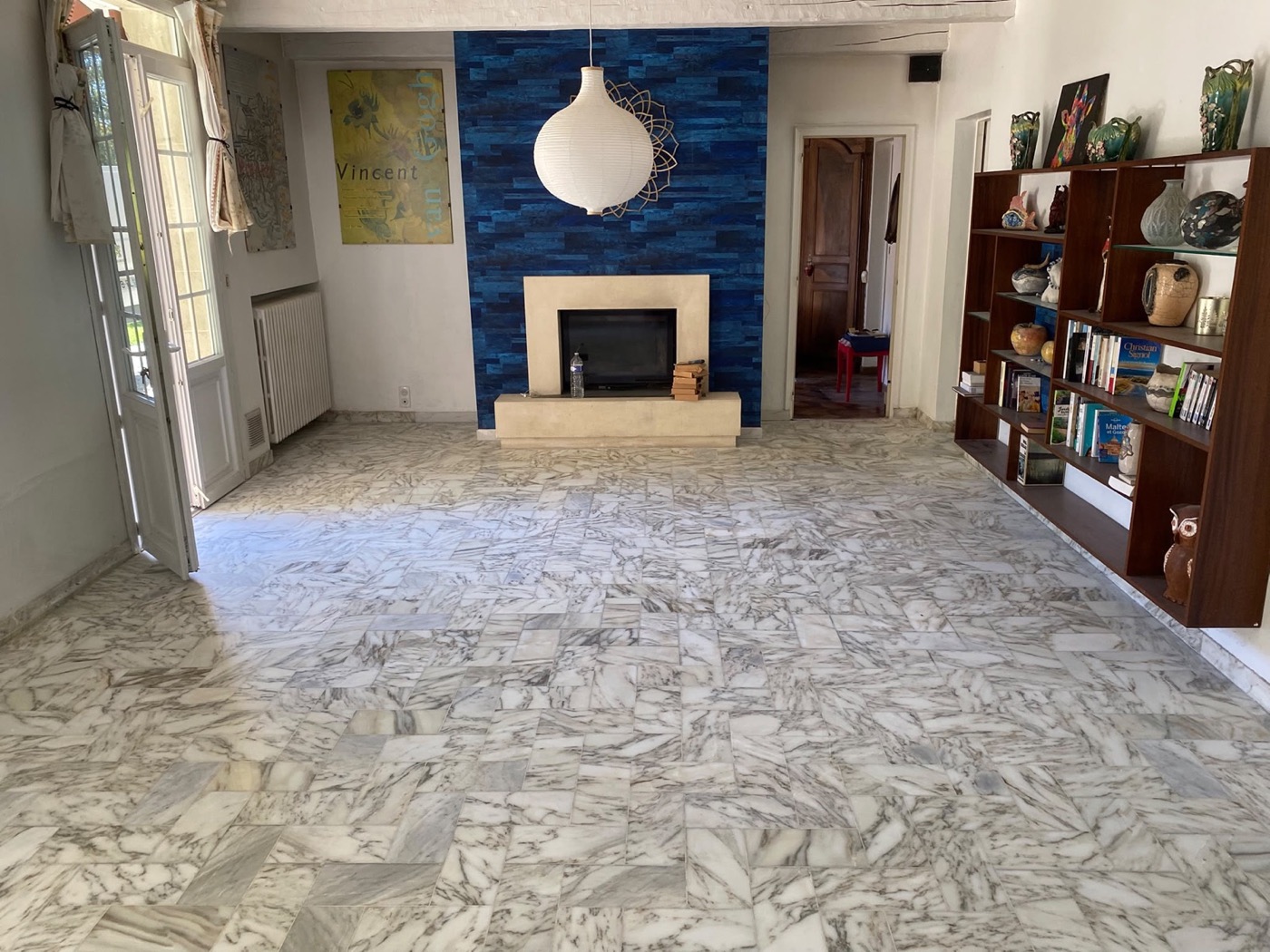
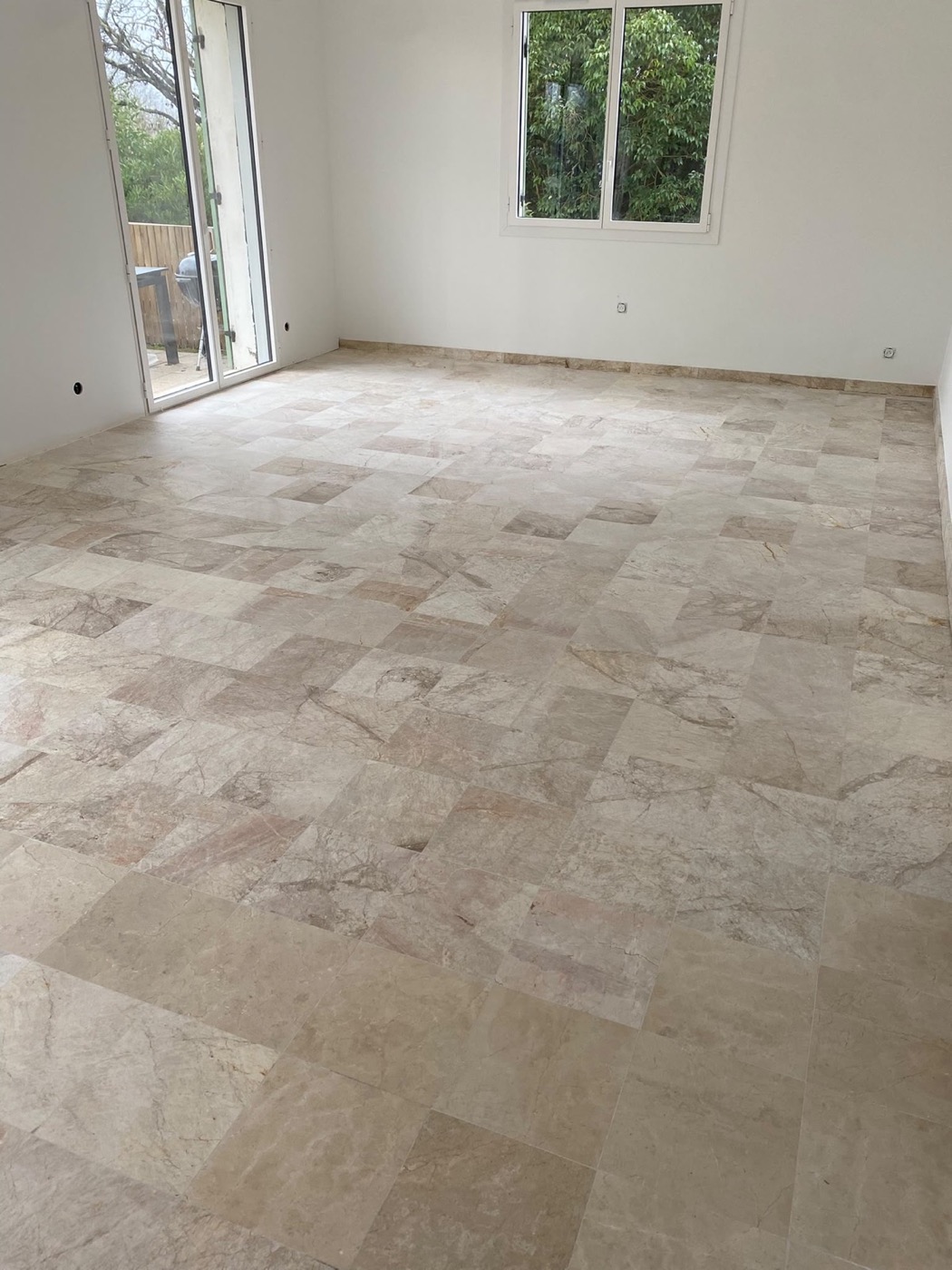
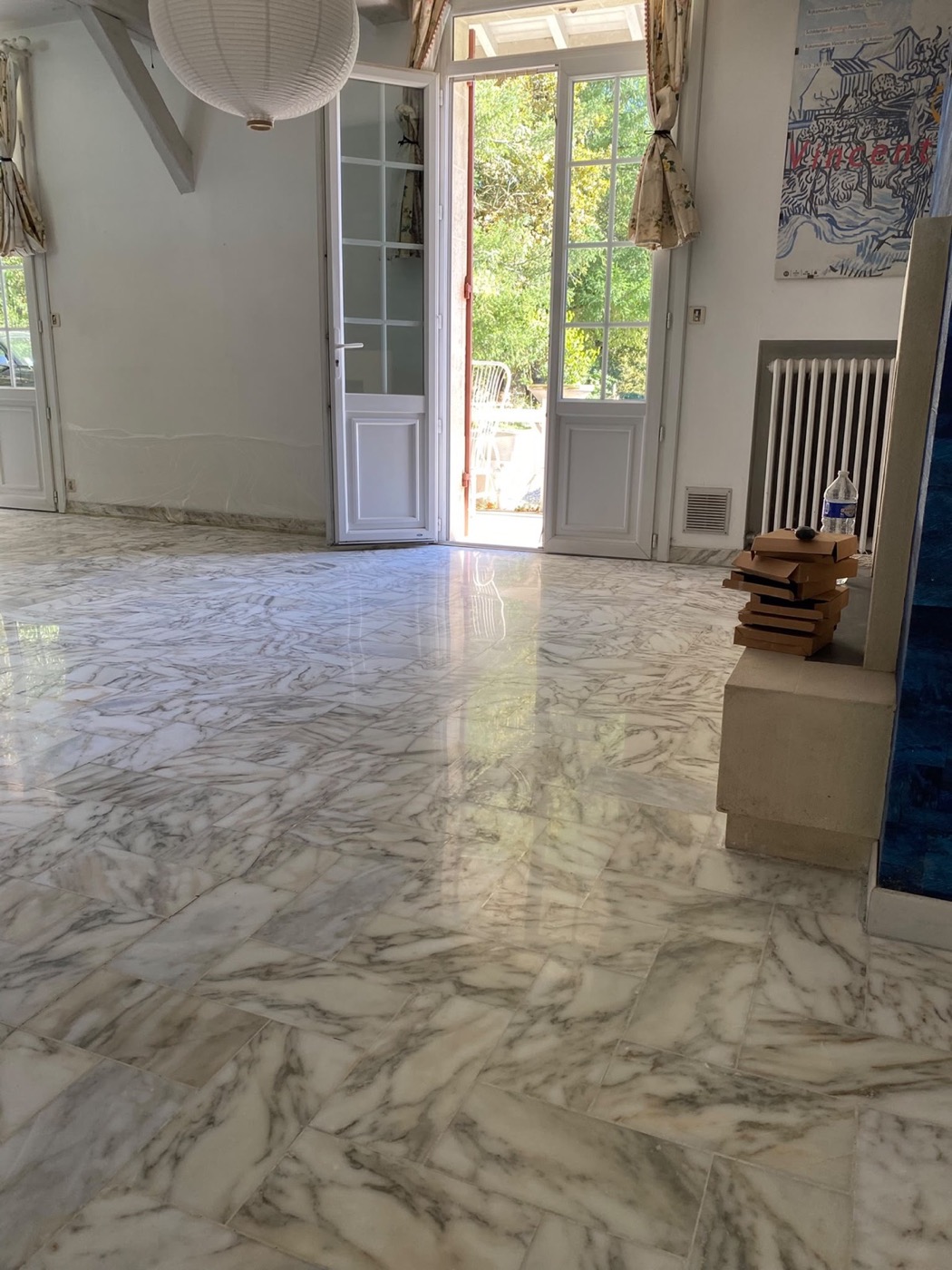
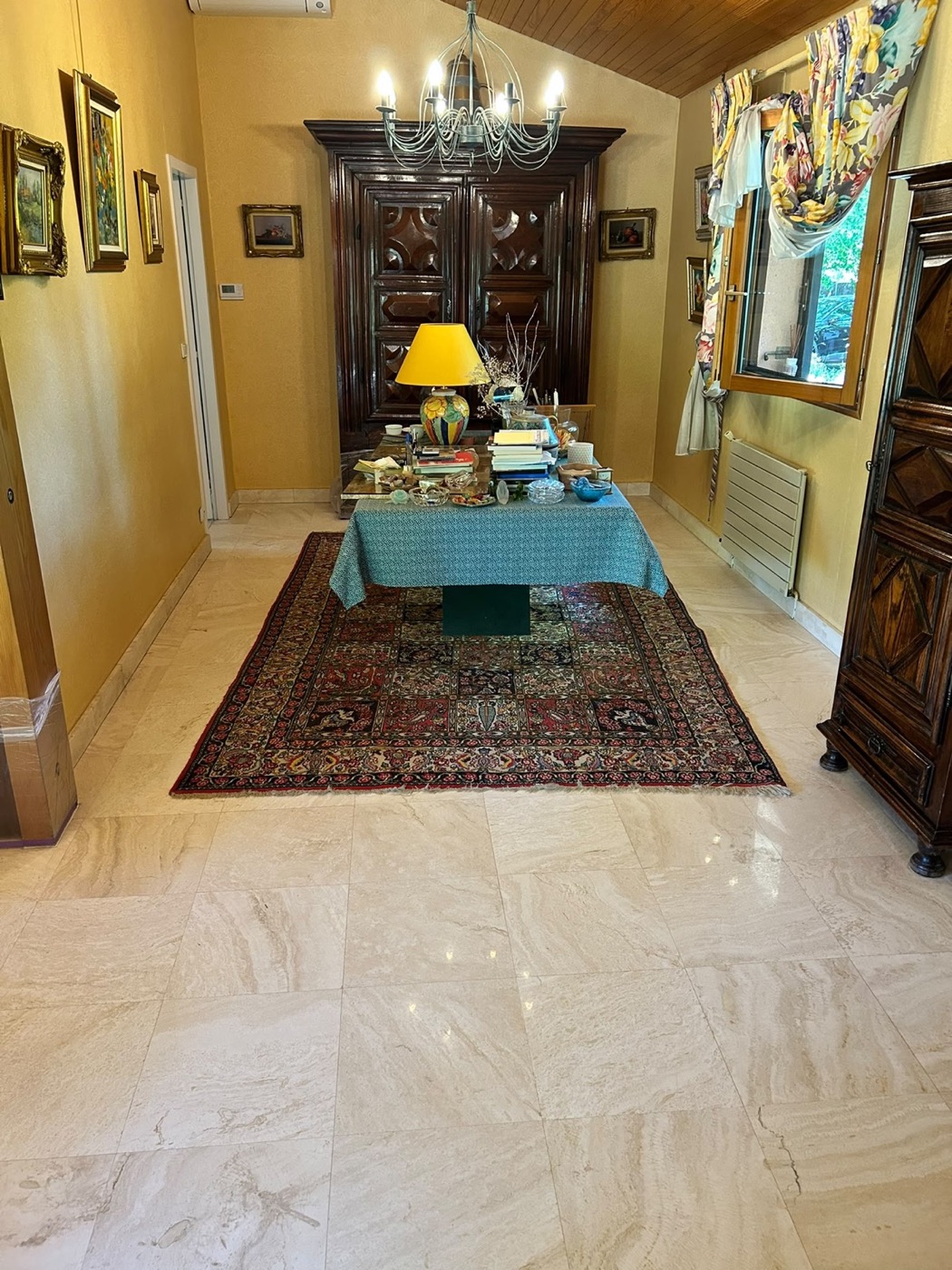
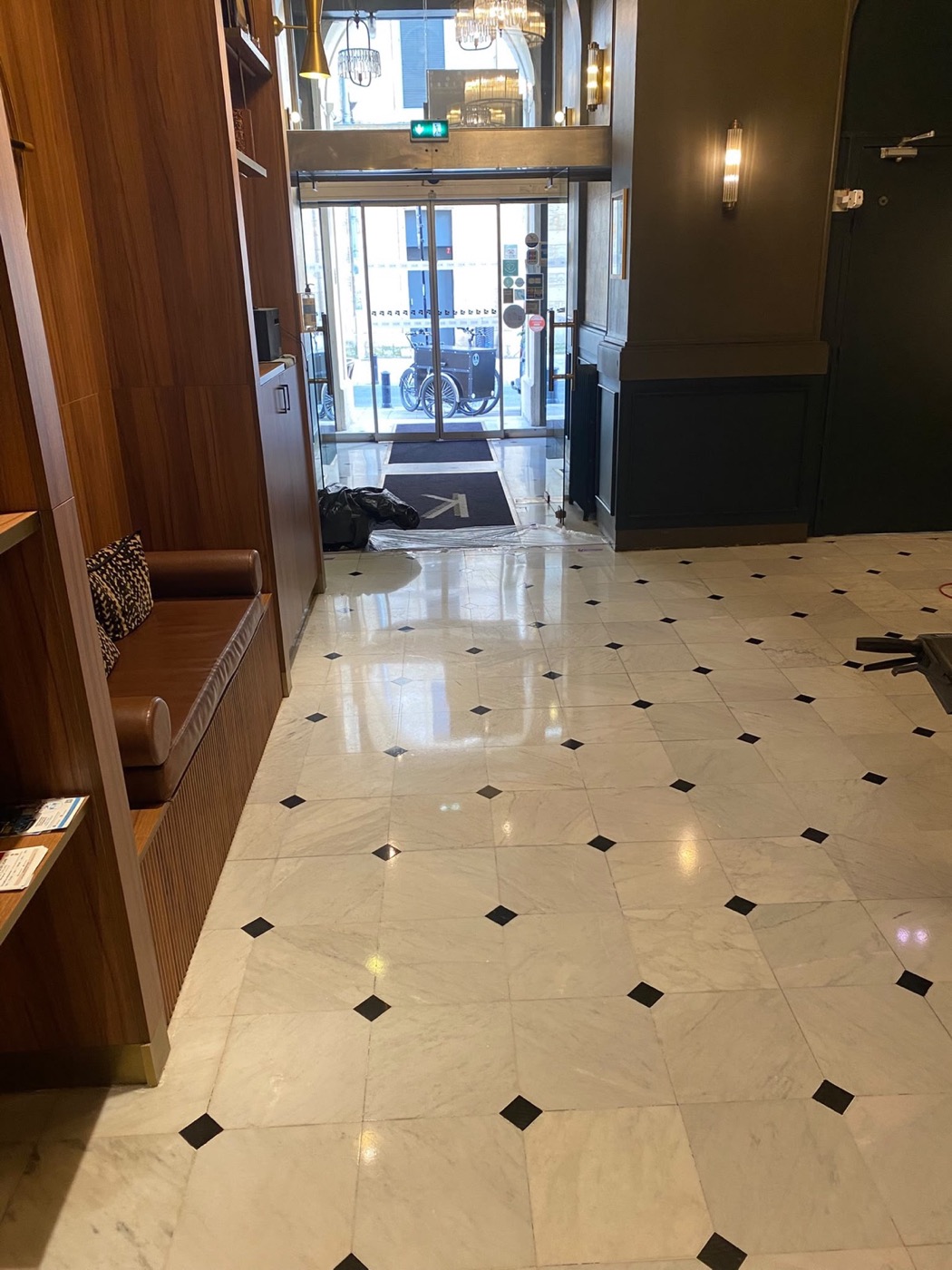
Is your marble scratched, dull, stained or damaged?
Natural stone can gradually lose the appearance it had when first installed.
Foot traffic can create fine scratches. Unsuitable cleaning products may dull the surface. Acidic liquids can etch marble and other carbonate stones. Dirt can build up in travertine joints and cavities. Impacts can chip edges, while an older finish may simply no longer suit the design of the space.
The first question should therefore not be:
“Does the marble need crystallising?”
but rather:
“What caused the problem, and which treatment will produce the required result?”
A light intervention may be enough for a surface that is merely dirty or slightly dull. Deeper scratches, lippage or a badly worn finish may require full mechanical restoration.
Which treatment may be suitable?
| Observed problem | Possible intervention |
|---|---|
| Ingrained dirt | Professional deep cleaning |
| Dull marble | Honing, polishing or crystallisation, depending on the case |
| Fine scratches | Polishing or light mechanical refinishing |
| Deep scratches | Grinding and honing |
| Uneven levels between tiles | Grinding and levelling |
| Acid etching on marble | Mechanical refinishing followed by the required finish |
| Open holes in travertine | Filling followed by restoration |
| Chip on an edge or stair tread | Local repair and finish matching |
| Old polished finish that has become uneven | Grinding, honing and a new finish |
| Glossy marble required in a matt finish | Finish alteration |
| Porous or stain-sensitive stone | Suitable water- or oil-repellent protection |
| Dirty terrace or pool coping | Cleaning and an exterior-appropriate treatment |
The final specification always depends on the stone type, its condition and thickness, the location, the expected traffic and the intended use.
Marble grinding and honing in Bordeaux
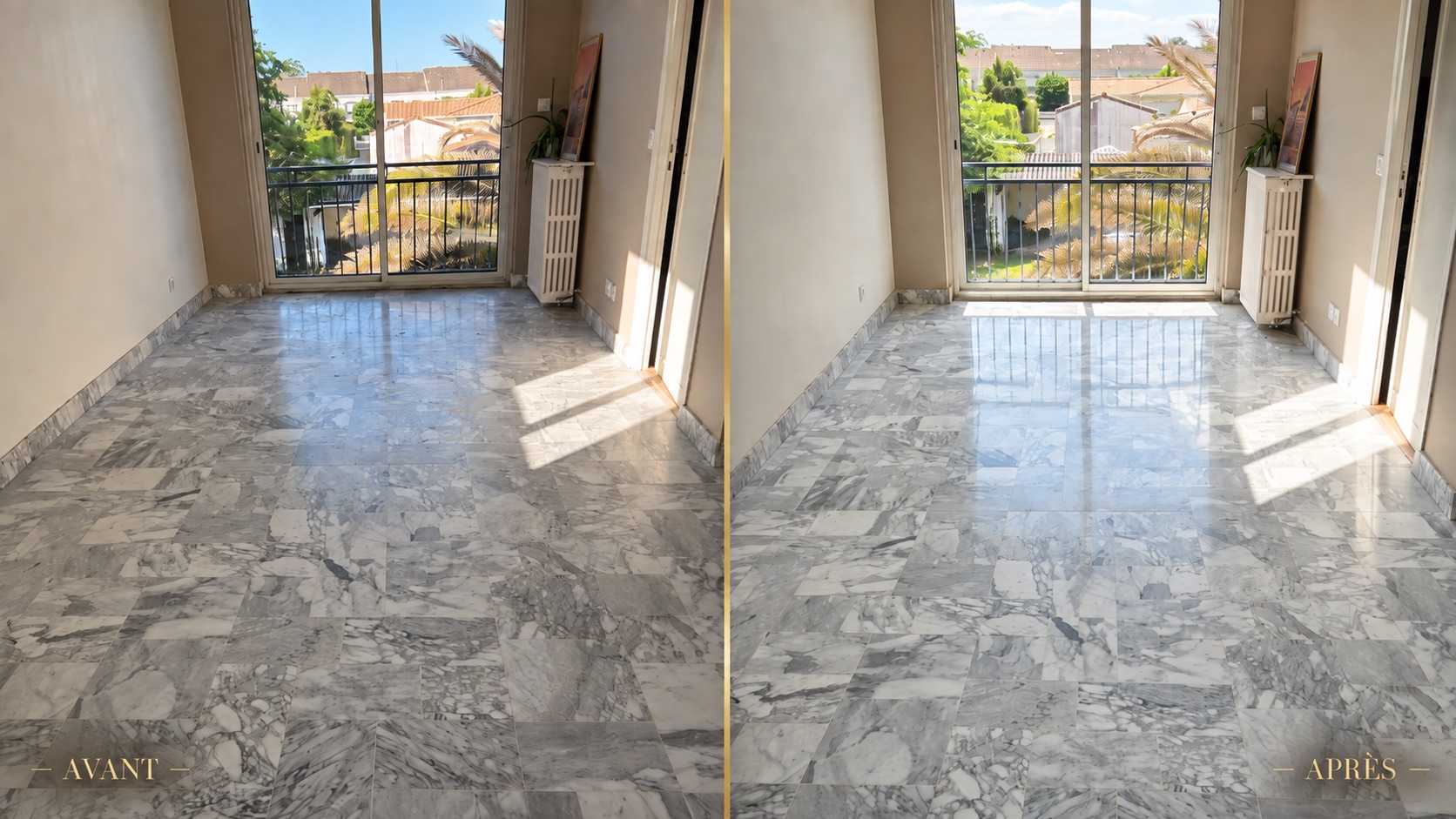
Grinding is a mechanical process that removes a very thin layer of stone to recreate an even, sound surface. It is followed by progressively finer honing steps.
It is especially relevant where a floor has deep scratches, uneven tile levels, pronounced wear, marks that cleaning cannot remove, or a badly deteriorated old finish.
The work is carried out in stages using a controlled sequence of diamond abrasives appropriate to the material.
The aim is not simply to “make the stone shine”. Grinding first rebuilds a level, consistent surface; honing and polishing then create the required visual and tactile finish.
The method is frequently used on marble floors and may also be suitable for travertine, granite, quartzite and terrazzo, using tools and abrasives selected for each material.
After preparation, the surface can be finished matt, honed, satin or polished, subject to the stone and the project requirements.
Polishing marble and natural stone
Polishing usually follows the mechanical preparation and honing stages.
Successively finer abrasives reduce the micro-scratches left by earlier stages and create a smoother surface that reflects more light.
On polished marble, veining often gains depth and the colours appear more saturated.
The gloss level can be adjusted to the design brief. A mirror effect is not always desirable: many contemporary interiors call for a softer satin or honed finish.
The finish should be chosen for both appearance and use. A hotel lobby, staircase, bathroom, terrace and worktop do not have the same technical constraints.
Marble crystallisation in Bordeaux
Crystallisation is a surface-finishing technique used mainly on certain compatible marbles and limestone-based stones.
Applied to a correctly prepared surface, it can revive the gloss and improve the appearance of a marble floor.
However, crystallisation is not a universal remedy. Deeply scratched marble will usually need to be ground and honed first. Acid etching cannot be concealed with a shine-enhancing product, while granite and quartzite generally require different mechanical processes.
A professional restoration should therefore begin by identifying the material and the defect, not by selecting a treatment in advance.
Grinding or crystallisation: what is the difference?
Grinding and honing are mechanical processes. They remove defects, correct minor unevenness and rebuild a consistent surface and finish.
Crystallisation is a finishing process that may be used on compatible carbonate stones when the condition of the surface allows it.
The two processes can be complementary, but they serve different purposes. Crystallisation will not replace grinding when a floor has deep scratches or significant lippage between tiles.
Professional natural-stone cleaning
A dull stone does not necessarily need grinding.
In some cases, the main issue is gradual soiling, residues from cleaning products, wax or soap, or deposits trapped in the pores and textured areas of the stone.
Professional cleaning helps reveal the real condition of the surface before a more substantial restoration is considered.
This is especially useful for natural-stone floors, travertine, terraces, pool copings, entrances and lobbies, shower walls and floors, textured or antiqued stones, paving and exterior surfaces.
Products and methods must be compatible with the material. Marble, travertine, limestone and some onyxes are sensitive to acids, so aggressive cleaning can cause more damage than it removes.
Changing the finish of installed marble
This option is often overlooked.
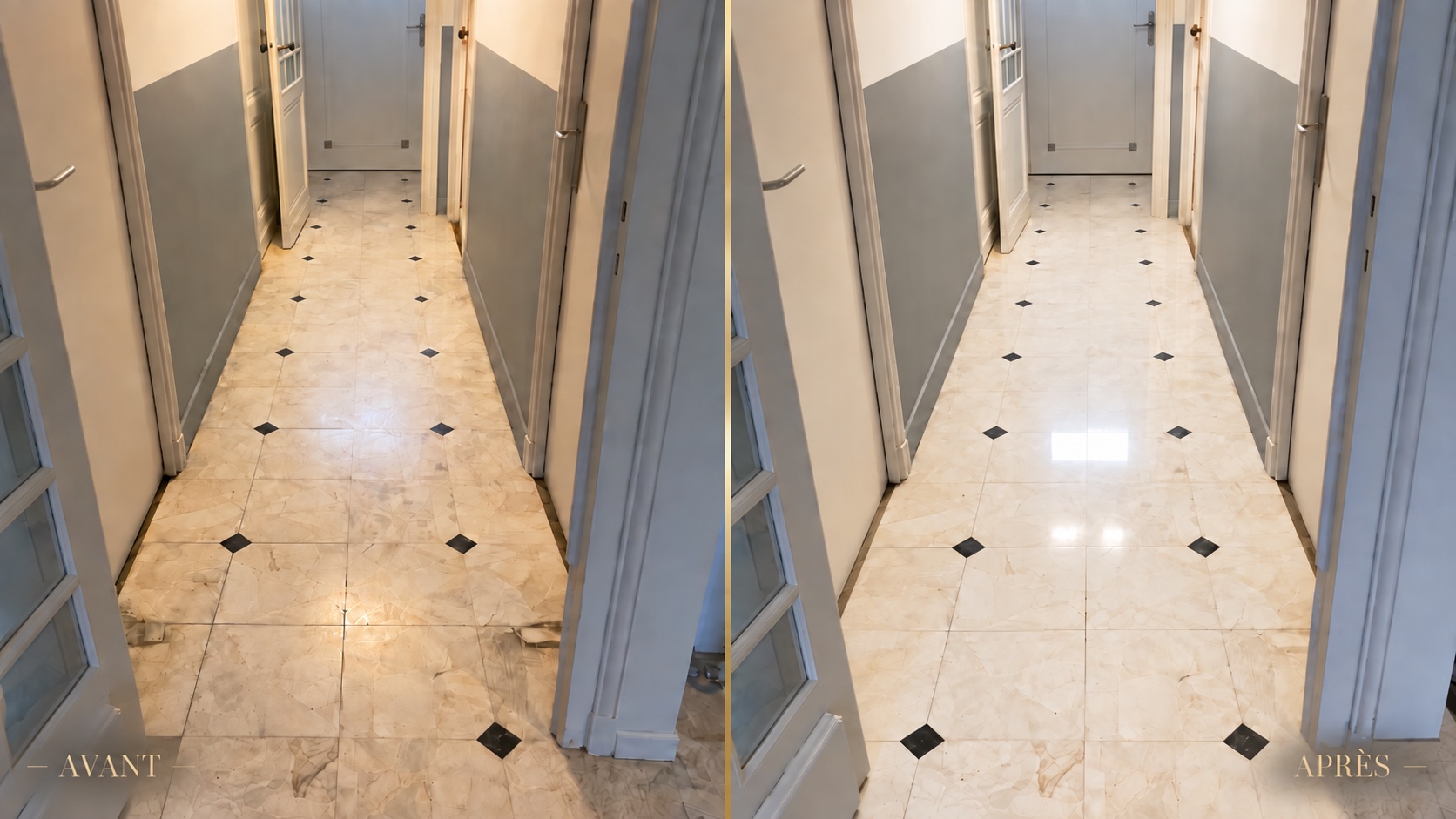
In many cases, the finish of marble or natural stone can be altered without replacing the material.
For example, an older polished floor may be refinished to achieve a softer matt or honed appearance. Conversely, a compatible honed stone can be worked progressively to increase its level of polish.
This can be useful when modernising an interior, changing the decorative scheme, matching an existing area to an extension, correcting an uneven finish, refinishing after repairs, changing the gloss level or unifying areas with different appearances.
Feasibility depends on the exact stone, its condition, the available thickness, its use and the intended finish.
A test area may be recommended before treating the entire surface.
Filling holes and repairing cracks and chips
Stone restoration is not only about gloss.
Age, impacts or movement in the substrate can cause local damage: open holes, cavities, chipped edges, cracks, deteriorated joints or older repairs that have become visible.
Depending on the situation, repairs may involve colour-matched fillers, appropriate resins, cavity filling or local mechanical refinishing.
The particular case of travertine
Travertine is naturally porous and contains cavities. Some finishes deliberately leave these holes open; in others they are filled.
Over time, old fillers may loosen or cavities may become ingrained with dirt. A restoration may therefore include:
cleaning → filling → grinding and honing → finishing → protection.
The aim is to recreate a consistent surface while respecting the natural character of the stone.
Water- and oil-repellent treatments
After cleaning or restoration, some stones benefit from a suitable protective treatment.
A water-repellent sealer is primarily intended to reduce water penetration. An oil-repellent or stain-resistant sealer helps reduce the absorption of oils and greasy substances.
These treatments can be useful on porous stones and surfaces exposed to staining, but they do not make stone completely waterproof or indestructible.
In particular, they do not protect marble from acid etching caused by lemon juice, vinegar or certain limescale-removing products.
A sealer should be regarded as additional protection, combined with appropriate day-to-day care.
Which materials can be restored?
Marble
Marble can be ground, honed and polished and, when compatible, crystallised. Restoration can correct scratches, superficial etching, differences in appearance and loss of gloss.
Travertine
Travertine restoration may include deep cleaning, filling cavities, grinding and honing, recreating the finish and applying suitable protection. Its natural voids and the condition of old fillers must be considered.
Granite
Granite is a particularly hard natural stone. Restoration normally uses mechanical processes selected for its hardness and mineral composition; it is not automatically treated like marble.
Quartzite
Natural quartzites are generally very hard and require suitable machinery, abrasives and expertise. Correct material identification is essential because stones sold under similar trade names may behave very differently.
Onyx
Decorative onyx requires particular care. Its translucency, mineral composition and relative fragility can make repairs and refinishing more delicate. Each project must be assessed individually.
Terrazzo and granito
The restoration method depends on the aggregate and, importantly, the binder. Grinding, honing, polishing or protection may be appropriate according to its construction and condition.
Resin-bound stone carpet
This material consists of stone aggregates held in a resin binder. Its care or repair should not be confused with the conventional grinding of a marble slab: the binder, its ageing and the aggregate condition must be assessed first.
Paving and exterior stone
Exterior stone is exposed to weather, soiling, biological growth and temperature changes. Cleaning, stripping or protection may be appropriate depending on the material, condition, drainage and surrounding environment.
Restoring interior marble floors
Floors are among the most common restoration projects. Circulation areas gradually develop variations in gloss, fine scratches and more visible wear than areas protected by furniture.
Restoration can unify the room and recreate a consistent finish in houses, apartments, villas, entrance halls, shops, hotels, restaurants, offices and shared residential areas.
Restoring natural-stone staircases
Treads, risers and landings require particular attention. Stair nosings are especially exposed to impacts and wear.
Work may include treads, risers, landings, edges, local chips and the overall finish of the staircase. Slip resistance and user safety must also be considered when selecting the finish.
Restoring natural-stone walls and showers
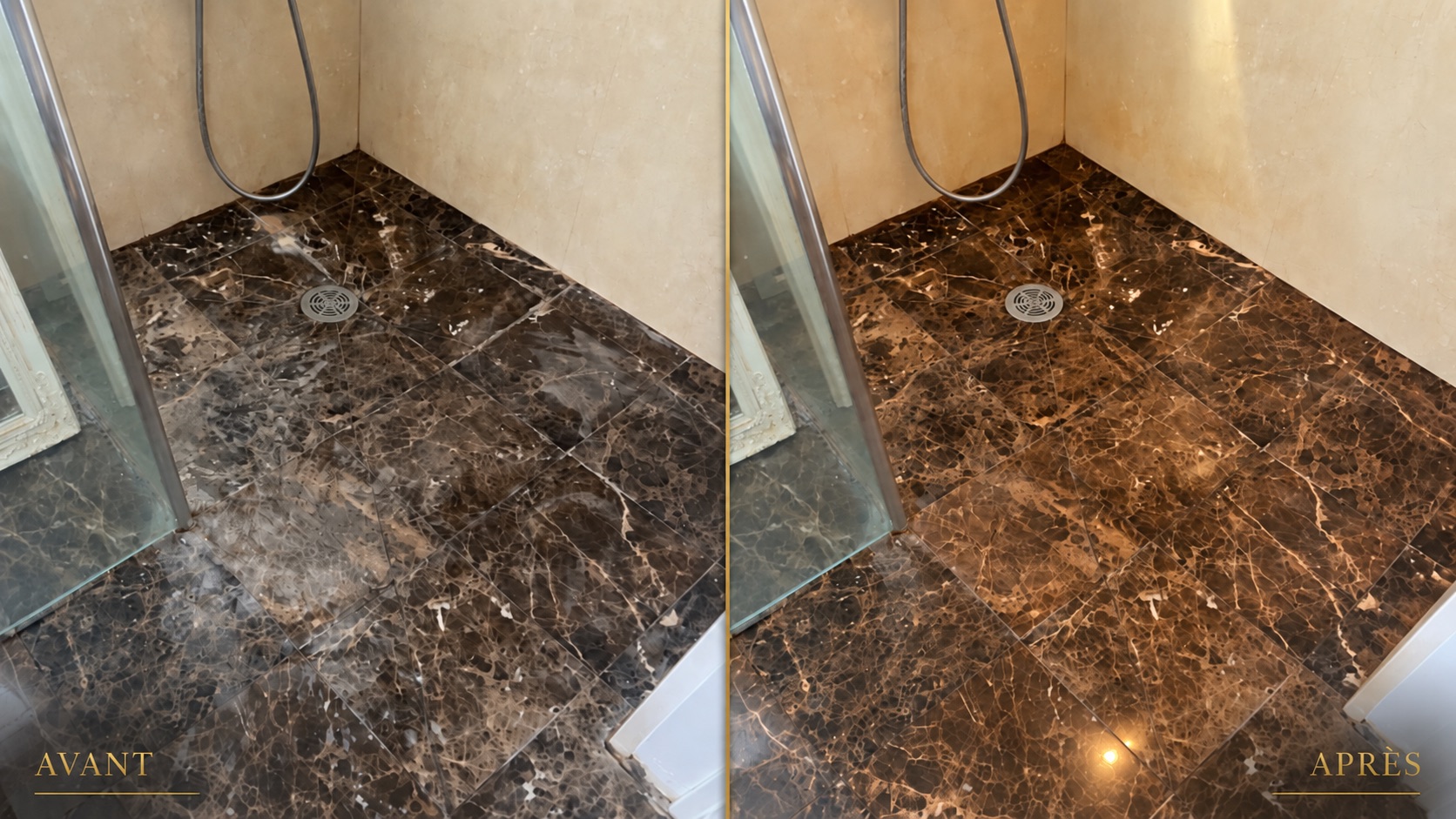
Bathrooms involve specific exposure to water, soap, limescale, cosmetics and sometimes unsuitable cleaning products.
Marble, travertine and other natural-stone shower walls and floors can gradually lose their original appearance. Before treatment, it is important to distinguish between ingrained dirt, mineral deposits, chemical etching, defective joints and deterioration of the stone itself.
The correct solution is different in each case.
Worktops, tables and other stone surfaces
Worktops and horizontal surfaces are exposed to oils, coloured liquids, scratches and acidic substances.
Depending on the stone and the depth of the defect, a local repair or more extensive refinishing may be possible. Marble and some limestones need particular care around food acids.
A suitable sealer can reduce the absorption of certain liquids, but it cannot make marble resistant to lemon juice or vinegar.
Terraces, swimming pools and copings
Exterior stone requires a different approach from an interior floor. The assessment must consider rain and moisture, pollution, moss and biological growth, frost where relevant, solar exposure, pool chemicals and slip resistance when wet.
For a terrace or pool coping, the finish must be selected for safety and use as well as appearance. A high-gloss finish suitable for an interior lobby is not necessarily appropriate around a swimming pool.
Marble restoration for hotels, shared buildings and commercial premises
Hotels, restaurants, shops, office buildings and jointly owned residential buildings often have larger surfaces and heavy-traffic areas.
The programme must take account of occupancy levels, operating hours, the surface area, site logistics and the expected finish.
Hotel lobbies, apartment-building entrances and retail spaces may show pronounced traffic patterns. Restoration can recreate a consistent finish without replacing good existing stone.
In shared buildings, work may include entrance halls, stairs, landings and other common areas.
How does a restoration project proceed?
1. Identify the stone and the defect
The first step is to understand the material. Marble, granite, quartzite, travertine and terrazzo react differently. It is also important to distinguish a stain from etching, a scratch from a crack, and simple loss of gloss from actual deterioration.
2. Define the intended result
Do you want to recover the original appearance, increase the gloss, move to a softer honed finish, remove scratches or repair damaged areas? This objective shapes the restoration method.
3. Carry out a test where necessary
For certain stones and finishes, a discreet test area is the best way to approve the result before a large surface is treated.
4. Prepare and protect the surrounding area
Adjacent elements are protected, and the stone is cleaned and prepared before mechanical work begins.
5. Restore the surface
Depending on the diagnosis, the work may combine cleaning, repair, filling, grinding, honing, polishing, changing the finish, crystallisation and protective treatment.
6. Inspect and hand over
The completed finish is checked for consistency and compliance with the agreed result. Stone-specific care recommendations can then be provided to help protect it over time.
Marble restoration in Bordeaux, Gironde and South-West France
This service is specifically intended for projects in Bordeaux and South-West France.
Requests may cover Bordeaux and the surrounding metropolitan area, including Bordeaux, Mérignac, Pessac, Talence, Le Bouscat, Bruges, Bègles, Bouliac, Gradignan, Villenave-d’Ornon and Saint-Médard-en-Jalles.
We also consider projects around the Arcachon Bay, Arcachon, La Teste-de-Buch and Cap Ferret, as well as throughout Gironde and the wider South-West.
Whether the project involves a few technically demanding square metres or the restoration of a lobby, hotel or other large area, the first step is the same: understand the stone and specify only the treatment that is genuinely required.
Why choose Marbre Import?
Marbre Import specialises in marble and natural stone. That material knowledge is particularly important in restoration: two stones that look similar can react very differently to the same treatment.
Our approach is based on clear principles:
- identify the stone before specifying the treatment;
- understand the cause of the defect before trying to conceal it;
- select a finish that suits the real use of the surface;
- restore high-quality existing stone whenever that is technically sound;
- explain both the possibilities and the technical limits of each intervention.
We also draw on our experience in sourcing, fabricating and specifying natural stone to assess wider issues involving marble, granite, quartzite, travertine and onyx.
Restoration in action
Marble crystallisation in action
See how surface treatment can revive the natural shine of marble and create an even, refined finish.
On-site video — crystallisation and restoration of a marble floor.
Frequently asked questions about marble restoration
Can scratches be removed from a marble floor?
In many cases, yes. Fine scratches may be corrected by honing and polishing, while deeper scratches usually require grinding. The depth of the damage must be assessed first.
What is the difference between grinding, polishing and crystallisation?
Grinding mechanically removes a very thin layer to correct defects and unevenness. Honing and polishing use progressively finer abrasives to rebuild the finish and gloss. Crystallisation is a finishing technique used on certain compatible marbles and limestone-based stones.
Can every marble be crystallised?
No. Suitability depends on the mineral composition, finish and condition of the stone. The choice should follow a proper diagnosis.
Can granite be crystallised?
Granite is not normally restored in the same way as marble. Its hardness and mineral composition call mainly for appropriate mechanical methods and abrasives.
Can quartzite be ground and polished?
Some quartzites can be mechanically restored, but their hardness requires suitable machinery and abrasives. The exact material must be confirmed before work starts.
Can badly worn travertine be restored?
Often, yes. Work may combine cleaning, filling cavities, replacing failed fillers, grinding and honing, recreating the finish and applying protection.
Can the finish of installed marble be changed?
In many situations, yes. Polished marble may be refinished to a matt or honed appearance, while some honed stones can be progressively polished. Feasibility depends on the material, thickness and condition.
Can a chip or crack in marble be repaired?
Many local repairs are possible with suitable fillers, resins and refinishing techniques. The visibility and durability of the repair depend on the stone and the position of the defect.
Will a sealer prevent every stain?
No. A water- or oil-repellent treatment reduces the absorption of certain liquids but does not make stone invulnerable. It does not remove marble’s sensitivity to acids.
How do I know whether my marble needs grinding?
Grinding may be required when defects are deep, tile levels are uneven or the finish is badly damaged. For simple loss of gloss or surface dirt, a lighter treatment may be sufficient.
Do you work only on floors?
No. Projects may involve interior and exterior floors, stairs, shower walls, worktops, tables, terraces, pool surrounds, copings, hotel lobbies, shops and shared residential areas.
Which areas do you cover?
This service is primarily available in Bordeaux, Gironde and South-West France, with particular focus on Bordeaux Métropole and the Arcachon Bay area.
How can I obtain a quotation?
Send photographs of the surface, the stone type if known, the approximate area in sqm, a description of the problem and the project location. This information allows an initial assessment before the next step is arranged.
Request an assessment for your marble or natural stone
Damaged natural stone does not necessarily need to be replaced.
Grinding, honing, polishing, deep cleaning, filling, local repairs, a change of finish or crystallisation may restore a consistent and durable surface.
The result, however, depends first on an accurate diagnosis and the correct treatment specification.
Do you have a project in Bordeaux or South-West France?
Send us photographs of the stone and describe the issue.
We will help identify the appropriate solution and prepare a free quotation.