Care and pathology
Marble Care, Restoration and Common Stone Defects
Understand marble maintenance, restoration and common defects by distinguishing natural features, surface change, stains, moisture, movement and structural damage.
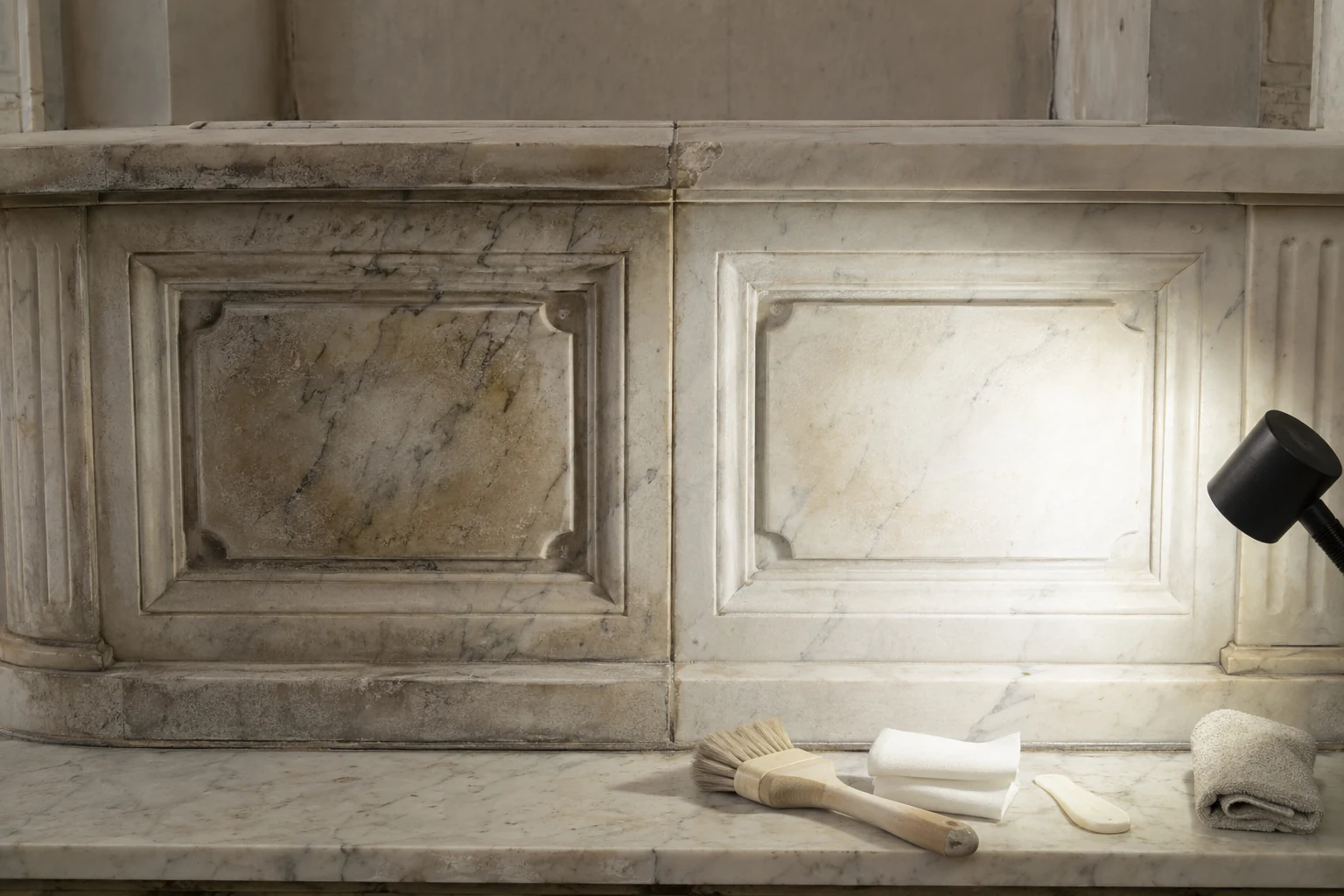
A symptom is not a diagnosis
A dark mark may be oil, moisture, resin or a natural mineral. A crack may be stable, active, structural or limited to a filler. Treatment begins by identifying the mechanism.
Record when the issue appeared, whether it changes and what cleaning or building work preceded it.
Natural feature, workmanship or damage
Veins, pores, fossils and colour variation belong to many stones. Open fractures, loose fills, poor joints or unsupported pieces are different questions.
Use approved samples and project records to distinguish expected geology from unacceptable execution.
Common conditions
Surface issues include detergent films, acid etching, scratches, wear and stains. Construction-related issues include moisture darkening, efflorescence, debonding, lippage and failed joints.
Exterior stone may also develop biological growth, black crusts, scaling or freeze–thaw damage.
| Observation | First question |
|---|---|
| Dull surface | Residue, wear or acid etching? |
| Yellow or orange mark | Oil, oxidation, resin or cleaning product? |
| White crystals | Which salt and moisture source? |
| Hollow sound | Void, debonding or construction type? |
| Crack | Stable feature or active movement? |
| Flaking surface | Salt, frost, fire, coating or weak layer? |
Maintenance, repair and restoration
Routine care removes grit and spills with compatible products. Repair addresses local physical loss; restoration coordinates diagnosis, cleaning, structural needs, refinishing and documentation.
Choose the smallest effective intervention and test it. More aggressive work can erase patina or spread damage.
When to call a specialist
Seek professional assessment for active cracks, loose façade panels, widespread moisture, valuable historic work, repeated stains or unknown coatings. Make unsafe areas secure first.
Keep photographs, samples, product history and intervention records. Future diagnosis depends on this evidence.
Need advice for a real project?
Marble Import supports international homeowners, architects and interior designers with stone selection, samples, technical feasibility and coordination of high-end stonework in France and across Europe.