Diagnosis by Symptom
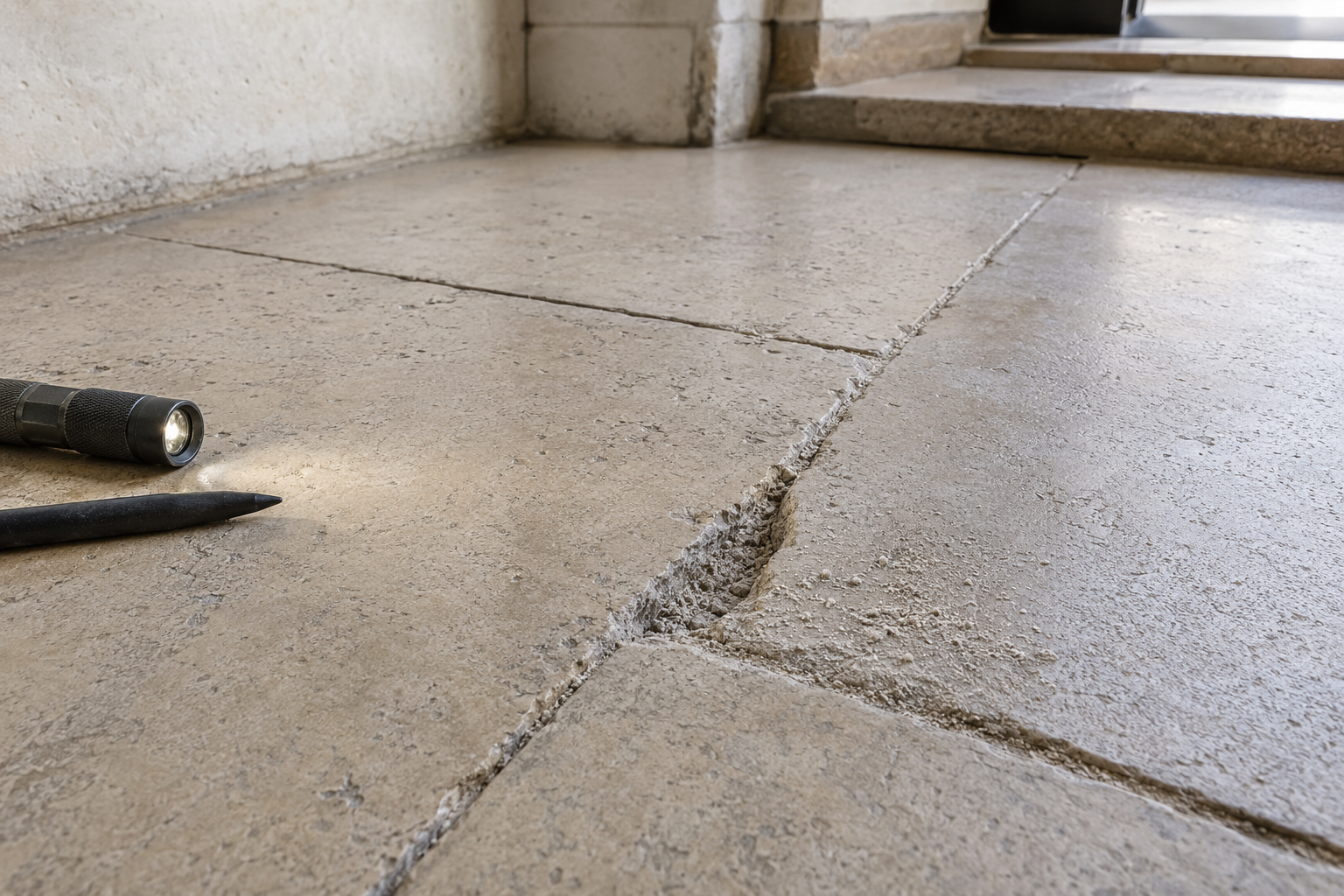
Diagnosis: Cracked, Recessed or Crumbling Joints
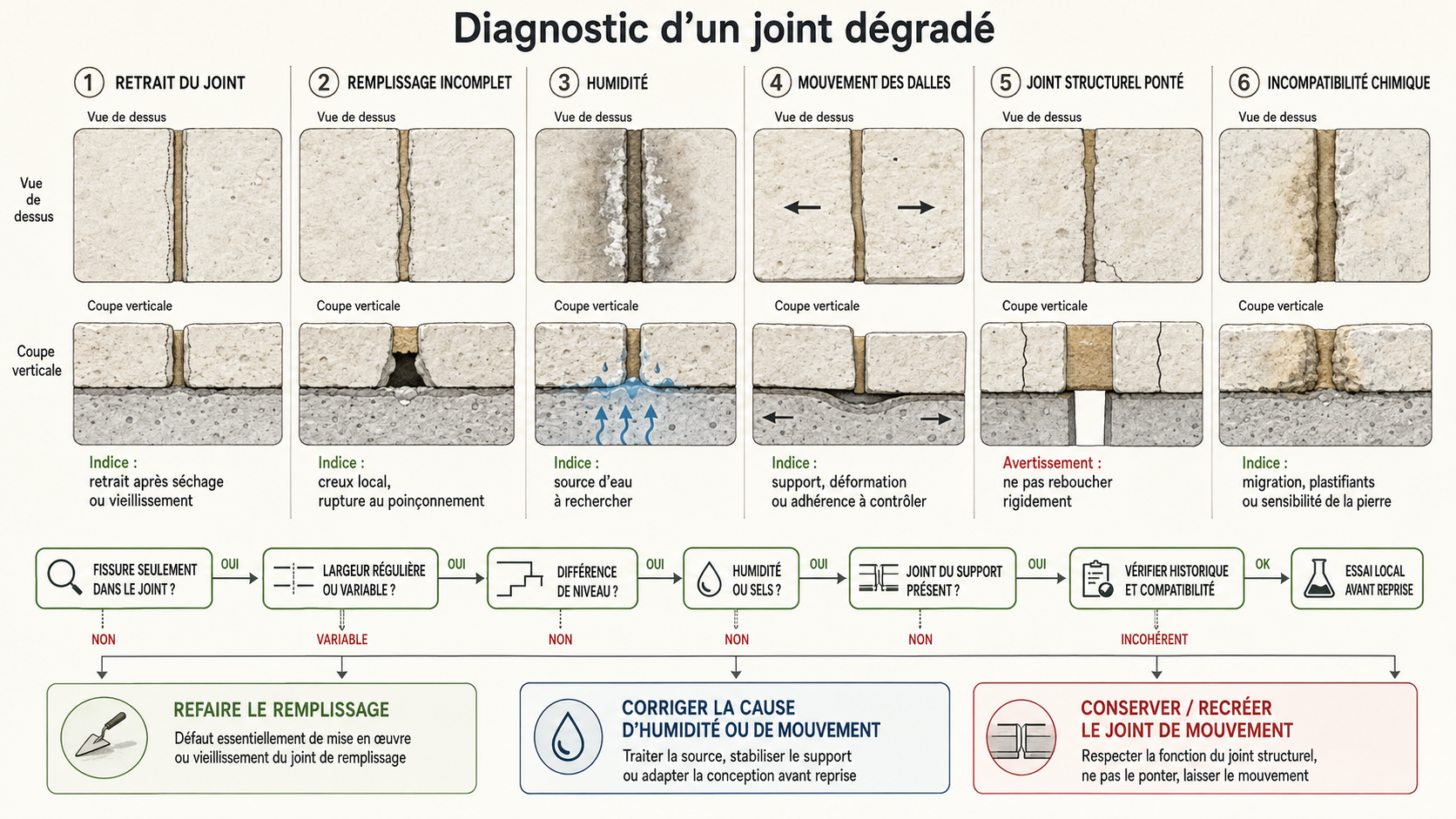
Determine whether joint failure is caused by an unsuitable product, incorrect width or depth, aggressive cleaning, substrate movement, moisture or a design error.
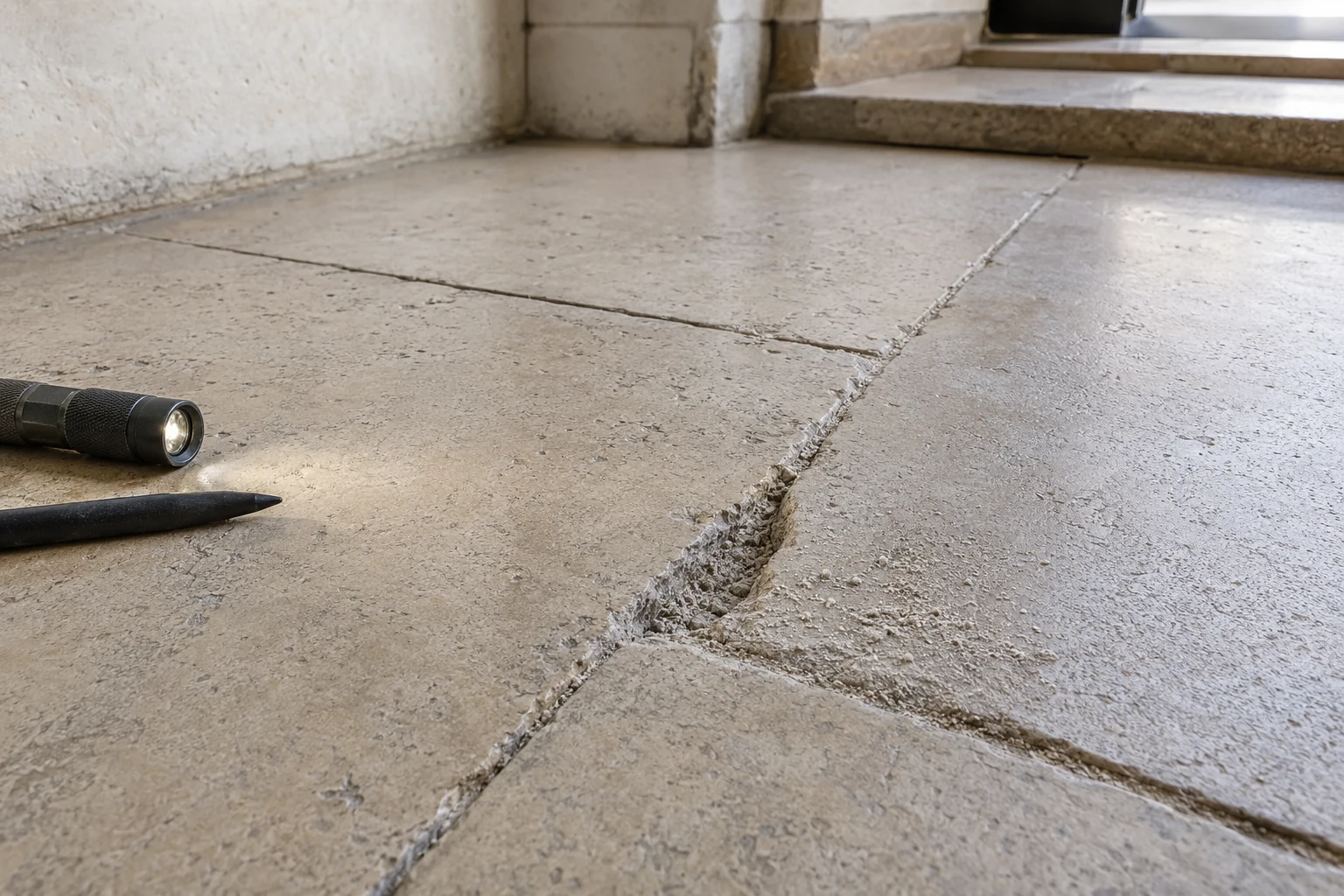
Identify the condition before treating it
A joint is not merely decorative filling. It accommodates tolerances, affects maintenance and must remain compatible with the stone, substrate and use. A joint that has been powdery from the outset does not have the same cause as a hard joint cracked above movement in the substrate.
Distinguish ordinary grout joints, intermediate movement joints, perimeter joints and structural joints. Replacing them all with rigid mortar can transfer stress into the stone or prevent intended movement.
| Observed sign | What it may indicate | First action |
|---|---|---|
| Uniform powdering when rubbed | Incorrect proportioning, mixing, curing or degraded product | Check depth and cohesion |
| Repeated straight cracking | Movement or a structural joint carried through incorrectly | Identify the underlying joint |
| Joints eroded in frequently washed areas | Excessive cleaning chemicals or pressure | Change the cleaning method |
| Darkening in damp conditions | Persistent moisture, biofilm or insufficient ventilation | Correct water management |
| Sealant detached from the joint faces | Poor adhesion, dust contamination or insufficient width | Inspect preparation and joint geometry |
Checks that will not make the condition worse
| Check | How to proceed | How the result informs the diagnosis |
|---|---|---|
| Joint type | Identify its function on drawings and in the construction | Determines whether a rigid or flexible material is required |
| Actual depth | Controlled local removal | Reveals shallow filling or a contaminated base |
| Cohesion | Comparative non-destructive scraping of small areas | Locates the deterioration |
| Moisture | Observe after use and in dry weather | Distinguishes leakage, standing water and condensation |
| Maintenance history | Record acids, steam, pressure washing and chemical concentrations | May identify progressive chemical attack |
Step-by-step diagnosis
| Stage | Question to resolve | Decision |
|---|---|---|
| 1 | Was the joint intended to accommodate movement? | Select a flexible system with suitable geometry |
| 2 | Is the substrate or stone moving? | Address the cause before repointing |
| 3 | Is the deterioration superficial or full-depth? | Remove material back to a sound layer |
| 4 | Is the area wet or exposed to aggressive chemicals? | Select a compatible product and maintenance regime |
| 5 | Have colour and width been approved? | Produce an approved sample panel |
Treat the confirmed cause
| Confirmed cause | Treatment principle | Condition for success |
|---|---|---|
| Stable deteriorated cementitious joint | Controlled removal and repointing to sufficient depth | Intact edges, clean base and correct curing |
| Detached flexible sealant | Remove it, prepare the joint faces and use a suitable backing rod and sealant | Two-sided adhesion and correct geometry |
| Substrate movement | Create or reinstate the movement-joint system | Continuity through every layer |
| Moisture or chemical exposure | Remove the cause and select a resistant system | Suitable maintenance and ventilation |
What not to do
- Cover friable old grout with a thin new layer.
- Fill a structural joint with rigid mortar.
- Erode joints with pressure washing.
- Use acid to remove grout haze from calcite-based stone.
- Choose the colour without a sample panel or allowing for drying.
When to consult a specialist
- Repeated cracking aligned with the building.
- A shower, terrace or façade with a risk of water ingress.
- A structural or fire-rated joint, or one exposed to intensive traffic.
- Fragile stone edges liable to spall during removal.
Preventing recurrence
- Define the function of every joint on the drawings.
- Respect the specified width, depth, waiting times and curing.
- Use compatible cleaning pressure and chemistry.
- Provide ventilation and drainage without standing water.
- Inspect sealants and vulnerable edges periodically.
Frequently asked questions
| Question | Practical answer |
|---|---|
| Can only a few joints be renewed? | Yes, if the cause is local and the colour transition is acceptable. |
| Is epoxy grout always better? | No. Its rigidity, appearance and cleaning requirements must suit the stone and expected movement. |
| Does the visible joint provide waterproofing? | A surface joint does not replace a continuous waterproofing system where one is required. |
Limits of remote diagnosis
This guide supports a methodical initial diagnosis. It does not replace an on-site investigation where stability, waterproofing, structure, public safety or professional liability may be involved.
Document the case with an overall view, a close-up with a scale, edges, joints, possible water paths and an unaffected comparison area. Record when it appeared, how it has changed, which products were used and any recent work.
Assess urgency before intervening
Determine whether joint failure is caused by an unsuitable product, incorrect width or depth, aggressive cleaning, substrate movement, moisture or a design error.
The first objective is not to hide the visible deterioration. Determine whether it is stable, progressive or hazardous. A dry, long-standing colour difference does not have the same priority as moving stone, opening cracks, active water ingress or loose material.
Begin by protecting people and the construction. Stop sources of water or aggressive chemicals where this can be done safely. Do not scrape out or cover the joints before recording their condition. Dated photographs, depth measurements and unaffected comparison areas are more useful than an aggressive trial.
Urgency increases when deterioration changes rapidly, returns after repointing, follows several aligned elements, accompanies movement, occurs on a façade or in a public area, or reveals water ingress. Cosmetic repointing must wait until safety, movement and waterproofing issues have been assessed.
| Response level | Typical situation | Recommended action |
|---|---|---|
| Documented monitoring | Stable, dry appearance with no movement or hazard | Photograph, measure and compare before any treatment |
| Controlled local trial | Probable cause and non-hazardous surface | Test the method on a small, discreet area |
| Specialist assessment | Uncertain cause, recurrence, large area or sensitive stone | Have the complete assembly examined before treatment |
| Immediate safety measures | Movement, risk of falling material, active ingress or risk to the public | Isolate the area and contact the appropriate specialist immediately |
Diagnostic reasoning in typical cases
Uniform powdering when rubbed makes incorrect proportioning, mixing, curing or a degraded product plausible. Check the depth and cohesion at several representative points before choosing a removal depth.
Repeated straight cracking suggests movement or a structural joint that has not been carried through correctly. Identify the underlying joint and all affected layers before repointing.
Joints eroded in frequently washed areas suggest excessive chemical action or cleaning pressure. Review products, concentrations, equipment and frequency and change the maintenance method before repair.
Darkening in damp conditions makes persistent water, biofilm or insufficient ventilation plausible. Check drainage, drying and ventilation and address water management before replacing the joint material.
Sealant detached from its joint faces suggests poor adhesion, dust contamination or inadequate geometry. Examine preparation, joint width and depth, backing material and adhesion surfaces before specifying replacement.
Preparing an assessment request a specialist can use
A useful assessment request describes the location, suspected stone, substrate, age of the installation, date of appearance and recent work or products. State whether the area is indoors or outdoors, dry or wet, exposed to frost, heavy traffic or intensive cleaning.
Prepare an overall view, a medium-distance view and a close-up with a ruler or object for scale. Photograph joint intersections, edges, drainage points, the underside where accessible and unaffected comparison areas.
Attach product references, the stone data sheet where available, joint-layout and waterproofing drawings and the repair history. State what has already been attempted and the observed result.
Choosing between monitoring, testing and treatment
Approve repointing only when it addresses the confirmed cause, preserves the stone edges and can produce an acceptable appearance. A sample panel verifies colour, texture, cleaning, curing and possible staining and must be assessed after it has dried fully.
Specialist involvement is particularly important for repeated cracks aligned with the building; showers, terraces or façades with a risk of water ingress; structural or fire-rated joints; intensive traffic; and fragile stone edges liable to spall during removal. The diagnosis should state its limitations and any further investigation required.
| Stage | What the check is intended to establish | Possible decision |
|---|---|---|
| Joint type | Identify its function on drawings and in the construction | Determines whether a rigid or flexible material is required |
| Actual depth | Controlled local removal | Reveals shallow filling or a contaminated base |
| Cohesion | Comparative non-destructive scraping of small areas | Locates the deterioration |
| Moisture | Observe after use and in dry weather | Distinguishes leakage, standing water and condensation |
| Maintenance history | Record acids, steam, pressure washing and chemical concentrations | May identify progressive chemical attack |
| 1 | Was the joint intended to accommodate movement? | Select a flexible system with suitable geometry |
Key concepts
Continue reading
Related guides
Natural-Stone Installation
Successful installation coordinates the substrate, stone, format, thickness, adhesive or mortar, joints, falls, uncoupling, protection and post-installation care.
Mortars, Lime, Traditional Joints and Historic Buildings
Stone in historic buildings cannot be treated like a modern substrate. Lime, mortars, joints, moisture, salts, vapour movement and material compatibility often determine durability.
Substrates, Screeds, Levelling Compounds and Residual Moisture before Installation
The durability of a stone floor or wall depends on the substrate: flatness, cohesion, moisture, cracks, primers, existing finishes, underfloor heating and product compatibility.
Waterproofing beneath Stone: Showers, Steam Rooms and Critical Junctions
Natural stone in wet areas requires a complete system coordinating the substrate, falls, waterproofing, upstands, drainage, adhesive, joints, compatible stone, ventilation and maintenance.
Diagnosis: Dull, Yellowed or Grey Marble
Distinguish a maintenance film, acid etching, moisture, oxidation, an ageing treatment and an actual change in the stone before attempting to clean or repolish it.
Diagnosis: Stains on Marble and Natural Stone
Identify the contaminant family, penetration depth and any chemical change before selecting absorption, poulticing, cleaning or surface restoration.