
Quarry and fabrication
Marble Quarrying, Processing and Production Techniques
Follow marble and natural stone from geological deposit to finished component through quarry planning, extraction, block selection, sawing, reinforcement, finishing and quality control.
Understanding the deposit
Quarry development begins with geological mapping, trial extraction and observation of beds, joints, faults, colour variation and weathered zones. The objective is not simply to remove rock but to recover blocks of useful size and consistent character.
Access, safety, water, waste management and restoration of the site form part of the extraction strategy.
Separating and moving blocks
Diamond wire, chain saws, drills and controlled splitting create cuts around a primary mass. The block is then eased down, squared and marked for transport.
Every movement must account for weight, centre of gravity, hidden discontinuities and the capacity of lifting equipment. Quarry-bed orientation should remain traceable.
From block to slabs and pieces
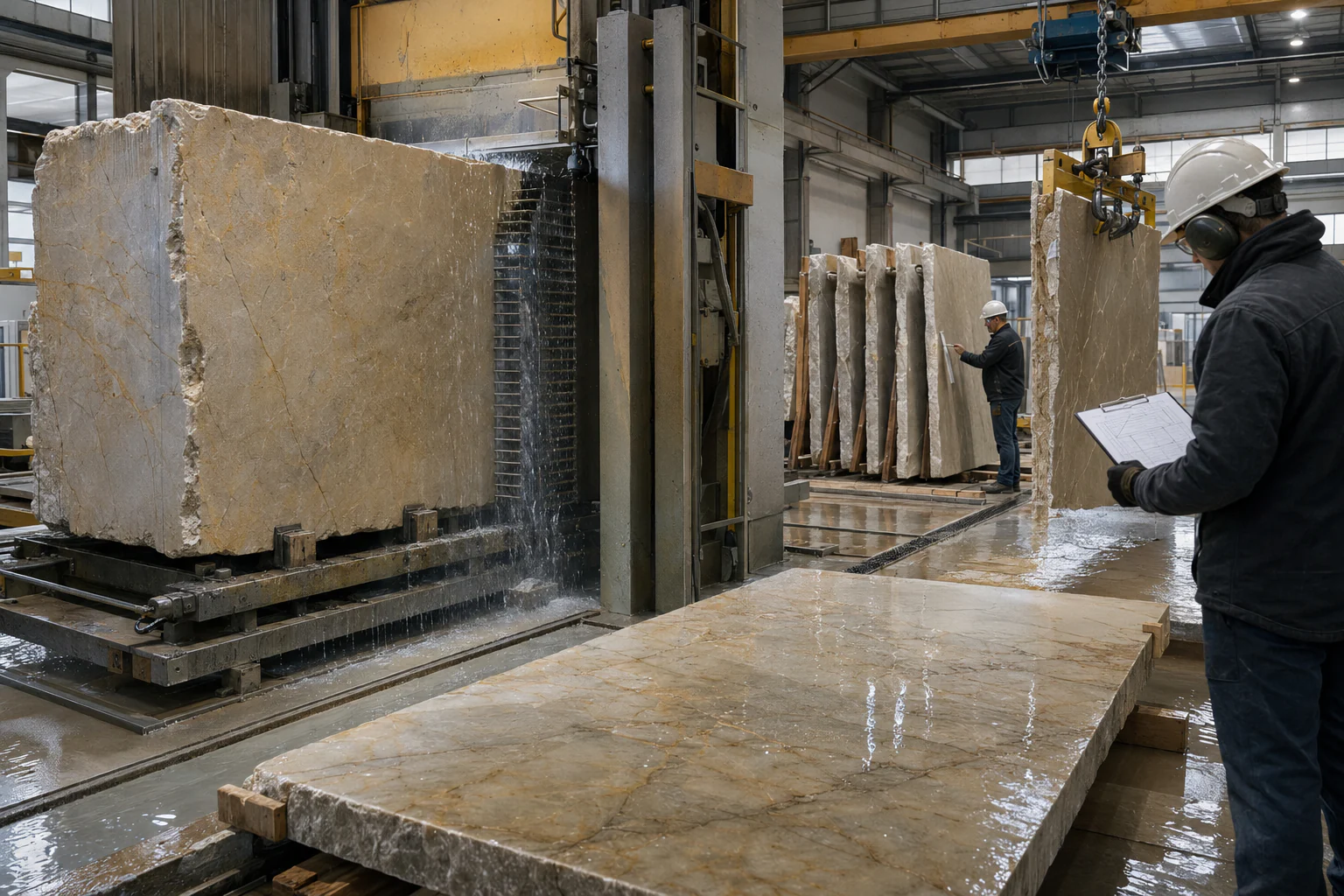
Gang saws, diamond wire and large saws divide blocks into slabs or thick elements. Cutting direction determines whether the visual result is vein-cut, cross-cut or another orientation.
Slabs may be calibrated, resin-treated, mesh-backed or filled before polishing, honing or texturing. These processes should be disclosed and assessed for the intended exposure.
| Stage | Main decision | Quality evidence |
|---|---|---|
| Deposit study | Beds, variation and extractable volume | Mapping and trial blocks |
| Blockk selection | Dimensions, soundness and orientation | Blockk photographs and references |
| Sawing | Thickness and cutting direction | Slab sequence and calibration records |
| Treatment | Resin, filling or reinforcement | Product compatibility and inspection |
| Finishing | Sheen, texture and flatness | Approved sample and first-off piece |
| Packing | Protection and installation order | Piece list and crate record |
Yield, offcuts and responsible production
Geology, required formats and slab layout determine yield. Thoughtful design can use smaller pieces and offcuts without compromising quality.
Water recycling, slurry treatment, energy, transport and quarry rehabilitation should be considered with service life and repairability rather than reduced to one environmental claim.
Traceability to the finished project
Keep the link between quarry, block, slab, cutting file, finish, piece number and final location. This makes visual approval, replacement and investigation far more reliable.
For high-end projects, current slab selection and workshop inspection remain essential even when the quarry name is well established.
Need advice for a real project?
Marble Import supports international homeowners, architects and interior designers with stone selection, samples, technical feasibility and coordination of high-end stonework in France and across Europe.