Performance and comfort
Thermal Comfort, Acoustics and Underfloor Heating with Natural Stone
Understand how stone affects perceived temperature, thermal inertia, underfloor heating, acoustics and everyday comfort—and how to design the complete build-up.
Why stone can feel cool
Stone often feels cooler than timber at the same room temperature because it draws heat from the skin more quickly. This sensation depends on thermal effusivity, surface finish, contact time and whether the user is barefoot.
A stone floor at 20°C can therefore feel cooler than a timber floor at 20°C without cooling the room. Comfort is a combination of air temperature, radiant temperature, humidity, air movement and contact with surfaces.
Thermal mass and inertia
Stone stores heat and releases it gradually. In a well-designed building, this can reduce temperature swings, support night cooling and improve comfort in warm climates. Thermal mass is useful only when solar gain, insulation and ventilation are coordinated.
Thin stone tiles contribute less storage than a massive slab or wall, but they still provide a durable conductive surface. Do not use the word inertia as a substitute for calculating the entire assembly.
| Property | Potential benefit | Design condition |
|---|---|---|
| High conductivity | Efficient transfer from underfloor heating | Good contact and controlled build-up |
| Thermal mass | Slower temperature swings | Appropriate insulation and control strategy |
| Hard surface | Durability and easy cleaning | Acoustic treatment elsewhere |
| Surface texture | Slip control and tactile character | Barefoot comfort and maintenance |
Underfloor heating as a complete system
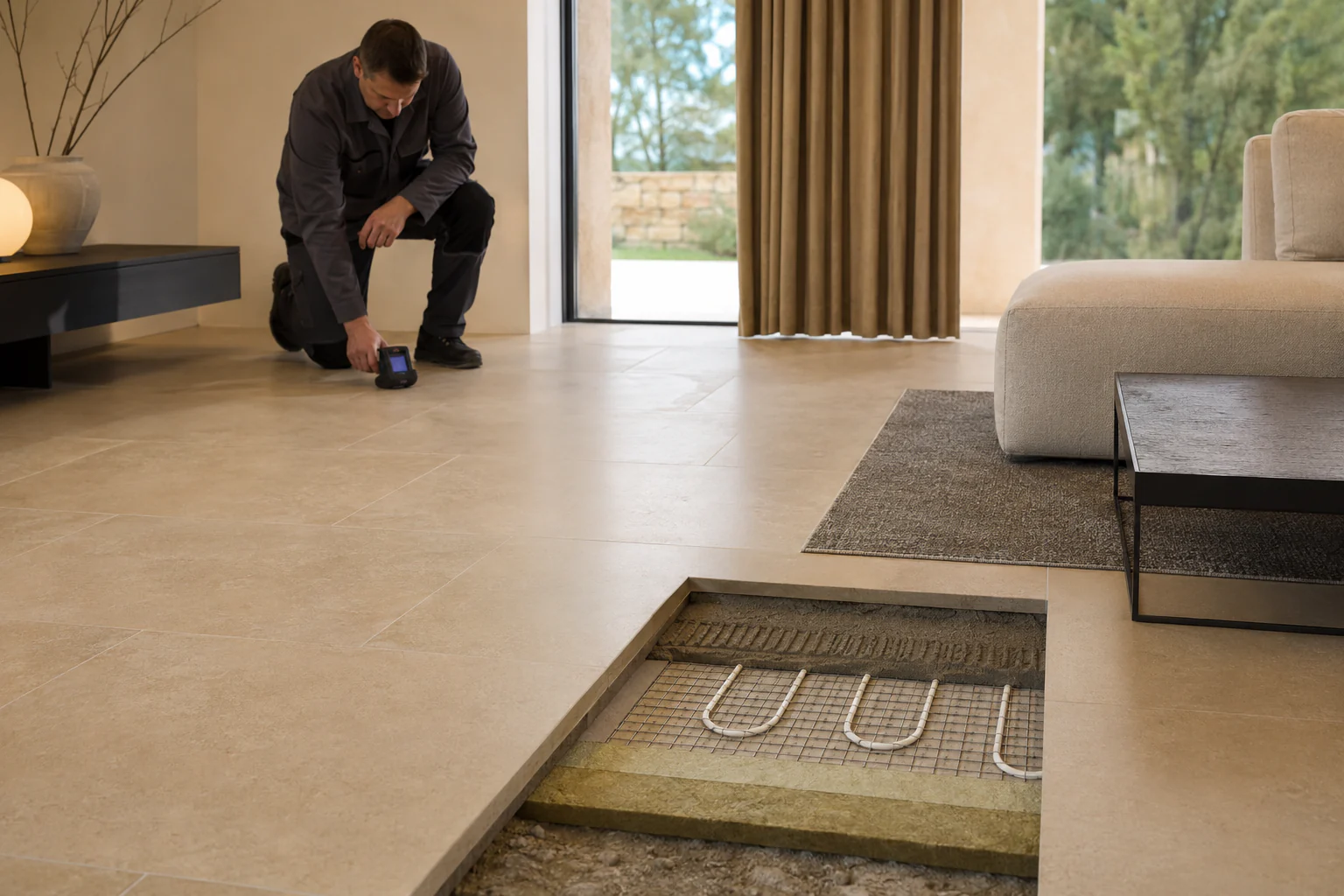
A heated stone floor includes the base, insulation, heating network, screed or distribution layer, adhesive or mortar, stone and joints. The response time and maximum surface temperature depend on all these layers.
The design must address commissioning, movement joints, residual moisture, compatible adhesives and controlled heating cycles. Heating too early can cause shrinkage, debonding or staining.
Stone selection and thickness
Dense marble, limestone, granite and many other natural stones can work well over underfloor heating when the system and material are compatible. Thickness affects weight, response and structural requirements but should not be reduced below what the format and loads require.
Veins, resin, mesh backing and moisture sensitivity must be considered. Approve the stone on representative samples and verify the proposed fixing products with both stone and heating-system suppliers.
Movement and joints
Heated assemblies expand and contract. Perimeter joints, structural joints and field movement joints must be carried through at the correct locations. A rigid stone finish cannot bridge movement indefinitely.
Large formats and continuous layouts across rooms require particular coordination. The stone grid, door thresholds, heating zones and substrate joints should be resolved together before cutting.
Acoustics: airborne and impact sound
Stone does not automatically make a room acoustically uncomfortable. Its hard surface reflects sound, but room volume, ceilings, walls, furnishings and openings determine reverberation. Rugs, curtains, upholstered furniture and acoustic panels can balance a stone interior.
Impact sound through floors requires isolation beneath the screed or finish. A thin soft layer selected without checking compressive behaviour can create movement and cracked joints, so acoustic and stone-installation requirements must be designed together.
Walls, bathrooms and barefoot areas
Stone wall linings can add thermal mass and a calm radiant character, but they do not replace insulation. In bathrooms, warm surfaces, ventilation, waterproofing and rapid drying influence comfort as much as the stone itself.
Texture affects the foot. A heavily textured finish may improve grip but feel harsh barefoot and retain soap residue. Select a finish that balances slip resistance, touch and realistic cleaning.
Commissioning and operation
Measure screed moisture, follow curing periods and commission heating gradually before installation where the system requires it. Record temperatures and retain the commissioning protocol.
After installation, raise and lower temperatures progressively. Explain cleaning products, thermostat use and the purpose of movement joints to the client so that comfort does not compromise durability.
Need advice for a real project?
Marble Import supports international homeowners, architects and interior designers with stone selection, samples, technical feasibility and coordination of high-end stonework in France and across Europe.