Applications
Natural-Stone Façades, Terraces and Exterior Applications
Exterior stone is a technical construction element. Frost, water, wind, fixings, slip resistance, falls, drainage, maintenance and applicable standards must be considered from the selection stage.
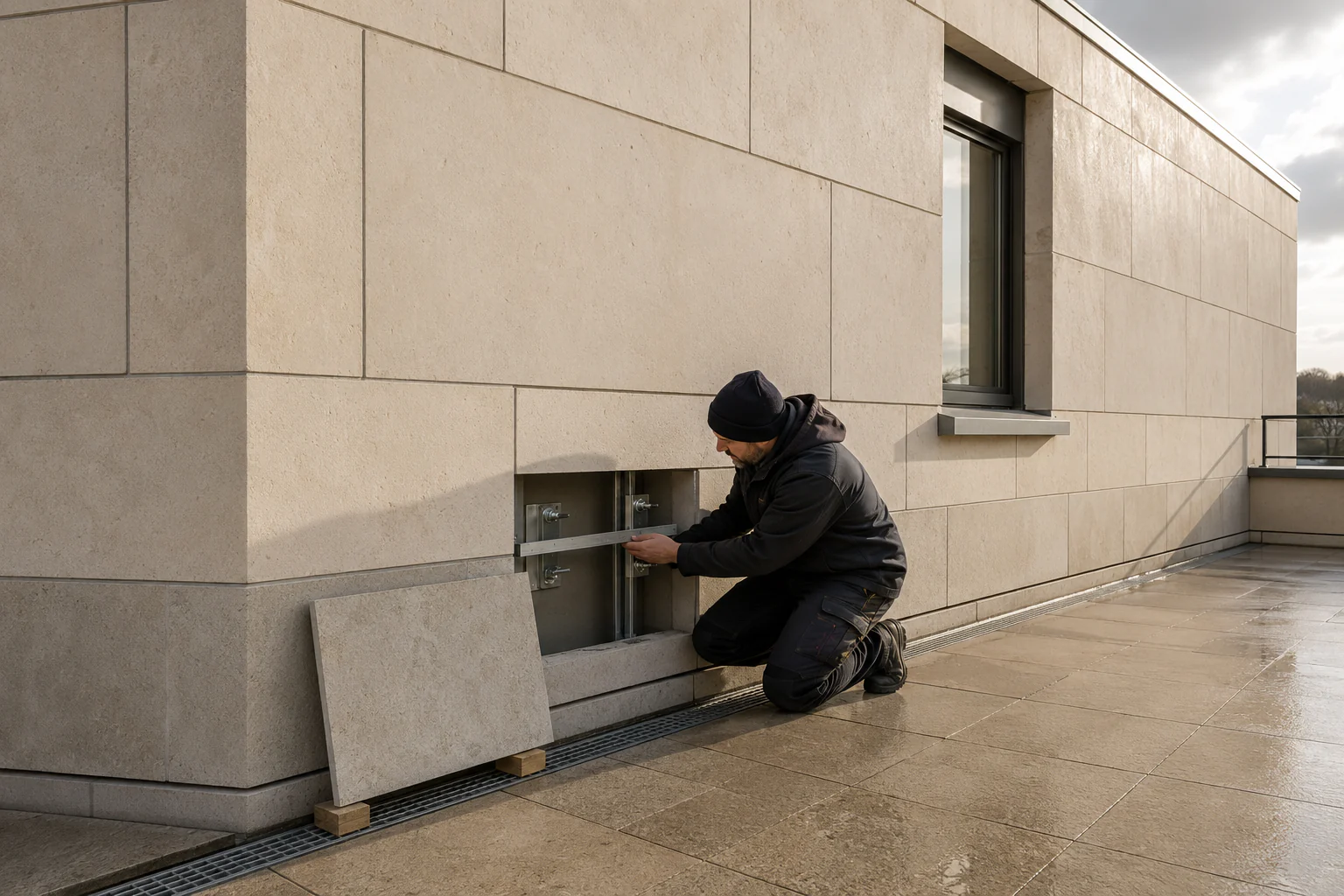
Exterior stone: from decoration to construction system
Outdoors, stone is no longer simply a decorative finish. It becomes an exposed construction component subject to rain, frost, wind, thermal movement, sunlight, pollution, salts, thermal shock, run-off and maintenance. Its suitability therefore requires more rigorous validation than for an interior application.
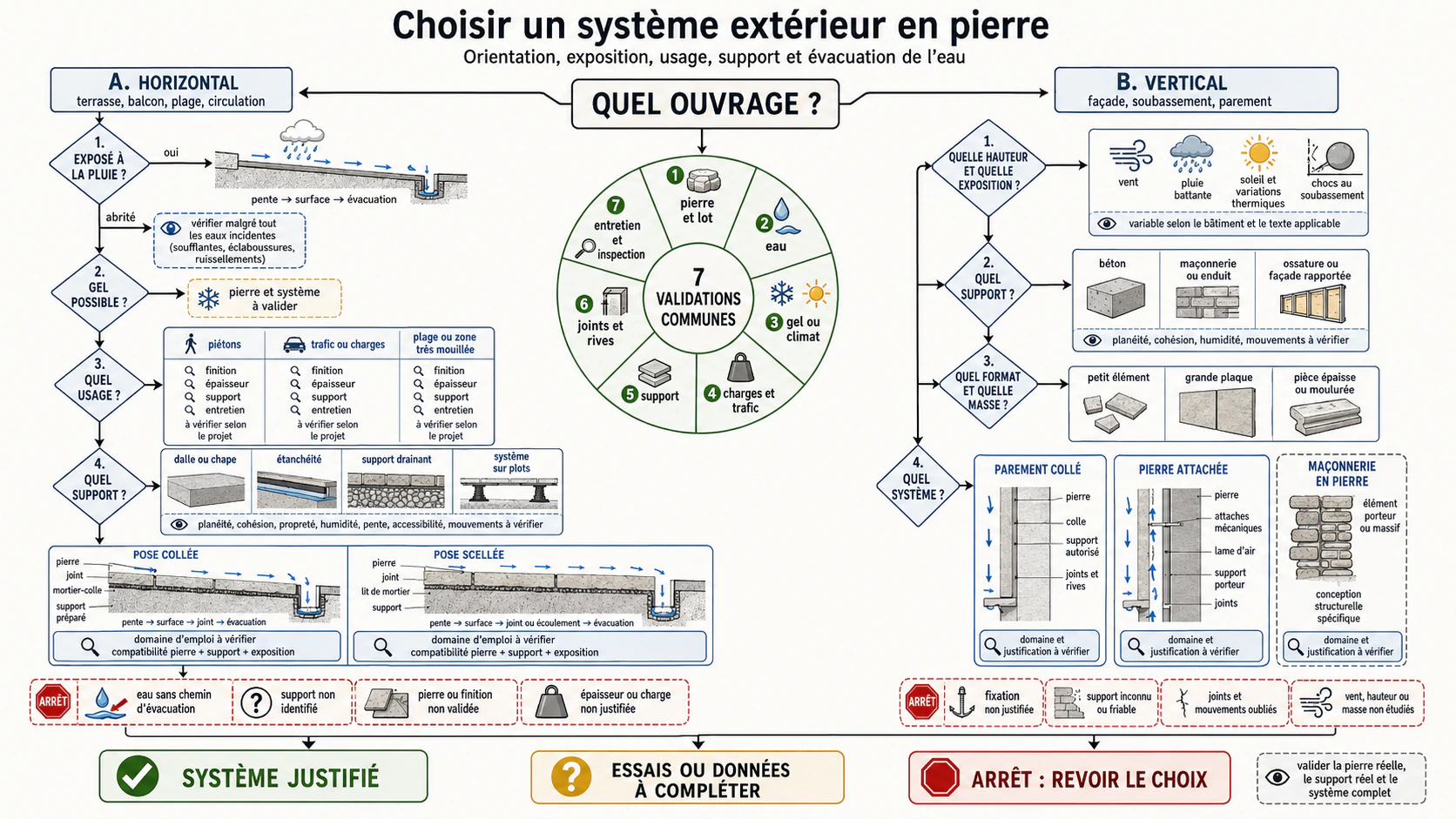
The two main application groups are horizontal surfaces, such as terraces and pool surrounds, and vertical surfaces, such as façades and cladding. They require different specification strategies.
Terraces, pool surrounds and exterior paving
A terrace requires stone with verified water and freeze-thaw suitability, an appropriate slip-resistant finish, adequate falls, effective drainage, compatible joints and a coherent installation method. Standing water is the principal threat because it encourages frost damage, salt migration, biological growth, staining and failure of the build-up.
Travertine and selected limestones, granites, quartzites or sandstones may be suitable, depending on their quality and the project conditions. Polished decorative marble is rarely the right choice for a wet exterior surface.
- Confirm freeze-thaw performance and water absorption.
- Design adequate falls and water outlets.
- Choose a textured finish that remains practical to clean.
- Avoid formats or thicknesses that are incompatible with the support system.
- Allow for salts, chlorine, leaves, furniture and cleaning requirements.
Mechanically fixed stone façades
A façade must be designed as part of the building envelope. The stone panel, thickness, fixing system, substrate, ventilation, joints, wind, frost, fire performance, maintenance and future replacement strategy must all work together. Appearance alone is not enough.
The French project specification (CCTP) should state the required performance, supporting tests, format, finish, tolerances, fixing method, visual acceptance criteria and batch approval process. Specialist technical validation is strongly recommended for this type of work.
Façade checks
| Subject | Question | Risk if omitted |
|---|---|---|
| Stone | Stone family, absorption, freeze-thaw behaviour, flexural strength and thickness? | Breakage, deterioration or non-compliance. |
| Fixings | Is the system suitable for the panel format and substrate? | Deformation, pull-out or system failure. |
| Joints | Open or sealed joints, ventilation and movement provision? | Water ingress, staining or excessive stress. |
| Stone layout | Formats, drilling, corners and replacement strategy? | Excessive waste, poor visual continuity or impossible maintenance. |
| Maintenance | Have cleaning and access been planned? | Soiling and difficult remedial work. |
Exteriors: water, frost and movement
Exterior stone responds continuously to its environment. Rainwater, frost, salts, pollution, wind, temperature changes, cleaning and biological growth all affect service conditions. A stone that performs perfectly on an interior wall may be vulnerable outdoors if its absorption, freeze-thaw behaviour or finish is unsuitable.
The project must therefore coordinate falls, drainage, joints, thickness, installation system and maintenance. On a terrace or pool surround, slip resistance and the way the finish ages are as important as colour.
Façades: from decorative stone to construction element
A natural-stone façade cannot be treated like interior cladding. Panel dimensions, weight, flexural strength, fixings, joints, any required ventilation, interfaces and maintenance provisions must form a coherent system.
The specifier must assess the complete system: stone, thickness, format, anchorage, substrate, exposure, height, wind actions and the ability to inspect it over time. Test evidence and recognised technical rules are essential.
- Never approve a façade solely from a decorative sample.
- Request the mechanical performance data relevant to the selected system.
- Design joints and movement accommodation from the outset.
- Treat corners, reveals, sills and fixing locations as critical details.
- Involve technical specialists for height, large formats or sensitive stones.
Understanding exterior stone as a complete system
An exterior natural-stone installation is never simply stone placed outdoors. It combines climate, exposure, falls, substrate, installation method, joints, finish, maintenance and a defined route for water discharge. Treating any one of these elements in isolation makes the project vulnerable.
The first decision is to classify the work: private terrace, pool surround, threshold, exterior staircase, mechanically fixed façade, adhesive-fixed cladding, plinth, sill, coping, low wall, pedestrian paving or public realm. Each category brings its own risks, including standing water, frost, salts, wind, impact, slip resistance, pollution, maintenance and safety at height.
| Initial question | Why it matters | Decision it informs |
|---|---|---|
| Is the stone horizontal or vertical? | Water behaves differently on a terrace and on a façade. | Define falls, drainage, run-off or the fixing strategy. |
| Is the installation exposed to freeze-thaw cycles? | Frost becomes damaging when water enters and remains trapped. | Review freeze-thaw data, absorption, falls and the drainage system. |
| Will people walk on the surface? | Safety depends on wet slip resistance, wear and cleaning. | Select a textured yet maintainable finish. |
| Is the stone installed at height? | Façades introduce safety, wind, fire, fixing and maintenance requirements. | Assess the complete system and obtain technical validation. |
| Will the stone be exposed to salts, chlorine or pollution? | Deposits and chemicals can accelerate staining, soiling and deterioration. | Specify compatible stone, finish, joints and maintenance procedures. |
Terraces: water management determines durability
Terraces are common but deceptively demanding. Although they resemble interior floors, they are exposed to rain, frost, sun, thermal movement, leaves, biological growth, furniture, repeated cleaning and sometimes de-icing salts. Durability depends less on a marketing label than on the system’s ability to discharge water.
A reliable terrace requires clearly defined falls, a coherent substrate, effective drainage, joints that accommodate movement, stone whose thickness and strength suit the installation method, and a finish that remains safe when wet and worn.
- Avoid low points where water can pond.
- Do not select the finish from a dry sample alone.
- Match thickness to format, installation method and support positions.
- Define water outlets before finalising the stone layout.
- Coordinate thresholds, edges, channels, steps and façade junctions.
- Explain that exterior stone weathers, becomes soiled and requires seasonal maintenance.
Pool surrounds: water, barefoot use and treatment chemicals
Around a pool, stone must withstand a particular combination of conditions: frequent water exposure, barefoot use, surface heat, splashing, chlorine or salt, sunscreen, furniture, possible frost, regular cleaning and demanding visual expectations. Selection must go beyond colour or a Mediterranean appearance.
The finish must provide suitable traction when wet without becoming uncomfortable under bare feet. The stone must also withstand treatment chemicals, repeated wetting and drying, organic staining and periodic maintenance.
| Subject | Key consideration | Recommended approach |
|---|---|---|
| Barefoot use | An excessively rough finish may be uncomfortable. | Assess the surface texture when wet. |
| Slip resistance | Soap, sunscreen and water can significantly change surface behaviour. | Choose a finish intended for wet areas. |
| Chlorine or salt | Deposits may mark joints, pores and textured surfaces. | Rinse and maintain the surface, avoiding incompatible treatments. |
| Surface heat | Dark stones can become uncomfortable in direct sunlight. | Consider colour, exposure and barefoot use together. |
| Freeze-thaw exposure | A pool surround often retains more water than a conventional terrace. | Confirm drainage, falls, absorption and freeze-thaw suitability. |
Freeze-thaw cycles: trapped water is the real problem
Frost does not affect dry stone in the same way as water-saturated stone. The critical mechanism occurs when water enters pores, cracks, joints or the substrate and expands as it freezes. The resulting pressure can cause spalling, cracking, disintegration, lifting or granular loss.
Freeze-thaw performance must be assessed alongside porosity, water absorption, potential saturation, falls, drainage and the frequency of freezing and thawing. A stone described as suitable for exterior use may still fail within a build-up that traps water.
| Aggravating factor | Possible consequence | Prevention |
|---|---|---|
| Standing water | Saturation, staining, frost damage and biological growth | Coordinated falls, outlets, drainage and joints. |
| Non-draining substrate | Water pressure beneath slabs, salts and lifting | Exterior-compatible installation system. |
| Highly porous stone | Rapid absorption and repeated saturation | Batch selection, testing, any suitable treatment and maintenance. |
| Sealed or deteriorated joints | Trapped water or uncontrolled ingress | Properly designed, maintained and compatible joints. |
| De-icing salts | Crystallisation, staining and accelerated deterioration | Avoid or strictly control their use according to the stone and setting. |
Exterior finishes: safety, cleaning and ageing
An exterior finish must be judged over its service life, not only on delivery day. A surface that is too smooth may become slippery when wet, while an excessively rough surface may retain biological growth, dust, pollution, barbecue grease or leaf marks. The right balance depends on the area, falls, traffic and accepted maintenance.
A mirror polish is generally unsuitable for wet terraces and pool surrounds. Honed, brushed, sandblasted, shot-blasted, bush-hammered or flamed finishes may be appropriate depending on the stone, but texture, slip resistance, cleaning and appearance after wear must all be assessed.
| Finish | Exterior advantage | Points to consider |
|---|---|---|
| Honed | Understated, comfortable and contemporary appearance | May remain too smooth in very wet areas, depending on the stone. |
| Brushed or antiqued | Soft texture and a lively, natural surface | Recesses may retain dirt or biological growth. |
| Sandblasted or shot-blasted | More consistent traction and a matt appearance | May become soiled if maintenance is insufficient. |
| Bush-hammered | Pronounced texture and good traction | Harder underfoot and more demanding to clean. |
| Flamed | Widely used on compatible granites | Not all stones tolerate the thermal shock of flaming. |
| Polished | Strong colour depth and visual impact | Avoid on wet exterior paving unless specifically justified. |
Exterior installation methods: adhesive-fixed, mortar-bed, pedestal or drainage systems
The installation method must be selected together with the stone, not as an afterthought. Fully bonded, mortar-bed, pedestal-supported and drainage-system slabs have different requirements for thickness, flexural strength, flatness, joints, acoustics, maintenance and repair.
For a client, the principle is simple: the more easily water can enter the build-up, the more effectively it must be able to leave. The selected method must accommodate drainage, movement, stable support and future access for repairs.
| Method | When to consider it | Points to confirm |
|---|---|---|
| Exterior adhesive fixing | Prepared substrates, compatible formats and an approved system | Falls, adhesive, back-buttering where required, joints and field of use. |
| Traditional mortar-bed installation | Traditional construction or thicker stone, depending on the project | Decoupling, moisture, drainage and drying time. |
| Installation on pedestals | Accessible terraces, removable slabs and services beneath | Thickness, flexural strength, supports, edges, noise and stability. |
| Drainage installation system | Exposed terraces or settings requiring rapid water discharge | Drainage layer, falls, joints, thresholds and maintenance. |
| Pedestrian paving or public realm | Slabs, setts, kerbs, loads and traffic | Bedding, thickness, abrasion, slip resistance, accessibility and maintenance. |
Façades: select the system before the stone
A natural-stone façade forms part of the building envelope. The visible material is only one element: substrate, fixings, any insulation, cavity, joints, wind, fire, rain, maintenance, replacement, stone layout and work at height must all be coordinated.
The question is not simply whether a stone looks attractive on a façade. The real question is whether that stone, at the proposed thickness and format, in that exposure and fixing system, can perform durably and be inspected throughout its service life.
- Identify the substrate: concrete, masonry or another structure, in new-build or refurbishment.
- Define the system: mechanically fixed panels, solid stone, adhesive-fixed cladding, ventilated rainscreen or a project-specific solution.
- Verify flexural strength, freeze-thaw performance, absorption and compatibility with the fixings.
- Coordinate joints, any required ventilation and water discharge.
- Treat corners, reveals, lintels, sills, parapets and façade bases as technical details.
- Involve a façade engineer whenever height, wind, fire or large formats require specialist input.
Mechanically fixed thin-stone façades: validation principles
Mechanically fixed façade systems require substantially more supporting evidence than interior cladding. Thin stone panels are carried by metal fixings connected to the substrate, with joints and details designed to accommodate wind, temperature changes and façade movement.
Exact values depend on the applicable technical rules, selected system and project. The essential principles remain consistent: controlled panel size, appropriate thickness, suitable stainless-steel fixings, verified stone strength, compatible substrate, resolved interfaces and provision for maintenance.
| Item to validate | Why it matters | Mistake to avoid |
|---|---|---|
| Panel size and area | As a panel becomes larger, wind actions, weight and bending effects increase. | Using an interior panel format on a façade without calculation. |
| Thickness | It affects flexural performance, fixing capacity and safety. | Selecting thickness solely to reduce cost. |
| Fixings | They transfer loads to the substrate. | Using an unverified or incompatible system. |
| Substrate | A fixing is effective only if the substrate can resist the applied loads. | Omitting an assessment of concrete, masonry or the existing structure. |
| Joints | They accommodate movement, water management, ventilation and the visual rhythm. | Reducing joints to imitate an interior wall. |
| Replacement | A façade must remain inspectable and maintainable. | Designing a layout that prevents panel replacement. |
Wind, height, seismic design and fire
Façades introduce risks not present at floor level. Wind creates positive and negative pressures, while height increases the consequences of failure. Seismic zones, public buildings, residential buildings and certain façade refurbishments may impose additional requirements.
Fire performance must also be assessed at system level, including the stone, any insulation, cavity, cavity barriers, openings, substrate and building regulations. Natural stone alone does not establish the fire performance of the complete façade.
- Determine wind actions according to height, location, exposure and building-edge zones.
- Do not assume that non-combustible stone automatically makes the complete façade compliant.
- Coordinate the cavity, cavity barriers and openings in externally insulated projects.
- Check seismic requirements for non-structural elements where applicable.
- Obtain a project-specific calculation or approval when the system falls outside standard practice.
Joints, run-off and critical interfaces
Exterior defects often begin at interfaces: thresholds, internal corners, structural joints, façade bases, terrace edges, outlets, penetrations, sills, copings, stair nosings and junctions with windows or doors. These locations concentrate water, movement and soiling.
A sound exterior detail answers three questions: where does the water go, what happens when the substrate moves, and how can the component be cleaned or replaced? Clear answers make the project more robust.
| Critical interface | Main risk | Design response |
|---|---|---|
| Threshold | Water entering the building, frost and slip risk | Falls, drip detail, flexible joint and upstand where required. |
| Façade base | Rising moisture, soiling, impact and salts | Draining detail, protection and accessible cleaning. |
| Sill and coping | Run-off over the cladding | Projection, falls, drip and controlled joints. |
| Corner | Impact, fragile cuts and poor visual continuity | Appropriate pieces, protected edges and a coordinated layout. |
| Water outlet | Concentrated water and soiling | Position before finalising the layout and retain access. |
| Structural movement joint | Building movement | Continue it through the finish without rigidly bridging it with stone. |
Which stone families should be considered outdoors?
No stone family should be approved automatically. Granite is often robust, but its finish still matters. Travertine can work very well on terraces, but quality, porosity, filling, thickness and drainage are decisive. Limestones can be exceptional for façades or paving, yet their freeze-thaw behaviour varies widely. Quartzites may provide high strength, subject to assessment of natural weakness planes and finish. Decorative marbles require greater caution.
Start with the application and climate, then compare actual available materials together with their technical data, finish and proposed installation method.
| Stone family | Potential exterior use | Points to consider |
|---|---|---|
| Granite | Often a strong candidate for terraces, stairs, public paving or façades, depending on the finish. | Often more granular in appearance; assess the wet finish and weight. |
| Quartzite | High strength with a decorative appearance that may resemble marble. | Confirm the true geological classification, weakness planes and exterior performance. |
| Travertine | Warm appearance, widely used for terraces and pool surrounds. | Porosity, voids, filling, freeze-thaw exposure, drainage and maintenance. |
| Limestone | Strong architectural character; selected stones suit façades and paving. | Absorption and freeze-thaw behaviour vary greatly between stones. |
| Marble | Distinctive, premium appearance on façades or protected details. | Acids, frost, possible bowing, slip resistance and patina. |
| Sandstone | Often well suited to exterior use, depending on provenance. | Verify absorption, freeze-thaw performance, thickness and finish. |
| Onyx or alabaster | Exceptional decorative impact. | Reserve for protected or interior applications, not routine exposed exterior use. |
Exterior maintenance: accepting natural ageing while preventing deterioration
Exterior stone develops a patina. It receives dust, rain, pollen, leaves, pollution, microorganisms, furniture marks, mineral deposits and splashes. This evolution is normal, but maintenance is required to prevent ordinary weathering from becoming deterioration.
Exterior maintenance must remain compatible with the stone. Aggressive pressure washing, acids, chlorinated products, limescale removers and film-forming treatments can damage certain marbles and limestones. Begin with sweeping and clean water, add a pH-neutral product only where required, test locally and increase treatment gradually.
- Plan gentle seasonal cleaning before heavy soiling develops.
- Avoid acidic products on marble, limestone and travertine.
- Test any water- or oil-repellent treatment on a sample or inconspicuous area.
- Inspect joints, outlets and ponding areas after winter.
- Remove biological growth and soiling without making the surface dangerously slippery.
- Provide a written list of approved care products at handover.
Common exterior stone defects
Exterior defects rarely have a single cause. A stain may come from leaf tannins, metal, rising moisture or a cleaning product. Spalling may result from frost, impact, a natural weakness or installation stress. Diagnose the mechanism before treating the symptom.
The correct approach is to understand the mechanism before choosing a remedy. Rather than reaching immediately for a miracle product, investigate water, salts, substrate, finish, installation, maintenance and the history of the work.
| Symptom | Possible causes | Prudent response |
|---|---|---|
| Spalling or flaking | Frost, salts, impact, unsuitable stone or trapped water | Check water, drainage, freeze-thaw behaviour and substrate before repair. |
| White deposit or haze | Grout residue, efflorescence, salts or poorly rinsed product | Identify the source before considering any acidic cleaner. |
| Biological growth and green staining | Persistent moisture, shade or soiled surface texture | Gentle cleaning and correction of ponding where possible. |
| Brown stains | Leaves, timber, metal, soil or moisture | Test progressively stronger cleaning and remove the cause. |
| Moving slabs | Unstable bearing, pedestals, substrate, drainage or joints | Inspect the complete system, not only the slab. |
| Cracks | Bending, point support, substrate movement or impact | Assess the structure, thickness, format and installation method. |
Exterior stone approval file before ordering
Before ordering stone for an exterior application, assemble a concise but complete approval file. This prevents visual intent from being confused with technical validation, supports meaningful comparison of quotations and avoids loosely defined substitutions.
The file should be proportionate: a small private terrace does not require the same level of evidence as a multi-storey façade or public square. The principle remains the same: material, application, finish, installation, water, frost, slip resistance, maintenance and supporting documents must be coherent.
| File item | Purpose | Especially important for |
|---|---|---|
| Sample and batch photographs | Approve appearance, variation and finish | All visible surfaces. |
| Technical data sheet | Review stone family, performance, finish and tolerances | Terraces, façades, stairs and public spaces. |
| Freeze-thaw test | Verify behaviour through freeze-thaw cycles | Cold climates, terraces and exposed façades. |
| Absorption and porosity | Assess water, staining, treatments and frost risk | Travertine, limestone, marble and wet areas. |
| Flexural strength | Design large formats, steps, pedestal slabs and façade panels | Thick slabs, pedestal systems, façades and stairs. |
| Slip resistance | Verify safety in wet conditions | Terraces, pool surrounds, stairs and public access. |
| Installation and stone-layout drawings | Coordinate falls, joints, cuts and outlets | Large areas or architecturally designed layouts. |
| Care instructions | Reduce maintenance errors after handover | Pools, hotels, restaurants and exposed exterior areas. |
Decision method for an exterior stone project
A useful recommendation should never be reduced to ‘choose this marble’. It should guide a structured assessment: where will the stone be installed, what will it be exposed to, how will water leave, who will walk on it, how will it be cleaned and what evidence supports the selection?
This method turns a vague request such as ‘I want a light-coloured stone terrace’ into a controlled brief covering climate, colour, stone family, finish, thickness, installation, joints, drainage, available stock and maintenance.
| If the client requests | Questions to ask | Recommended direction |
|---|---|---|
| Light-coloured terrace | Freeze-thaw exposure? Pool? Accepted maintenance? Shade or sun? | Compare travertine, dense limestone, light granite or quartzite using project-specific data. |
| Stone around a pool | Barefoot use, chlorine or salt, slip resistance, heat and cleaning? | Assess the wet finish and avoid stones that are excessively dark or smooth. |
| Stone façade | Height, substrate, wind, fire, system and maintenance? | Use a validated mechanically fixed or alternative façade system, with engineering input where required. |
| Large-format exterior paving | Pedestal-supported or adhesive-fixed? Thickness? Flexural strength? | Design the slab before fixing the final format. |
| Marble outdoors | Exposure, frost, acids, finish and accepted patina? | Validate rigorously or propose a suitable granite, quartzite or limestone. |
| Maintenance-free stone | What level of maintenance is genuinely acceptable? | Explain that a durable exterior requires at least seasonal cleaning and inspection. |
Key concepts
Continue reading
Related guides
Diagnosis: Stained, Blackened or Run-Off-Marked Stone Façades
Read the pattern of soiling to distinguish run-off, pollution, corrosion, microorganisms, salts, coping defects and migration from joints or fixings.
Technical Guidance: NF DTU 55.2 and Mechanically Fixed Thin-Stone Façades
Responsibilities, calculations, tests, fixings, substrates, joints and inspections required for the safety of a mechanically fixed stone façade.
Technical Guidance: Walls, Renders, Substrates and Façade Joints
Coordinate masonry, concrete, renders, sealants and stone cladding without asking the finish to perform the substrate’s function.
Fire, Wind, Seismic Design and Eurocodes for Natural Stone
Natural stone is heavy, rigid and durable, but it must be designed as a complete system on façades, in large formats, on stairs, outdoors or in exposed construction. Eurocodes provide the design framework; the specification must then coordinate stone, substrate, fixings, wind, fire, seismic actions, thickness and maintenance.
Mechanically Fixed Stone Façades: Fixings, Joints, Maintenance and Responsibilities
A natural-stone façade is never simply decorative cladding: it combines stone, fixings, substrate, ventilation, joints, water, wind, fire, seismic design, maintenance and defined responsibilities.
Natural-Stone Terraces: Drainage, Frost, Pedestals, Falls and Exterior Maintenance
A natural-stone terrace must be designed around water management: falls, drainage, freeze-thaw exposure, joints, substrate, pedestals, slab thickness, slip resistance, cleaning and future slab replacement.