Architecture and interiors
Marble and Natural-Stone Fireplaces: Styles, Heat and Safe Design
Understand fireplace styles and design a marble or natural-stone surround that coordinates proportion, heat, structure, installation and long-term care.
An architecture built around fire
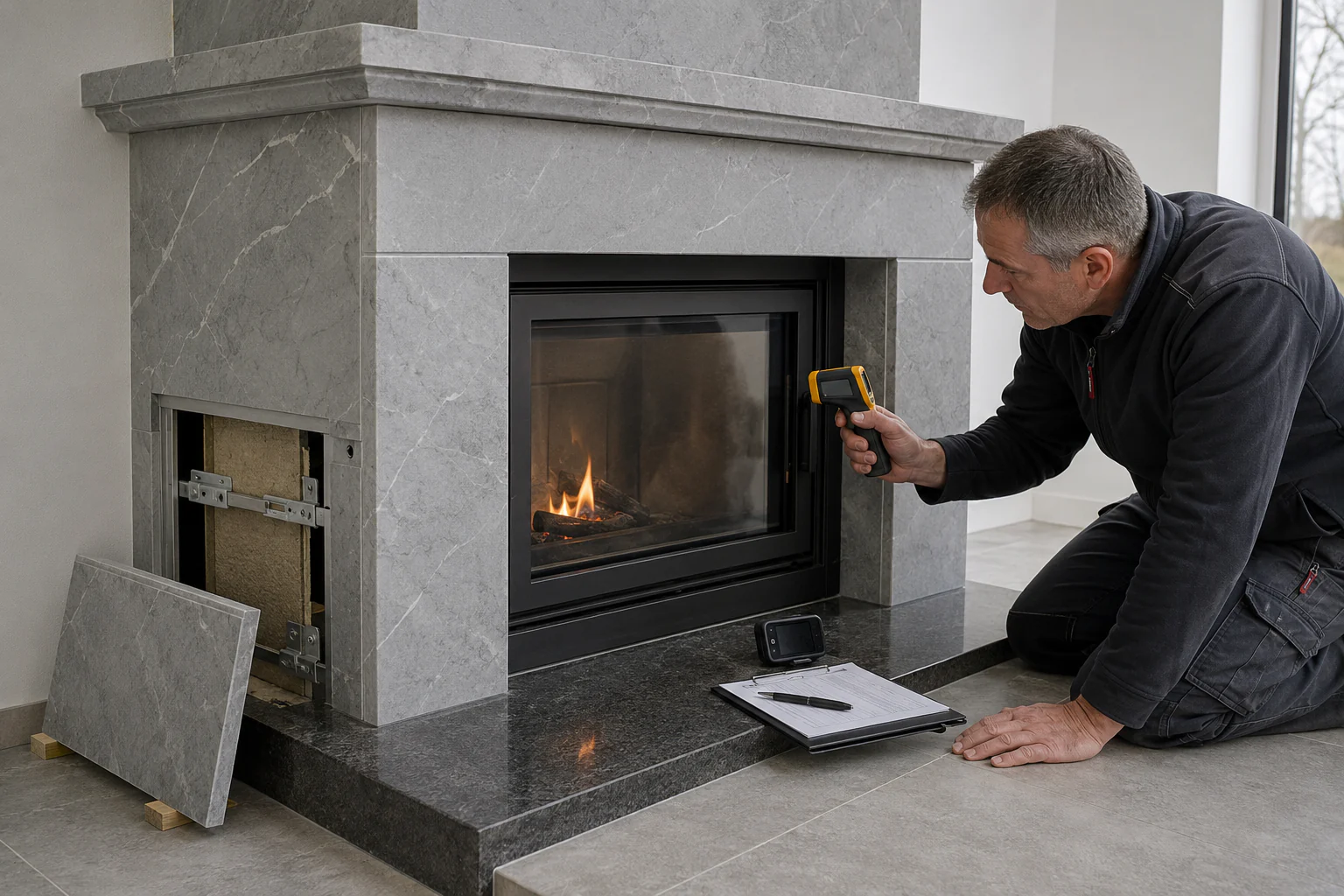
A fireplace combines three distinct systems: the appliance or firebox contains the heat source, the flue removes combustion products, and the stone surround forms the visible architecture. They work together but do not have the same technical role.
In many contemporary projects, marble is decorative cladding around a closed insert, gas appliance or electric fire. Stone is non-combustible, but that fact alone does not validate clearances, ventilation, fixings or flue design.
Why marble works so well
Marble can be carved into crisp profiles, polished to depth and selected in whites, blacks, reds, greens, breccias and expressive veins. Firelight gives polished and honed surfaces movement, while book-matching can make the surround a composed artwork.
The selection must also consider thermal gradients, resin, hidden repairs, veins, soot and impact. A beautiful slab may suit the outer surround but not a position exposed to intense local heat.
Historic styles and proportion
Gothic fireplaces emphasise mass, pointed or depressed arches and deep masonry. Renaissance designs adopt columns, pilasters, friezes and classical symmetry. Louis XIV favours monumentality; Régence and Louis XV introduce movement and curves; Louis XVI returns to refined straight lines.
Directoire and Empire designs use geometry, symbolic ornament and strong contrasts. Nineteenth-century Parisian surrounds are often more restrained and adaptable. In every case, proportion matters more than adding decorative motifs.
| Style | Typical character | Suitable stone expression |
|---|---|---|
| Gothic | Deep, structural and vertical | Limestone or restrained honed marble |
| Renaissance | Ordered, symmetrical and sculptural | Fine-grained marble with controlled contrast |
| Louis XV | Curved and fluid | Veining coordinated across shaped pieces |
| Louis XVI | Straight, refined and neoclassical | Calm marble that preserves detail |
| Contemporary | Minimal or monolithic | Large-format stone with precise joints |
Wood, gas and electric systems
Wood-burning appliances require a compliant flue, air supply, hearth protection and clearances to combustible materials. Gas systems require installation and exhaust arrangements approved for the selected appliance. Electric fires remove combustion gases but still have ventilation and manufacturer requirements.
Never transfer a clearance from one project to another. Use the appliance documentation, applicable local rules and a qualified installer. The stone drawings must be coordinated with the approved technical system.
Designing the stone surround
Set out jambs, header, shelf, hearth and returns from measured site dimensions and the appliance envelope. Bearings, hidden brackets and joints must allow assembly without forcing the stone. Long thin shelves and veined lintels deserve particular structural attention.
Use full-size templates for irregular walls and historic openings. Approve profiles and mouldings at scale, then dry-assemble complex surrounds in the workshop so joints and vein continuity can be checked before delivery.
Heat, movement and joints
Stone, metal, masonry and plaster expand differently. Direct rigid contact can create cracks or debonding. Appropriate gaps, flexible interfaces and mechanically sound supports allow each component to move as intended.
Resins, adhesives and fillers must be selected for the temperatures they may experience. Decorative bonding must never replace structural support where a heavy piece could fall.
Installation and handover
Confirm substrate condition, floor capacity, appliance position, flue route and finished levels before fabrication. Protect polished faces and fragile edges during handling, and use lifting methods suited to the weight and centre of gravity.
At handover, verify stability, joint finish, clearances, ventilation openings, hearth geometry and access for appliance maintenance. Keep drawings, product data and stone-care instructions with the property records.
Cleaning, repair and restoration
Remove loose dust and soot with dry, non-abrasive methods before introducing water or chemicals. Acidic household cleaners can etch marble. Always test a compatible product on a discreet dry area.
Historic surrounds should be recorded before dismantling. Retain original pieces, old tool marks and patina wherever possible. Repairs should be structurally sound but visually restrained, allowing the fireplace history to remain legible.
Need advice for a real project?
Marble Import supports international homeowners, architects and interior designers with stone selection, samples, technical feasibility and coordination of high-end stonework in France and across Europe.