
Fabrication and craftsmanship
Stone Cutting, Carving and Stereotomy
Follow natural stone from geological block to precisely cut architectural element, with guidance on sawing, waterjet and CNC machining, hand carving, stereotomy, tolerances, safety and workshop control.
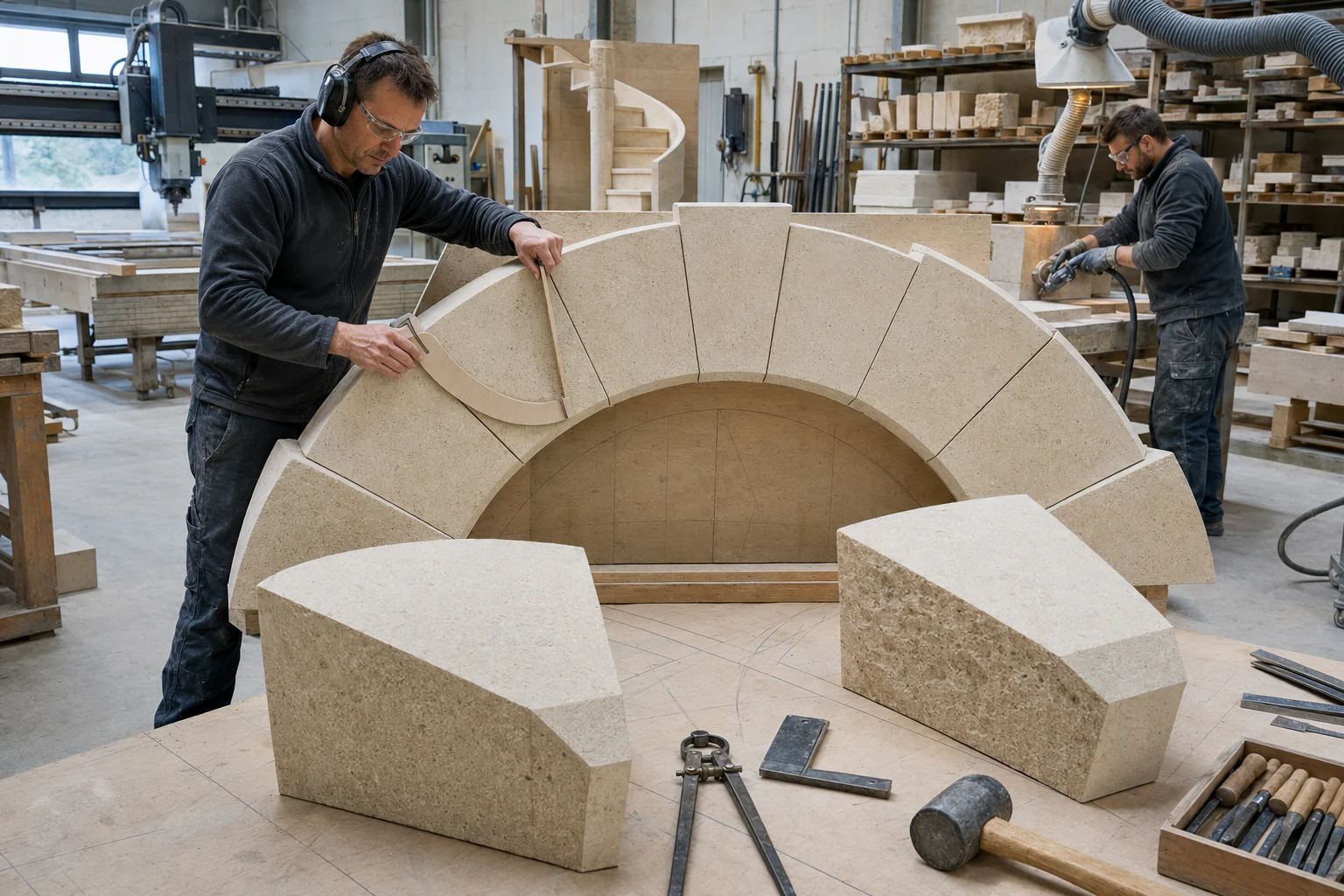
From geological block to architectural component
Cutting natural stone transforms an irregular geological volume into components that must meet an architectural, structural and visual purpose. Every decision affects yield, vein direction, strength, colour continuity and cost.
The process begins before the saw. Blockk inspection identifies beds, veins, fissures, cavities, repairs and the dimensions that can be obtained safely. The cutting plan then relates these features to the project layout.
Primary sawing and slab production
Gang saws, diamond wire and large bridge saws divide blocks into slabs or thick pieces. Feed rate, cooling water, blade condition and support influence flatness, chipping and tool marks.
Slab thickness must allow for calibration and finishing. Thin tolerances cannot be promised independently of block quality, piece size, finish and later reinforcement.
| Process | Typical purpose | Key control |
|---|---|---|
| Diamond wire | Blockk extraction and primary cutting | Alignment, cooling and surface deviation |
| Gang saw | Repeated slab production | Thickness consistency and blade tracking |
| Bridge saw | Straight project cuts | Dimensions, squareness and edge quality |
| Waterjet | Complex shapes and internal cuts | Kerf, taper and starting points |
| CNC machining | Profilees, drilling and repeated geometry | Toolpath, support and reference datum |
| Hand carving | Detail, fitting and final character | Grain reading and controlled impact |
Waterjet and CNC machining
Waterjet cutting is useful for curves, inlays and shapes with limited heat input. CNC centres can profile edges, drill, mill relief and reproduce complex geometry. Both depend on accurate files, stable supports and realistic tool access.
Digital precision does not remove material variability. Fragile veins, unsupported offcuts and narrow bridges can fail even when the geometry is correct. Machining strategy must follow the stone.
Hand tools and the stonemason’s judgement
Point chisels, tooth chisels, pitching tools, mallets, abrasives and rifflers remain essential for carving, fitting, repairing and producing characteristic finishes. Hand work also reveals sound and resistance that a digital model cannot describe.
Tool direction and impact are adapted to the grain, bed and edge. The aim is not merely to remove material but to control fracture and leave the intended surface without bruising the stone beneath.
Edges, openings and internal corners
Sink openings, slots, rebates and sharp internal corners concentrate stress. Use radii where possible, maintain adequate residual sections and support the piece throughout machining and transport.
Mitres and thin edges require controlled calibration and bonding. A visually fine detail should not depend on an invisible strip too fragile to survive installation or use.
Stereotomy: geometry made buildable
Stereotomy defines the three-dimensional pieces that form arches, vaults, stairs, squinches and complex junctions. It translates survey geometry and load-bearing logic into contact faces, joints and individually numbered stones.
For arches and vaults, voussoirs must meet with deliberate joint geometry and bear on capable supports. Cutting files, templates, centring and site assembly must share the same datum.
Surface finishing
Grinding and polishing progressively refine the surface; honing gives a lower sheen; brushing, bush hammering, sandblasting and other textures change light, grip and maintenance. The same finish name can vary between workshops and stones.
Approve a physical finish sample from the actual material. Inspect under raking and diffuse light after drying, because water and processing residue can conceal inconsistency.
Tolerances and workshop quality control
Drawings should define finished dimensions, thickness, flatness, squareness, hole positions, edge profiles, visible faces and joint assumptions. Tolerances must be achievable and coordinated with site conditions.
Inspect the first piece, then control repeated work with calibrated tools. Number pieces, photograph visible faces and preserve the link between slab layout, fabrication file, packing list and installation position.
Handling, packing and site fitting
Many failures occur after machining. Lift large pieces with appropriate equipment, protect edges, keep slabs correctly supported and design crates for the transport route. Handling points should be agreed before production.
Site adjustment must be limited and controlled. Cutting dry without suitable extraction exposes workers to respirable crystalline silica; wet methods, extraction, respiratory protection and local regulations are essential.
Safety and crystalline silica
Stone fabrication can generate hazardous respirable crystalline silica, particularly during dry cutting and grinding of silica-rich rocks. Control dust at source, use water or effective extraction, isolate work areas and follow occupational exposure requirements.
Personal protective equipment supports, but does not replace, engineered controls. Training, equipment maintenance, exposure monitoring and safe housekeeping form part of professional fabrication.
From approval to installation
Approve material, slab layout, geometry, finish and prototype before full production. Coordinate interfaces with supports, fixings, services, waterproofing and adjoining trades.
The final record should include stone identification, piece numbers, drawings, approved samples, repairs, inspection results and maintenance information. This traceability protects both design intent and future repair.
Need advice for a real project?
Marble Import supports international homeowners, architects and interior designers with stone selection, samples, technical feasibility and coordination of high-end stonework in France and across Europe.