Building standards do not exist to reduce marble, granite, limestone or travertine to paperwork. Their practical purpose is to help the project team select the right stone for the right use, understand the expected performance and agree on how the material will be installed.
Natural stone, however, cannot be judged from technical figures alone. The current lot, colour range, veining, finish, lighting and proposed layout remain essential. A successful specification brings these two dimensions together: measurable performance and informed visual approval.
What is a building standard?
A standard is a common technical reference used by designers, manufacturers, contractors, control bodies and clients. It can define terminology, product characteristics, test methods, tolerances or installation practices. A standard is not automatically the same thing as a legal regulation, but it may become contractually important when it is cited in a specification, tender, contract, insurance requirement or accepted rule of practice.
For international teams working in France, this distinction matters. The project may need to satisfy European product standards, French implementation rules, the contractual specification and the requirements of the architect, installer, control body or insurer. The current edition and precise scope of every reference should therefore be checked for the project.
Why natural stone remains a special material
Factory-made products are generally designed for repetition. Natural stone is geological: every block and slab has its own composition, movement and tonal range. Two slabs from the same block may differ, and two blocks from the same quarry can show even greater variation.
This variation is not a defect; it is part of the material’s architectural value. It also means that a data sheet cannot replace inspection of the current lot. A reference sample, representative photographs, slab approval and a clear layout are often required to define the expected appearance.
Four layers of technical information
- Product standards describe products such as wall cladding slabs, modular tiles, floor and stair slabs or paving units.
- Test standards define how characteristics such as flexural strength, water absorption, frost resistance, abrasion or slip resistance are measured.
- Rules for intended use help relate the stone and its performance to an interior floor, external terrace, staircase, façade or wall covering.
- Installation standards and DTU documents address how products are fixed, bonded, laid, jointed and coordinated with the substrate and building system in France.
Common references for marble and natural stone in France
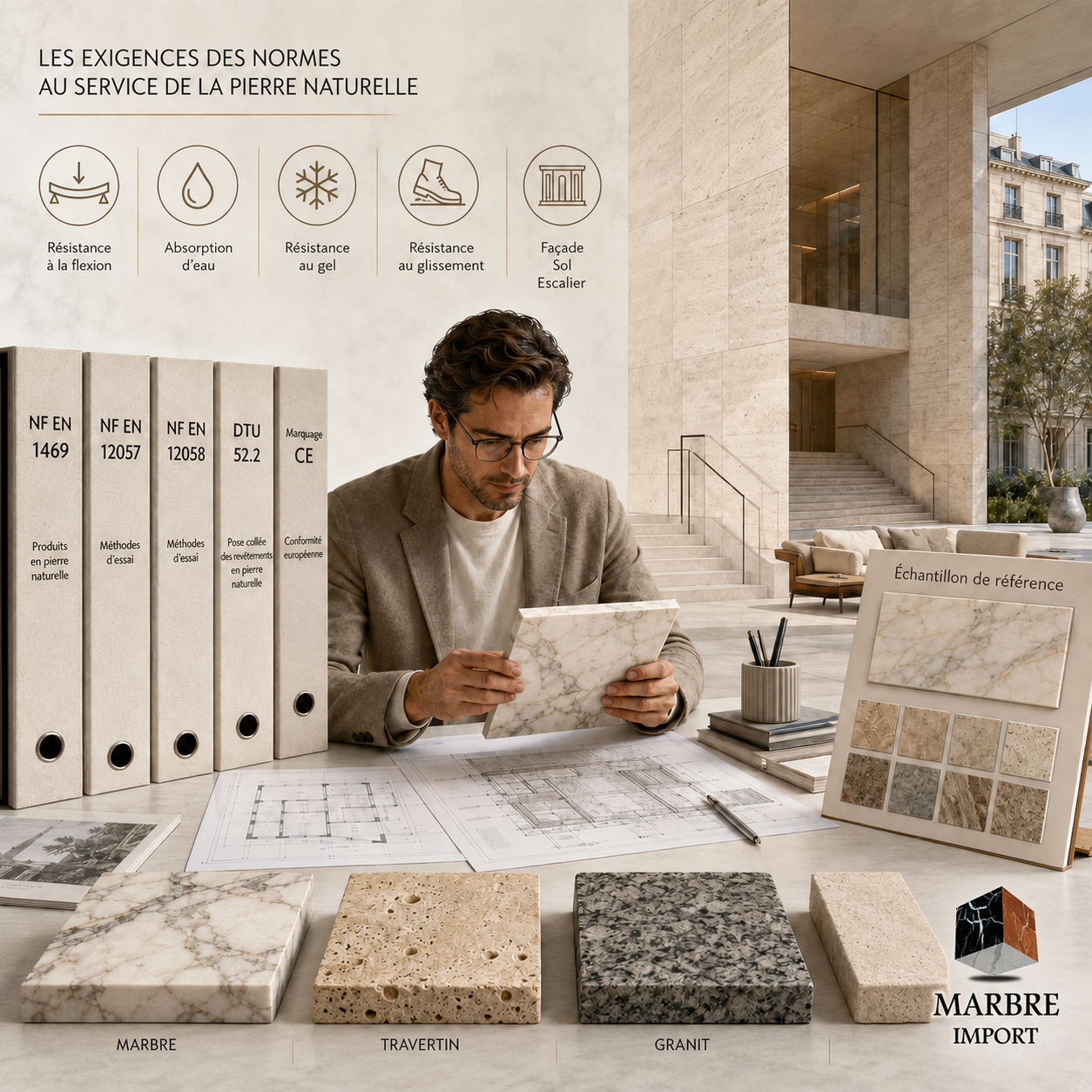
The exact list depends on the application. References commonly encountered include NF B10-601 for general requirements concerning the use of natural stone, NF EN 1469 for natural-stone slabs used as wall cladding, NF EN 12057 for modular tiles and NF EN 12058 for floor and stair slabs.
For installation, the relevant French DTU may include NF DTU 52.1 for sealed floor finishes, NF DTU 52.2 for bonded coverings and NF DTU 55.2 for mechanically fixed thin-stone wall cladding. These references are not interchangeable. Material format, substrate, height, exposure and fixing system determine which framework applies.
This overview is informative rather than a substitute for project-specific technical validation. The architect, engineer, installer, control body and insurer should confirm the applicable documents and current editions.
What CE marking does—and does not—mean
Where a natural-stone construction product is covered by a harmonised European standard, CE marking and a declaration of performance provide a common framework for placing it on the market. They communicate declared characteristics relevant to the intended use.
CE marking is not an aesthetic quality label. It does not guarantee that a stone is suitable for every climate, detail or installation method, and it does not approve colour, veining or workmanship. The project team must still interpret the declared performance in relation to the intended use.
Which properties should be reviewed?
The answer depends on the project. Flexural strength may be critical for cladding panels or large floor formats. Frost resistance and water absorption matter for exposed external work. Abrasion and slip performance may be relevant for public floors or wet areas. Anchored façades require particular attention to stone resistance, panel dimensions, fixing zones, wind loads and support tolerances.
A technical result should never be read in isolation. Thickness, finish, orientation, joints, maintenance and the complete installation system can all change the behaviour of the finished work.
A reliable specification process
- Define the location, exposure, substrate, format, traffic and maintenance conditions.
- Shortlist stones whose test data and previous use are compatible with the application.
- Review the current lot, not only a historic sample or marketing photograph.
- Agree the acceptable colour and veining range, finish, edge details and joint appearance.
- Prepare a cutting or laying plan for projects where vein direction and continuity matter.
- Build a representative mock-up when the façade, floor or feature is technically or visually sensitive.
- Record approvals and responsibilities before fabrication begins.
Support for international teams working in France
French standards, DTU documents and trade practices can be difficult to navigate from abroad. Marbre Import works in English with international homeowners, architects and interior designers. We can help source suitable lots, obtain available technical information, arrange samples and photographs, explain finishes and fabrication constraints, and coordinate deliveries.
For high-end projects, we can also manage or coordinate the marble and natural-stone works with the architect, fabricator and installer. Independent specification reviews, inspections and technical risk analysis are available through Eye Stone Consulting.
Explore our guide to natural-stone façade systems, browse the English catalogue, or discover our services for architects and professional teams.
Need help specifying a stone?
Send us the project location, drawings, intended use, format and finish. We will help identify the questions to resolve before material approval and ordering.