Natural stone gives a façade depth, texture and permanence that manufactured surfaces rarely reproduce. Yet “a stone façade” can describe very different construction systems. Solid or thick stonework, mechanically anchored cladding and bonded stone each have their own limits, weights, detailing requirements and fields of use.
The right solution cannot be chosen from appearance alone. Building height, substrate, climate, wind loads, stone properties, panel size, joints, insulation strategy, maintenance access and the applicable French or European rules must all be considered.
Why specify natural stone on a façade?
A façade is the public face of a building. Limestone can create a calm and luminous elevation; granite brings density and a contemporary character; sandstone or travertine can provide warmth and texture. Correctly selected and detailed, stone also offers exceptional longevity and can connect a new building with its landscape or architectural context.
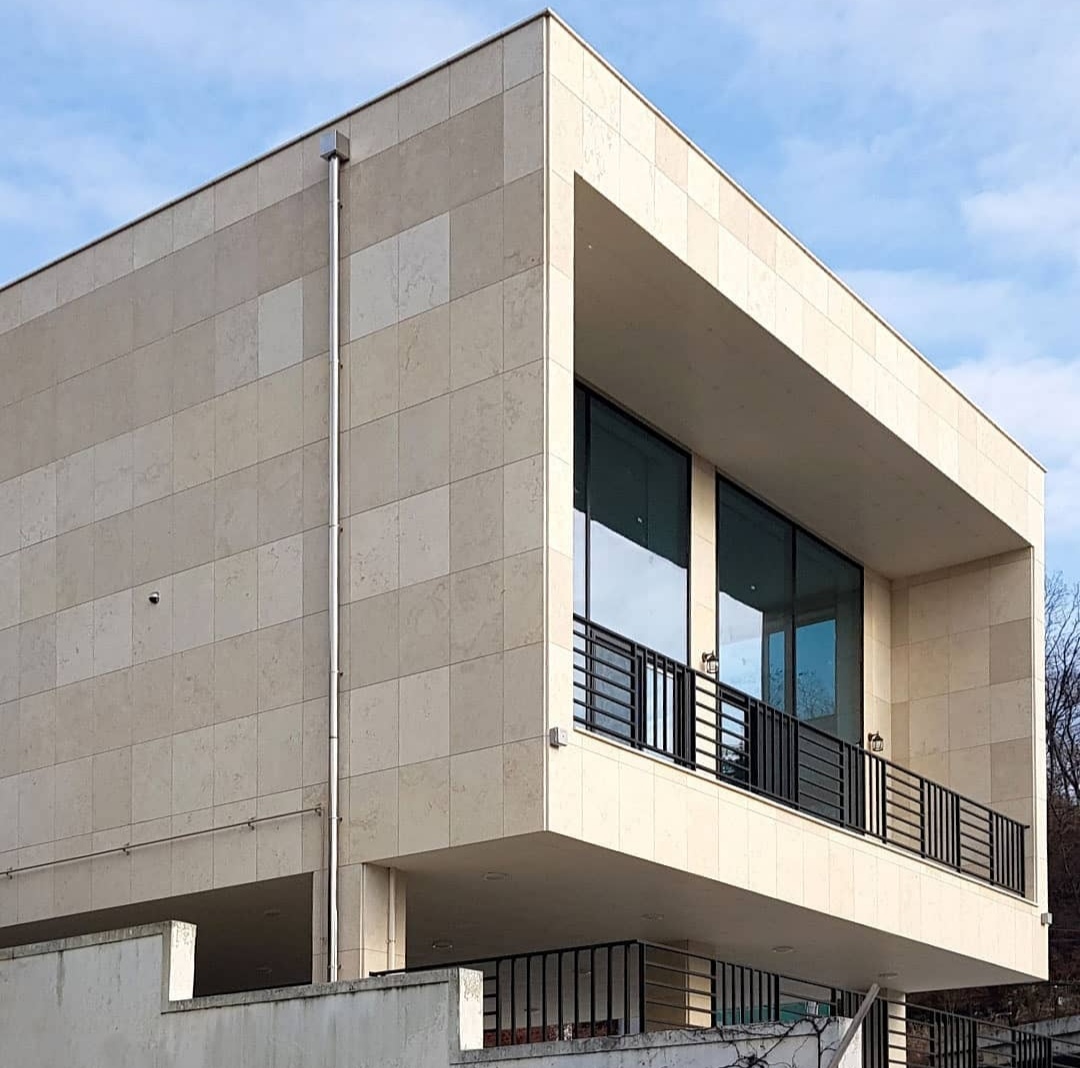
A successful stone façade begins with the relationship between material, format, fixing system and architectural rhythm.
1. Solid or thick stone: mass and architectural presence
Solid stonework uses blocks or thick elements that form part of the wall or create a substantial outer leaf. It is the closest to traditional masonry, but it also suits contemporary architecture when the design calls for deep reveals, strong corners and a visibly mineral construction.
Its advantages are authenticity, durability and three-dimensional detail. Its constraints are weight, foundations, handling, capillary water, joints and the coordination of the wall build-up. A cavity wall can combine an inner structural wall, insulation and an outer stone leaf, but ties, drainage and thermal bridges must be designed as a complete system.
2. Mechanically anchored stone: precision for contemporary façades
Mechanically anchored cladding uses stone panels fixed to the supporting wall or to a secondary frame. The stone is not load-bearing. This approach offers controlled joints, repeatable modules and considerable freedom in the architectural grid. It is widely used for hotels, offices, public buildings and high-end residential projects.
The fixings remain largely invisible after completion, but they are central to safety. Panel thickness, stone flexural strength, anchor resistance, wind loads, building height, seismic conditions and support tolerances must be assessed. The joints also manage water, movement and thermal variation; they are technical elements as well as design lines.
3. Bonded stone: a thin solution with a narrower field of use
Bonded stone is fixed directly to a compatible substrate with an approved adhesive or mortar system. It can be appropriate for interiors, sheltered areas, lower heights and limited formats. On an external façade, however, its use is more constrained. The support, stone absorption, weight per square metre, frost exposure, adhesive compatibility and joint pattern must all be validated.
Bonding should never be treated as a universal shortcut. Large panels, heavy stones, unstable substrates or severe exposure may require a mechanical system. The installer and project professionals must confirm the relevant technical framework for the precise configuration.
How to choose between the three systems
- Choose solid or thick stone when depth, traditional craft or a powerful material expression is fundamental and the structure can accommodate the load.
- Choose mechanically anchored cladding for controlled large-format elevations, ventilated build-ups and projects requiring engineered fixings.
- Consider bonded stone for smaller formats and compatible substrates where the height, climate and technical rules allow it.
In every case, the stone itself must be suitable for exterior exposure. Frost resistance, water absorption, flexural strength, dimensional stability and surface finish are among the points to review. A stone that performs well in an interior lobby may be unsuitable for an exposed façade.
Design and procurement decisions that reduce risk
- Start with the system, not only the colour. The fixing method influences thickness, module and detailing.
- Request relevant test data. Results must relate to the stone and intended use.
- Approve the current lot. Natural variation affects the overall elevation; a small sample cannot show the whole range.
- Prepare a façade layout. Openings, corners, sills, parapets and expansion joints should align with the stone grid.
- Build a representative mock-up. It validates colour range, finish, joints, fixings and workmanship before full production.
Support for international projects in France
For clients and design teams based outside France, local standards, insurance expectations and trade coordination can be difficult to read from a distance. Marbre Import works in English with international homeowners, architects and interior designers. We can assist with stone identification, lot sourcing, samples, technical data, slab or panel approval, fabrication constraints and delivery planning.
For high-end projects, we can also coordinate the marble and natural-stone works with the architect, façade specialist, fabricator and installer. Independent technical advice can be provided through Eye Stone Consulting where the project requires specification support, inspections or risk analysis.
Explore our English stone catalogue, learn more about our work with architects and professionals, or send us your façade brief.
Planning a natural-stone façade?
Share the drawings, location, panel dimensions and intended fixing system. We will help you identify suitable materials and the checks to complete before ordering.