Architectural stonework
Natural-Stone Columns, Capitals, Cornices and Balustrades
Design and specify carved architectural elements by coordinating classical proportion, stone selection, load paths, joints, fixings, fabrication and conservation.
Structure, rhythm and architectural meaning
A column may carry load, organise a façade or simply express stability. Its base meets the ground, its shaft establishes proportion and rhythm, and its capital mediates between the vertical support and the element above.
Appearance does not prove structural function. A monolithic load-bearing column, a drum-built column, four stone panels around a frame and a decorative half-column require completely different calculations and details.
The classical orders
Doric, Ionic, Corinthian and later composite vocabularies coordinate base, shaft, capital and entablature. Their value lies in proportion and relationships, not in copying isolated ornaments.
A contemporary interpretation may simplify mouldings while retaining visual logic. Full-scale profiles, light studies and mock-ups help determine whether a detail remains legible at the intended distance.
| Element | Primary role | Key design issue |
|---|---|---|
| Base | Transfer and visually ground the load | Bearing, moisture and impact |
| Shaft | Carry load or establish rhythm | Slenderness, joints and orientation |
| Capital | Spread or express the transition | Fragile projections and carving depth |
| Cornice | Crown and shed water | Projection, drip and fixing |
| Balustrade | Provide guarding and rhythm | Safety loads, anchorage and spacing |
Choosing stone for carving
Fine, consistent stone supports sharp mouldings and detailed carving; strongly veined or fossiliferous stone can add character but may create directional weakness. Selection must balance the desired image with residual thickness at leaves, volutes and edges.
Review blocks and slabs for beds, stylolites, veins, cavities and previous resin treatment. The cutting orientation should respect both the quarry fabric and the forces expected in service.
Monolithic pieces and assembled drums
Monolithic columns reduce horizontal joints but demand large sound blocks, specialist transport and controlled lifting. Columns built from drums are easier to handle, yet each bed joint must be flat, stable and correctly centred.
Dowels may assist alignment or structural performance, but their material, diameter, embedment, corrosion protection and movement allowance must be designed. Site-drilled metal inserted by habit can split valuable stone.
Cornices and weathering details
A cornice is exposed on several faces and concentrates water at projections and joints. Falls, drips, end conditions and back interfaces must discharge water clear of the wall instead of trapping it behind the stone.
Long projecting elements need verified bearings and fixings. Piece lengths, joint positions and cutting direction should limit bending and make replacement possible without dismantling an entire elevation.
Balustrades and safety
Balustrades are not only decorative. They must resist the horizontal loads, impacts and geometry requirements applicable to the project location. Balusters, top rails, plinths and anchors form one system.
Water entering dowel holes can corrode metal and fracture the stone. Stainless grades, drainage, sealed interfaces and replaceable details should be selected according to exposure, not assumed from appearance.
Digital modelling and hand finishing
Surveying, parametric modelling and CNC machining improve repetition and coordination, particularly for twisted shafts, capitals and curved cornices. They do not replace knowledge of grain, fragile edges or assembly tolerances.
Hand finishing restores crisp arrises, undercuts and surface character. The digital model, workshop drawings, templates and site setting-out must share one reference system and piece numbering method.
Conservation and replacement
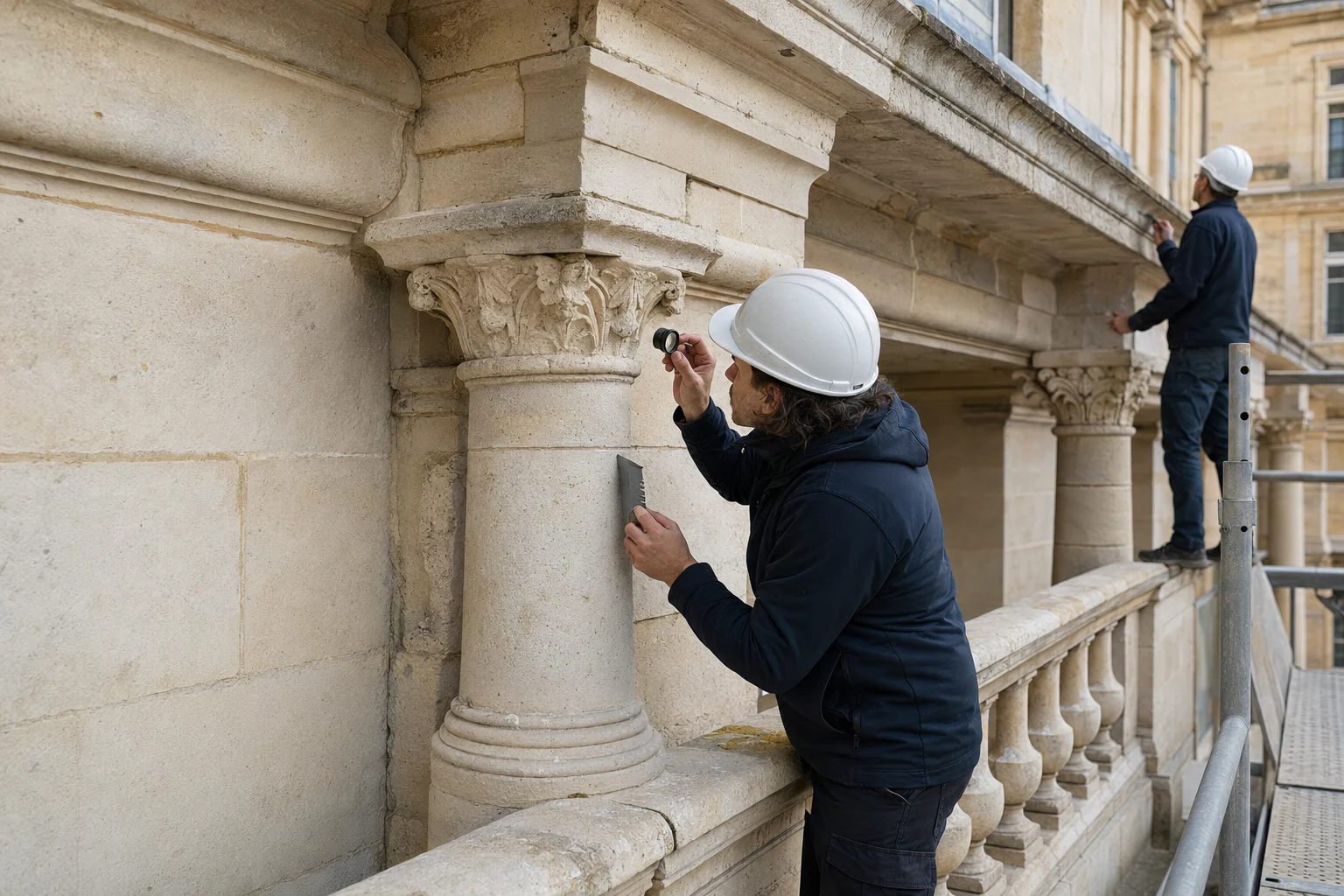
Record geometry, tool marks, deformation, cracks, biological growth and previous repairs before intervention. Diagnose water and movement before cleaning or replacing material.
Retain sound historic fabric. Where replacement is necessary, match petrographic and moisture behaviour as well as colour. A new piece that is harder or less permeable than its neighbours can accelerate decay around it.
Need advice for a real project?
Marble Import supports international homeowners, architects and interior designers with stone selection, samples, technical feasibility and coordination of high-end stonework in France and across Europe.