Applications
Natural Stone for Interior and Exterior Applications
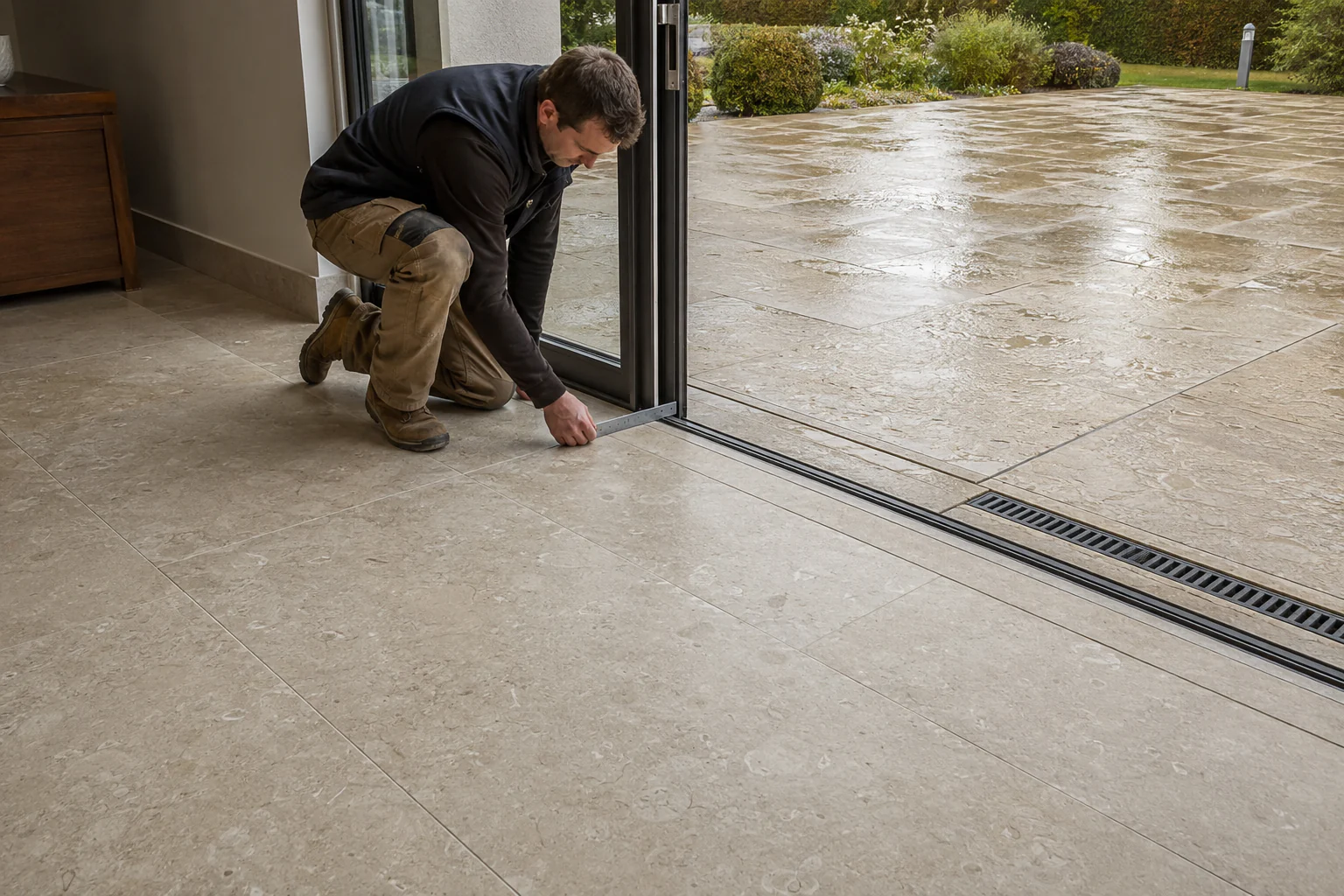
The same stone may perform beautifully in a living room yet be unsuitable for a terrace. The actual application, exposure to water and frost, traffic, cleaning products and maintenance requirements determine whether it is appropriate.
The question that changes everything
Stone should never be selected on appearance alone. The right questions are where it will be installed, how it will be used and cleaned, which liquids or products will reach it, who will walk on it and how much natural patina the client is prepared to accept.
A polished stone may be ideal for an interior wall. The same material used as exterior paving and exposed to rain and frost may be entirely unsuitable.
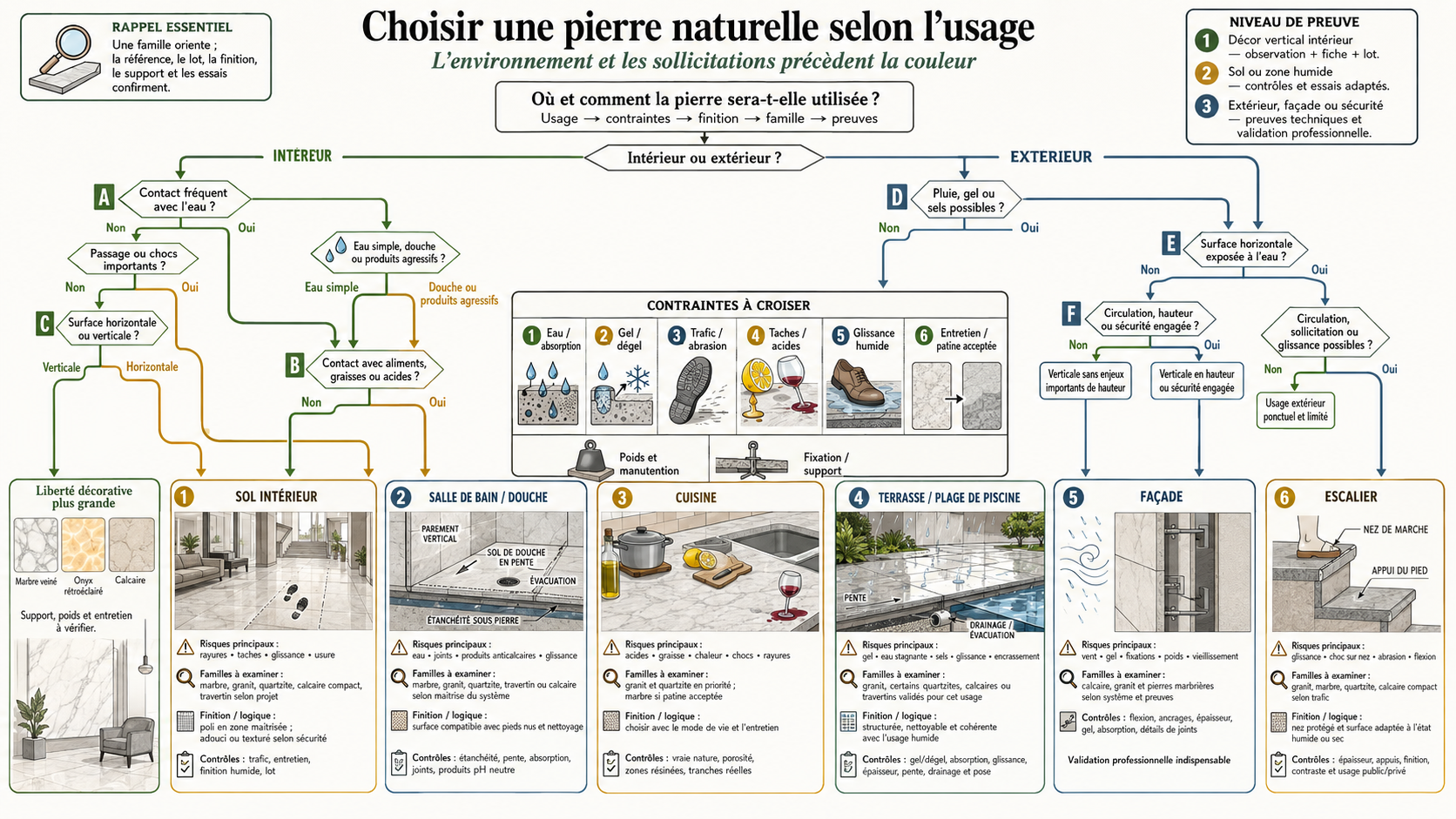
Quick application matrix
| Application | Main risks | Questions to ask |
|---|---|---|
| Interior flooring | Scratches, traffic, slip resistance and staining | What level of traffic, which finish and what cleaning regime? |
| Bathroom | Water, joints, products and falls | Is this a shower or decorative cladding? Which waterproofing system is required? |
| Kitchen | Acids, grease, heat and impact | Will the client accept a natural patina? Should quartzite or granite be considered? |
| Terrace | Frost, standing water, slip resistance and salts | Has freeze-thaw suitability been confirmed? Is drainage adequate? Is a textured finish required? |
| Façade | Wind, frost, fixings, fire performance and maintenance | Mechanically fixed system? Required thickness? Supporting test evidence? |
| Staircase | Impact, nosings, slip resistance and wear | Which finish, nosing detail, anti-slip provision and thickness? |
Interiors: greater design freedom, with clear care guidance
Interior projects allow considerable freedom to use expressive marbles, limestones, onyx and travertine. The main considerations are traffic, staining, cleaning products, slip resistance and consistency within the overall interior scheme.
Natural patina must be discussed from the outset: marble in a bathroom or a frequently used floor will evolve. Properly selected and understood, it ages gracefully; without clear expectations, the same change may become a source of dissatisfaction.
Exteriors: technical validation is essential
Exterior stone requires a higher level of technical scrutiny. It is exposed to rain, frost, UV radiation, temperature changes, pollution, salts, standing water, biological growth and demanding cleaning. The finish must provide suitable slip resistance while remaining practical to maintain.
Exterior suitability must be supported by freeze-thaw behaviour, water absorption and mechanical performance, together with the proposed drainage, falls, joints, installation method and maintenance plan. A trade name alone is never sufficient evidence.
The Marbre Import approach
- Start with the application, not the photograph.
- Compare several suitable stone families.
- Confirm the finish and maintenance requirements before quotation.
- Match the specification to an available batch only after the technical requirements are clear.
- Request specialist validation for façades, hospitality projects, complex exterior work and highly decorative stones.
The application determines the level of evidence required
Decorative interior cladding does not require the same level of justification as exterior paving, a pool surround, a public staircase or mechanically fixed façade. As safety, water, frost, traffic or height become more critical, design inspiration must be supported by objective evidence.
A sound method is to classify the project before selecting the stone: dry or wet area, horizontal or vertical surface, interior or exterior location, light or heavy traffic, easy or difficult future access, and acceptance of patina or an expectation of a consistently new appearance.
Understanding the subject without unnecessary jargon
The same stone may perform beautifully in a living room yet be unsuitable for a terrace. The actual application, exposure to water and frost, traffic, cleaning products and maintenance requirements determine whether it is appropriate.
Assessment starts with the actual setting: interior or exterior, water exposure, traffic, frost, cleaning products, safety requirements and the expected appearance. Stone is not inherently good or bad; it is more or less suitable for a defined combination of conditions.
This guide separates four questions. What is actually present on site? Which conditions will affect the stone? Which solution is compatible with the complete construction build-up? How will the project team demonstrate that the solution was understood and correctly executed? This framework prevents a material, finish or technique from being selected on the basis of a single sales claim.
A non-specialist can make meaningful progress without knowing every standard at the outset. Begin by recording the location, intended use, moisture, traffic, exposure and desired appearance. Then identify the stone and substrate, gather the available technical documentation and list any points requiring tests, calculations or professional advice. The technical solution follows this assessment of need, never the other way around.
Worked examples
Consider interior flooring. The key concerns are scratching, traffic, slip resistance and staining. Appearance alone is not enough: review the context, assess a representative sample area and keep a written record of the decision. Establish the traffic level, finish and cleaning regime. This explains why two visually similar projects may require different solutions.
Consider a bathroom. Water, joints, cleaning products and falls are the key concerns. Appearance alone is not enough: determine whether the stone is in a shower or used as decorative cladding, specify the waterproofing strategy, assess a representative sample and record the decision. Two visually similar bathrooms may therefore require different solutions.
Consider a kitchen. Acids, grease, heat and impact are the principal concerns. Confirm whether the client accepts the patina associated with certain marbles and whether quartzite or granite would better match their expectations. Review a representative sample and document the decision rather than relying on appearance alone.
Consider a terrace. Frost, standing water, slip resistance and salts are the principal concerns. Confirm freeze-thaw suitability, drainage and the required surface texture, review a representative sample and document the decision. Appearance alone cannot establish exterior suitability.
A practical decision-making method
The following method turns project questions into verifiable decisions. Every answer should be linked to an observation or document. Missing information must never be replaced by an unrecorded assumption; list it as a point requiring confirmation before ordering or starting work.
| Decision required | Assessment approach | Evidence to retain |
|---|---|---|
| Interior flooring: what must be checked? | Interior flooring: scratches, traffic, slip resistance and staining | What level of traffic, which finish and what cleaning regime? |
| Bathroom: what must be checked? | Bathroom: water, joints, products and falls | Is this a shower or decorative cladding? Which waterproofing system is required? |
| Kitchen: what must be checked? | Kitchen: acids, grease, heat and impact | Will the client accept a natural patina? Should quartzite or granite be considered? |
| Terrace: what must be checked? | Terrace: frost, standing water, slip resistance and salts | Has freeze-thaw suitability been confirmed? Is drainage adequate? Is a textured finish required? |
| Façade: what must be checked? | Façade: wind, frost, fixings, fire performance and maintenance | Mechanically fixed system? Required thickness? Supporting test evidence? |
| Staircase: what must be checked? | Staircase: impact, nosings, slip resistance and wear | Which finish, nosing detail, anti-slip provision and thickness? |
Useful terminology
Technical terminology should describe a phenomenon or requirement accurately without becoming a barrier. The following terms help clients, suppliers, installers, architects and contractors distinguish the appearance of stone from its expected performance in the completed work.
| Term | Plain-English definition |
|---|---|
| Freeze-thaw susceptibility | The material’s susceptibility to freeze-thaw damage, a critical consideration for exterior use. |
| Slip resistance | The ability of a surface to provide traction, influenced by its condition, contamination, footwear and the test method used. |
| Patina | The natural evolution of the stone’s appearance over time. |
| Drainage | The system used to collect and discharge water from within or beneath the construction build-up. |
| Finish | A term that must be defined in relation to the intended interior or exterior application before it is used in a specification or site decision. |
| Application | A term that must be defined in relation to the intended interior or exterior application before it is used in a specification or site decision. |
From selection to handover: who checks what?
The client defines the application, visual priorities, budget and acceptable maintenance. The designer or specifier turns those expectations into measurable criteria and coordinates the details. The supplier identifies the stone, batch and available performance data. The contractor checks the substrate, product compatibility and installation conditions. At handover, the completed work is assessed against the approved sample, slab layout and stated tolerances.
These responsibilities do not mean that each party works in isolation. Information must circulate before the order is placed. Acceptance of natural variation, a reservation concerning substrate moisture or a maintenance limitation is useful only when it has been explained and recorded in writing.
| Project stage | Essential question | Expected outcome |
|---|---|---|
| Concept design | Is the proposed stone compatible with the intended interior or exterior application? | Requirements recorded without ambiguity |
| Stone selection | Have the stone family, batch, finish and relevant performance characteristics been identified? | Approved sample and technical data linked to the project |
| Preparation | Have the substrate, products, water management, joints and details been coordinated? | Written method and inspection hold points |
| Installation | Do the actual site conditions remain consistent with the approved solution? | Quality-control records and photographs |
| Handover | Are the appearance, geometry, performance and maintenance requirements understood? | Defects addressed and care instructions supplied |
Key concepts
From the Marbre Import blog
Related articles and completed projects
Travertine terraces: timeless elegance for exterior spaces
Explore an additional guide, example or completed project from Marbre Import.
Travertine: a natural stone for both interiors and exteriors
Explore an additional guide, example or completed project from Marbre Import.
Natural stone in a mountain chalet
Explore an additional guide, example or completed project from Marbre Import.
Continue reading
Related guides
Natural-Stone Staircases, Steps, Nosings and Accessibility
A marble or natural-stone staircase brings together appearance, safety, slip resistance, impact, wear, visual legibility, walking comfort, thickness, fabrication and maintenance. It must be designed as a complete assembly, not simply as a sequence of slabs.
Natural Stone in Kitchens, Bathrooms and Worktops
Wet and food-preparation areas are frequent sources of misunderstanding. Marble, quartzite, granite, travertine and onyx must be assessed in relation to the application, finish, protection and maintenance expectations.
Natural-Stone Terraces: Drainage, Frost, Pedestals, Falls and Maintenance
A natural-stone terrace must be designed around water management, including falls, drainage, frost, joints, substrate, pedestals, thickness, slip resistance, cleaning and future slab replacement.
Natural-Stone Façades, Terraces and Exterior Applications
Exterior stone is a technical construction element. Frost, water, wind, fixings, slip resistance, falls, drainage, maintenance and applicable standards must be considered from the selection stage.
Marble in Architecture and Interior Design: Learning from Exemplary Projects
Marble becomes remarkable when it serves a clear intention: bringing light, rhythm, prestige, softness, contrast or a sense of place. This guide examines major design choices and how they can inform a contemporary project.
Thermal and Acoustic Comfort, and Heating with Natural Stone
Natural stone affects comfort through its mass, thermal inertia, tactile qualities, conductivity, response to underfloor heating, acoustic character and the sound-control solutions incorporated into the installation system.