Selecting and Identifying Stone
Natural Stone, Porcelain, Engineered Quartz, Terrazzo, Concrete and Timber Compared
Comparing natural stone with alternative materials supports an informed choice based on authenticity, use, maintenance, repairability, whole-life cost, design intent and durability.
What this guide helps you resolve
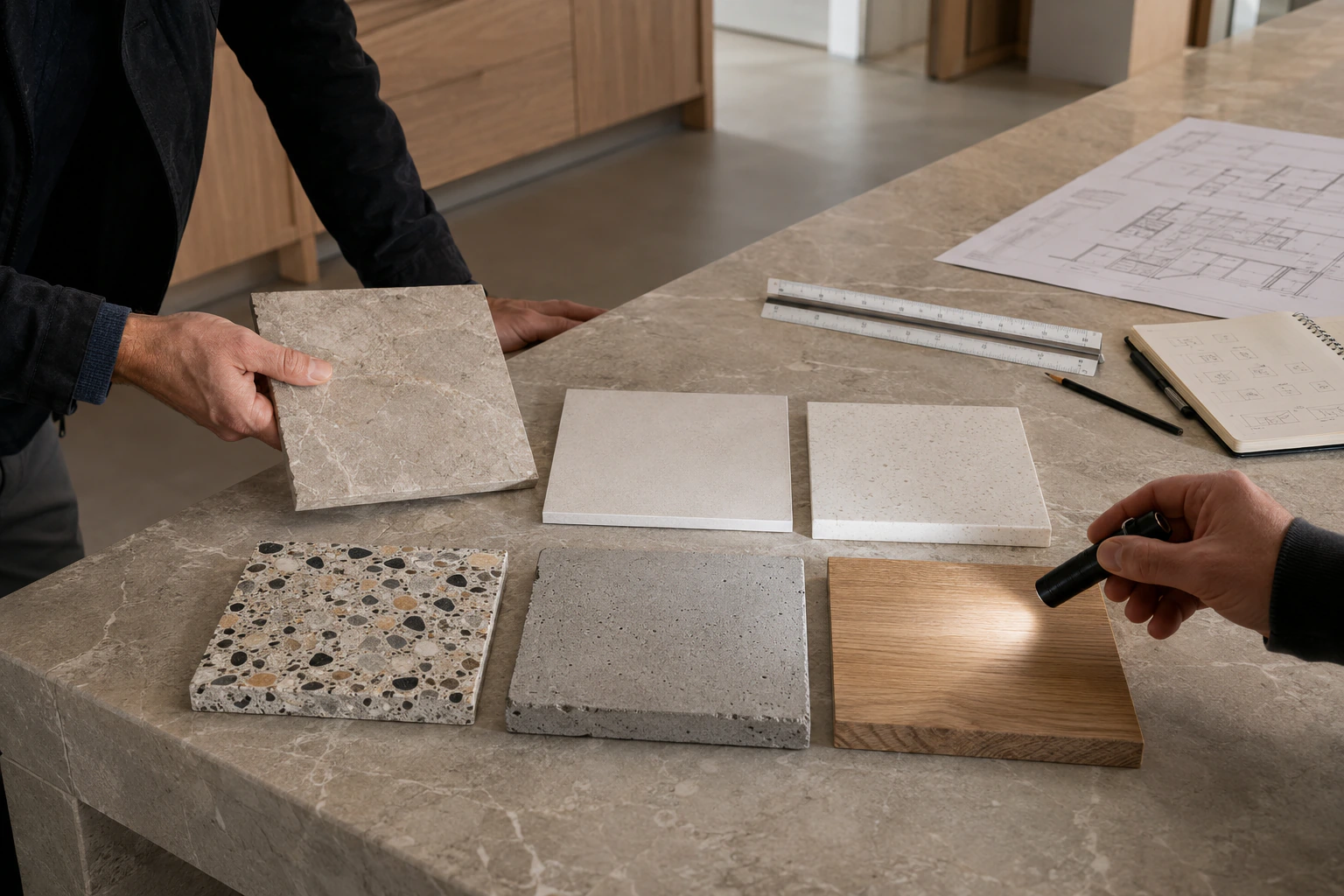
Clients rarely compare marble only with another marble. They also consider porcelain, engineered quartz, polished concrete, terrazzo, timber, laminate and resin. The comparison should be honest and project-specific.
Marble Import approaches accessibility as a decision framework linking the material, intended use, site conditions, maintenance, risk and required evidence. The aim is to clarify what must be approved before natural stone is selected, ordered, installed or maintained.
Questions to answer before making decisions
- What is the intended use?
- What degree of patina is acceptable?
- Is repairability important?
- Is natural variation or uniformity preferred?
- Is the priority initial cost or whole-life cost?
- Indoors or outdoors?
- What design character is required?
Decision table
| Situation | Primary risk | Marble Import recommendation |
|---|---|---|
| Marble | Depth and patina | Explain acid sensitivity |
| Porcelain tile | Uniformity and resistance | Less readily repairable |
| Engineered quartz | Interior worktops | Heat, UV and application limits |
| Terrazzo | Graphic character | Binder and maintenance |
| Timber | Warm tactile quality | Water and wear |
Common mistakes
- Dismiss alternative materials.
- Overpromise the performance of natural stone.
- Compare only the price per square metre.
- Ignore repairability.
- Ignore the actual conditions of use.
The Marble Import approach
Compare materials using consistent criteria: appearance, authenticity, use, maintenance, repair, service life, whole-life cost and environmental impact.
The final recommendation should be expressed clearly for the client: what is feasible, what is advisable, what requires verification, which natural variations must be accepted and which matters require a qualified professional or design specialist.
Detailed technical guidance
Natural stone varies and can often be restored; porcelain performs consistently but is more often replaced than repaired; engineered quartz depends on its resin matrix; terrazzo depends on its binder; and timber responds to moisture.
General guidance must be distinguished from project-specific assessment. Natural stone varies by stone family, batch, finish, thickness, substrate, environment and maintenance regime. Suitability depends on that complete combination.
Checks to document
| Check | Purpose | Useful evidence |
|---|---|---|
| Intended use | Actual choice | Material composition |
| Maintenance | Approval | Care guidance |
| Repairability | Service life | Repair options |
| Appearance | Expectation | Samples |
| Cost | Whole-life view | Comparison |
Writing the quotation, specification or method statement
The comparison should avoid absolute claims and explain the applications where each material performs well, together with its limitations.
Written documents should avoid vague promises. They should identify the actual material and approved batch or range, tolerances, available tests or evidence, limits of use, exclusions and acceptance conditions.
Answers to common client questions
| Question or concern | Clear response |
|---|---|
| Why choose natural stone? | For authenticity, visual depth, repairability and longevity when the material suits the use. |
| Is porcelain better? | It can be for certain applications; the right answer depends on the project. |
| Is marble fragile? | It is durable, but certain uses and chemicals require informed care. |
Practical summary
- Compare honestly.
- Begin with the intended use.
- Explain patina and ageing.
- Include repairability.
- Consider whole-life cost.
Understanding accessibility without jargon
Comparing natural stone with alternative materials supports an informed choice based on authenticity, use, maintenance, repairability, whole-life cost, design intent and durability.
A trade name provides an initial indication but is not enough. Geological family, structure, porosity, test data, batch and finish give a better basis for predicting performance and precautions.
This guide separates four questions. What is the material actually made of? Which conditions affect it? Which option suits the complete project? What evidence supports the comparison? This prevents selection based on a single sales claim.
Begin by describing the location, use, moisture, traffic, exposure, expected appearance and maintenance. Then identify each material system, assemble its technical documents and note which points require testing, calculation or specialist advice.
Worked project scenarios
For marble, visual depth and patina are central. Explain natural variation and acid sensitivity, then assess whether the client accepts the way the surface will age in its actual setting.
Porcelain provides consistent appearance and resistance in many applications, but local damage is usually addressed by replacing units rather than restoring the surface. Consider access to matching spare tiles.
Engineered quartz is widely used for interior worktops, but its resin matrix introduces limits concerning heat, ultraviolet exposure and certain chemicals. Follow the manufacturer’s declared scope.
Terrazzo offers a distinctive graphic character, but performance depends on the binder, aggregate, installation, joints and care regime. Assess the complete system rather than appearance alone.
A structured decision method
The method below turns comparison criteria into decisions that can be checked. Link every claim to a sample, technical document, service history or test and record missing information before ordering.
| Question to resolve | How to assess it | Simple evidence to retain |
|---|---|---|
| What is the intended use? | Use: actual material choice | Material composition |
| What degree of patina is acceptable? | Maintenance: client acceptance | Care guidance |
| Is repairability important? | Repair: service-life strategy | Repair options |
| Is natural variation or uniformity preferred? | Appearance: expectation | Samples |
| Is the priority initial cost or whole-life cost? | Cost: whole-life view | Comparison |
| Indoors or outdoors? | Use: actual material choice | Material composition |
Useful terminology
The following terms help clients, suppliers, installers and designers compare material composition, appearance, performance, maintenance and repair without confusing visual similarity with equivalent behaviour.
| Term | Plain-English definition |
|---|---|
| Natural stone | A comparison term whose practical meaning depends on the precise product, build-up, intended use and manufacturer or supplier documentation. |
| Porcelain tile | A comparison term whose practical meaning depends on the precise product, build-up, intended use and manufacturer or supplier documentation. |
| Engineered quartz | A comparison term whose practical meaning depends on the precise product, build-up, intended use and manufacturer or supplier documentation. |
| Terrazzo | A comparison term whose practical meaning depends on the precise product, build-up, intended use and manufacturer or supplier documentation. |
| Concrete | A comparison term whose practical meaning depends on the precise product, build-up, intended use and manufacturer or supplier documentation. |
| Timber | A comparison term whose practical meaning depends on the precise product, build-up, intended use and manufacturer or supplier documentation. |
| Repairability | A comparison term whose practical meaning depends on the precise product, build-up, intended use and manufacturer or supplier documentation. |
From selection to handover: who checks what?
The client defines the intended use, appearance priorities, budget and acceptable maintenance. The designer converts them into measurable criteria. Suppliers identify the actual products and available performance data. Contractors verify substrates and installation conditions. Handover compares the work with approved samples, layouts and tolerances.
These parties must exchange information before ordering. Acceptance of natural variation, product limitations, substrate assumptions and maintenance expectations only have value when explained and recorded.
| Project stage | Essential question | Expected outcome |
|---|---|---|
| Concept design | Which material system best fits the actual use, appearance, maintenance and whole-life priorities? | Requirements described without ambiguity |
| Stone selection | Have the stone family, batch, finish and available performance data been identified? | Sample and data sheet linked to the project |
| Preparation | Have the substrate, products, water exposure, joints and details been coordinated? | Written method and hold points |
| Installation | Do the actual site conditions remain consistent with what was approved? | Quality checks and photographs |
| Handover | Are the appearance, geometry, function and maintenance requirements understood? | Snagging resolved and maintenance information provided |
Common questions
| Question | Explanation |
|---|---|
| Why avoid dismissing alternative materials? | Because advice must remain understandable without omitting the risks that require specialist input. |
| Why avoid overpromising natural stone? | Because each material has appropriate uses and limitations. Compare them against the same project criteria and supporting evidence. |
| Why not compare only the price per square metre? | Because fabrication, substrate preparation, installation, maintenance, repair and service life can outweigh the initial material rate. |
| Why include repairability? | Because surfaces age and may be damaged. Consider whether they can be refinished, locally repaired or must be replaced. |
| Why must the actual use come first? | Because water, heat, ultraviolet exposure, traffic, chemicals and cleaning determine suitability more reliably than appearance alone. |
Key concepts
From the Marble Import blog
Related articles and completed projects
How to Choose the Right Natural Stone
Explore an additional guide, example or completed project from Marble Import.
Marble Flooring and Oak Flooring Compared
Explore an additional guide, example or completed project from Marble Import.
Marble and Porcelain Tile: Key Differences
Explore an additional guide, example or completed project from Marble Import.
Continue reading
Related guides
Natural, Engineered and Reconstituted Stone
Comparing natural stone, engineered quartz, terrazzo, stone-effect porcelain and reconstituted stone clarifies value, care, limitations and authenticity.
Marble Quality and Selection Criteria
Selecting marble involves more than appearance: assess the batch, finish, thickness, stability, acceptable characteristics, test data, quantity and suitability for the intended use.
Environmental Impact, Durability and Life Cycle
Natural stone can be durable, repairable, mineral and long-lived, but its impact depends on extraction, transport, fabrication, installation and potential reuse.
Natural-Stone Colour, Veining and Light
Stone colour is not merely decorative. It reflects geology, changes with the finish and influences maintenance, spatial perception and layout decisions.
Natural-Stone Petrography, Identification and Laboratory Interpretation
Identifying stone involves more than recognising a trade name. Petrography links the actual rock, minerals, texture, pores, veins and test results with a specific use.
Applied Petrography: Field and Laboratory Identification Sheets
Petrography becomes practical when it helps identify a stone, avoid confusion, request relevant tests and understand defects.